Digi Power’s $1.1B AI Deal Faces a 40 MW Test
The ten-year Cerebras contract creates long-duration revenue visibility, but its full economic value still depends on delivering 40 MW and securing the second phase of financing.

Authority path
Start with the strongest SIAIntel analysis in this topic, then follow the latest reporting below.
Category Intelligence
Chips, data centers, grid demand, capital spending, and adoption signals.
Equities, bonds, liquidity, capital rotation, and risk-pricing signals.
Central banks, credit, inflation, fiscal pressure, and growth signals.
Chips, data centers, grid demand, capital spending, and adoption signals.
Supply routes, security shocks, sovereign risk, and energy infrastructure.
Market structure, stablecoins, regulation, tokenized finance, and settlement rails.
The ten-year Cerebras contract creates long-duration revenue visibility, but its full economic value still depends on delivering 40 MW and securing the second phase of financing.

Amazon’s AI demand boom and a fund’s 67% July loss reveal why patient balance sheets may be the next scarce AI resource.

MediaTek’s $5B plan turns custom AI chips into a contest for financed, deliverable semiconductor capacity.

A 9–3 Fed split and PJM’s 6.8 GW reliability gap show why AI infrastructure is being repriced through both capital and firm power.

Ofgem’s £71.3m collateral proposal, Oracle’s BBB- rating and a 73 GW queue turn AI data-centre grid access into a live credit test.

Nvidia’s reported $250B OpenAI guarantee talks, project bonds and BIS warnings confirm SIAIntel’s early map of AI’s hidden credit circuit.

Korea’s reported $950B AI framework links Nvidia, SK Hynix, Samsung, HBM4, sovereign AI factories and infrastructure finance to the power bottleneck.

Meta’s $12.3B data-center bond shows how Wall Street is turning Big Tech lease promises into investment-grade AI debt—and pricing a new risk premium.

More than 3 GW of data-center load vanished from PJM. See the hidden AI grid risk, investor impact, Virginia tax cost and next regulatory catalysts.

AMD’s Anthropic investment, Amazon’s milestone-linked financing and OpenAI’s 25-year Georgia power deal expose the closed capital circuit behind AI infrastructure.

A five-stock event study and SEC-filed contracts show no durable equity discount after FERC—while power terms already reach project finance.

China is institutionalising AI access while the United States turns large-scale electricity access into a test of grid readiness, operating flexibility and financial collateral.

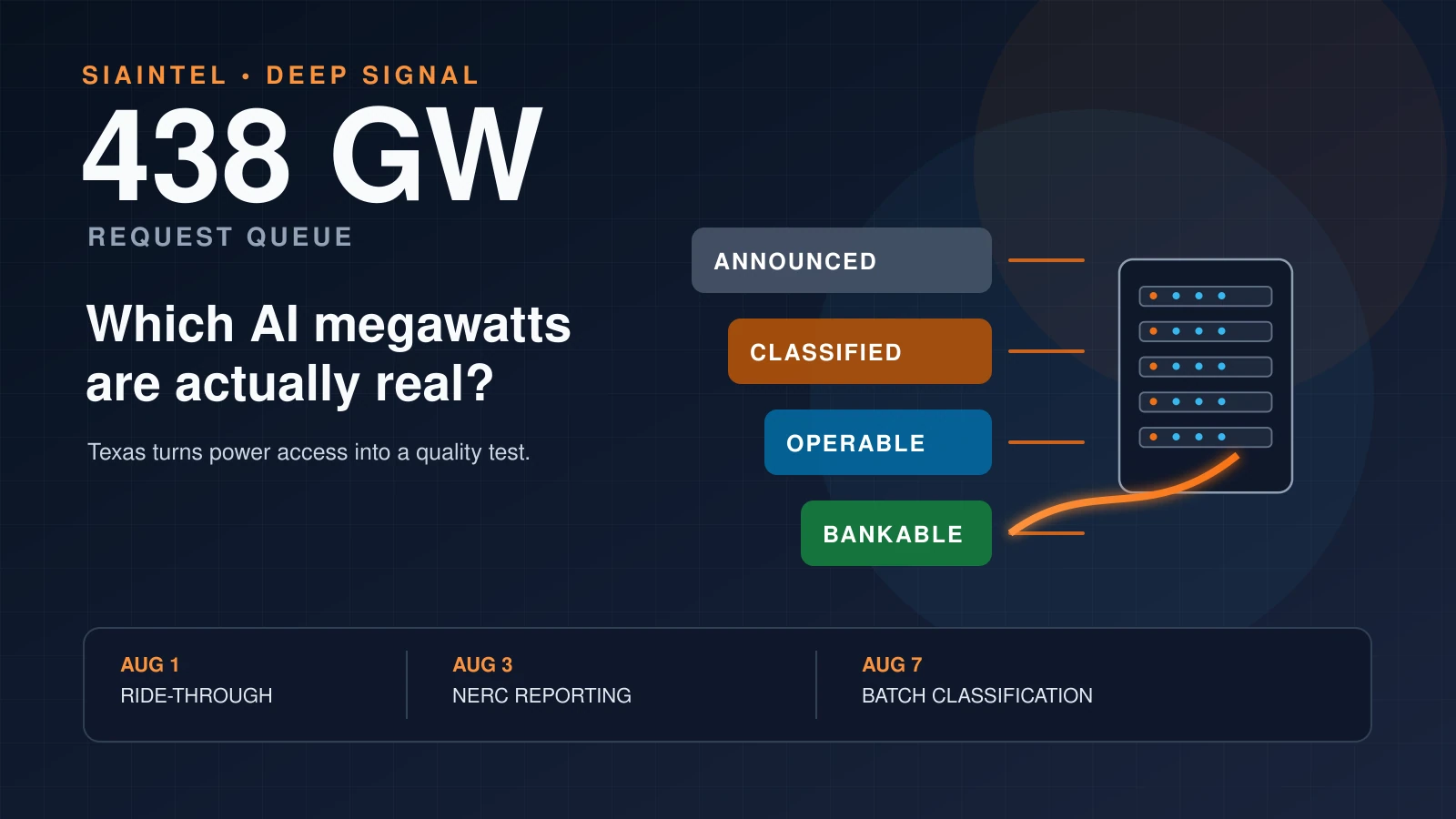
Nearly 90% of ERCOT’s 438 GW queue comes from data centers. On August 7, Batch Zero will show which AI projects advance—and which remain speculative.

More than $70 billion in AI/HPC contracts is turning bitcoin miners into energy-backed data-centre companies financed by Big Tech.

PJM’s July 14 auction, a $325/MW-day cap and 160-week equipment delays show why AI’s next bottleneck may be firm power.

On July 3, PJM turned demand response into a live AI infrastructure signal. The grid was not only pricing electricity. It was rationing flexibility. For data centers, utilities and investors, the next scarci...

As EU data center capacity heads toward 28 GW by 2030, AI power demand is reshaping electricity prices, grid investment, industrial competitiveness and the green transition.

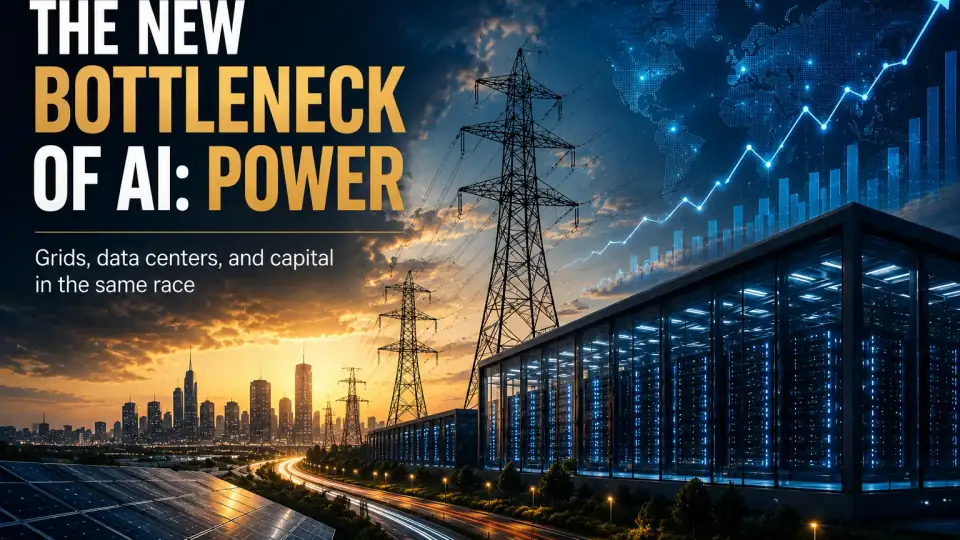
AI’s next bottleneck is moving beyond chips toward power grids, data-center infrastructure, nuclear energy agreements and capital intensity.

AI growth is moving beyond chips as electricity, water, grid access, transformers and cooling capacity become the next strategic bottlenecks.

Google's energy and infrastructure partnerships reflect a shift toward securing carbon-free baseload power for large-scale AI computation.

OpenAI's reported IPO preparations could reshape how public markets evaluate frontier AI. Investors will scrutinize infrastructure costs, energy demands, governance, and regulatory risks.