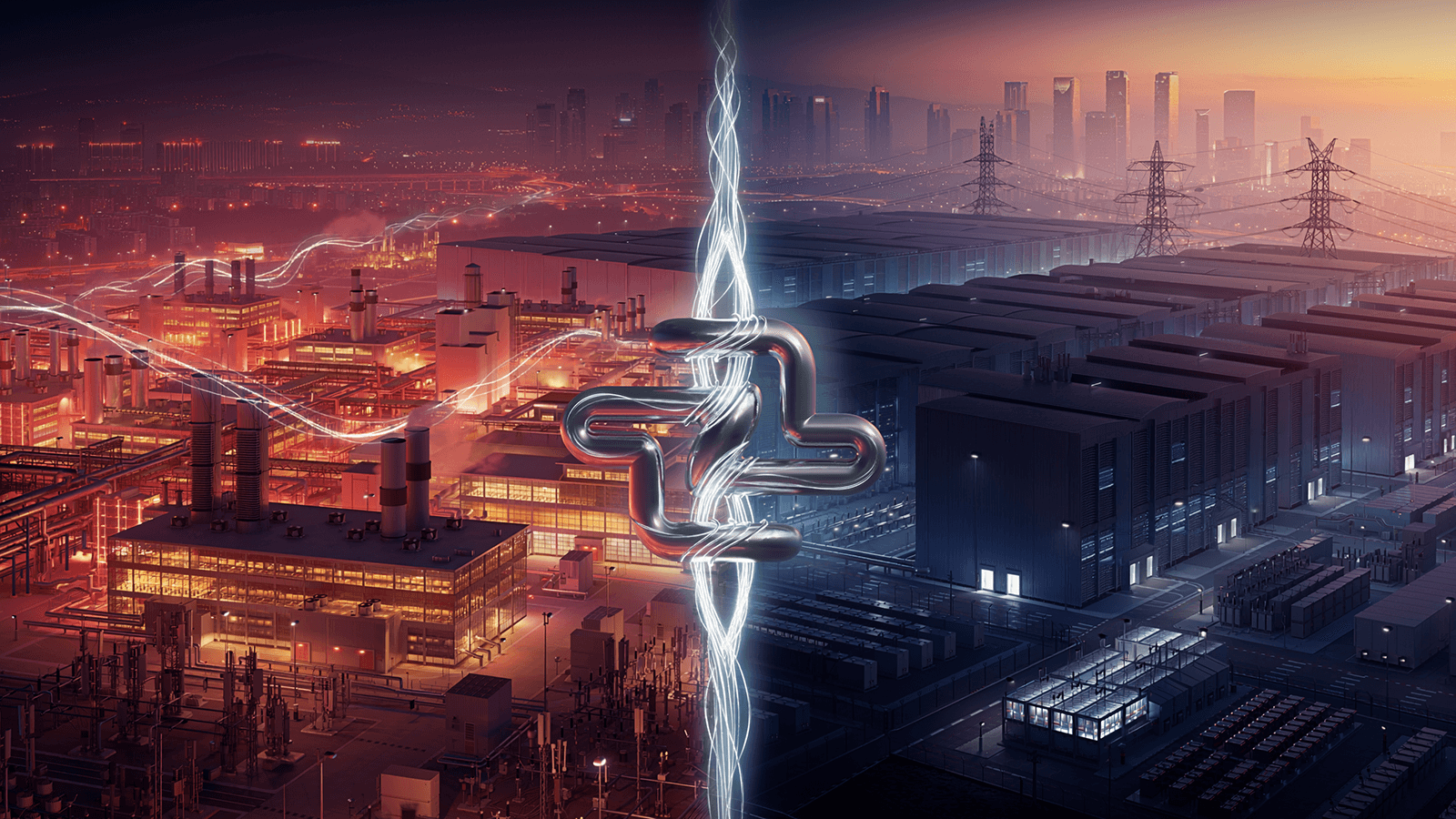
China is institutionalising AI access while the United States turns large-scale electricity access into a test of grid readiness, operating flexibility and financial collateral.
Executive Signal
The artificial-intelligence race has crossed a structural threshold. China is lowering the political and software cost of AI adoption through open models, training and a new 29-country institution headquartered in Shanghai. The United States is moving toward a different allocation system: large-scale AI electricity must increasingly survive grid studies, operational restrictions, equipment queues and financial-security tests.
The resulting divide is more important than a single model launch. China is exporting AI access. America is collateralizing access to AI electricity. The first strategy seeks geopolitical reach; the second filters announced demand through land, engineering and balance-sheet capacity. Together they mark the point at which model competition becomes an infrastructure and credit contest.
The AI Race Has Split Into Two Systems
Access versus physical delivery
At the World Artificial Intelligence Conference, representatives of 29 countries signed the founding agreement for the World AI Cooperation Organisation, with Shanghai designated as its headquarters. The verified fact is the institution, its founding count and location—not every political claim made around it. [4] [5]
China’s offer is designed for governments and companies that cannot independently build frontier models or finance hyperscale computing. Open-weight systems, training programmes and technical cooperation can reduce the initial cost of entry while extending Chinese standards, cloud relationships and governance influence.
Why this changes the investment map
America retains the deepest private AI capital pool and many of the strongest model and semiconductor companies. Yet capital expenditure does not create electricity on demand. A data-center campus can be financed on a corporate timetable, while transmission, generation and major electrical equipment move on industrial and regulatory timetables.
The next ranking of AI power will therefore depend on more than benchmark scores. Countries and companies will be judged by whether they can convert announced compute into deliverable, financeable and contractually defensible megawatts.
China Institutionalises AI Access
WAICO turns an offer into an organisation
WAICO gives Beijing a permanent container for training, standards discussions and international coordination. The 29-country foundation and Shanghai headquarters are supported by official municipal information and independent reporting. [4] [11]
The strategic value is not that every member must choose a single technological bloc. A government may combine American chips, Chinese open models, European regulation and local data rules. The value is that China now has an institution through which it can package models, education and diplomatic access as one offer.
Open models become infrastructure diplomacy
An open model is not merely downloadable software. Adoption can pull demand toward hosting providers, developer tools, telecom networks, technical standards and cybersecurity practices. That makes the model a gateway product and the surrounding ecosystem the durable economic asset.
This is why the phrase “AI access” matters. Beijing does not need every Chinese model to lead every benchmark. It needs a sufficiently capable stack that is available to markets where cost, sovereignty and political dependence matter as much as absolute performance.
America Turns Power Access Into a Readiness Test
FERC puts the large-load problem on the federal agenda
On June 18, the Federal Energy Regulatory Commission issued orders to PJM, MISO, SPP, CAISO, ISO New England and NYISO. The operators must defend or revise tariffs governing large-load connections and report how sufficient generation will be made available. The areas include faster studies, cost-shift protection, co-located generation and flexible or interruptible service. [1]
The 30-day reporting window falls on Saturday, July 18. Under ordinary federal deadline treatment, the practical filing date moves to Monday, July 20. That date is a calculated legal-calendar result, not a separate date printed in FERC’s announcement.
ERCOT’s 438 GW queue is not a demand forecast
ERCOT is tracking more than 438 GW of requested large-load capacity, roughly 89% of it associated with data centers. The number is several times the peak demand of the Texas system and should not be read as capacity that will necessarily be built. It includes projects at different stages, overlapping plans and applications that may never reach construction. [2]
Batch Zero is a credibility filter. It groups qualified projects into a system-wide study and distinguishes existing load, studied and allocated load, controllable load and projects that must wait for a later process.
What July 24 actually means
The first project-entity deadline for key PCLR or WLPUN elections was July 10. July 24 is the date by which distribution or transmission service providers transmit completed forms to ERCOT. August 7 is the next public-facing milestone, when ERCOT is scheduled to communicate project classifications. [3]
This distinction matters because “projects apply on July 24” would overstate the event. The real signal is administrative consolidation: ERCOT receives the documents required to sort headline megawatts into operational categories.
The SIAIntel Power-Collateral Ladder
Five grades of AI megawatts
SIAIntel classifies announced AI electricity through a five-step ladder:
- Announced MW: capacity stated in a press release, investor deck or queue request.
- Qualified MW: land, documentation and engineering milestones are sufficiently mature for study.
- Allocated MW: the grid process assigns a defined level or operating condition.
- Financed MW: security, network upgrades, construction capital and tenant support are committed.
- Operating MW: the site is energised and delivering compute under real grid conditions.
The gap between each rung is where valuation errors accumulate. Announced megawatts can attract market capital long before they become qualified. Qualified megawatts can still fail to secure equipment or debt. Financed projects can miss delivery dates.
The conditional $50,000-per-MW illustration
ERCOT-related planning documents use a default financial-security amount of $50,000 per MW in applicable circumstances. It is not an automatic fee on every megawatt in the 438 GW queue. Project status, required upgrades and interconnection terms determine the obligation. [2] [3]
| Requested load | Illustrative default security where applicable | Interpretation |
|---|---|---|
| 100 MW | $5 million | Material pre-construction liquidity test |
| 500 MW | $25 million | Likely requires institutional capital support |
| 1 GW | $50 million | Becomes a credit-committee issue |
| 5 GW | $250 million | Portfolio-level financing exposure |
| 10 GW | $500 million | Filters speculative pipeline at scale |
The table is scenario mathematics, not a claim that Texas has invoiced every listed project. Its purpose is to show how quickly a seemingly technical interconnection rule can become a capital-allocation mechanism.
Bitcoin Miners Become Infrastructure Brokers
CleanSpark proves that power rights can support an AI lease
CleanSpark disclosed a 20-year lease for a Georgia campus designed for 175 MW of critical IT load. The company described approximately $6.6 billion of expected contract value during the initial term and estimated landlord project costs of $10 million to $12 million per MW. That implies an illustrative construction range of $1.75 billion to $2.10 billion. [6]
The $6.6 billion figure is not cash already received, and the construction range is not a completed budget. Both remain exposed to financing, equipment, construction and tenant-performance risk. The transaction is nevertheless important because it converts a miner’s electricity and land position into a long-duration AI infrastructure contract.
Texas is an LOI, not an 885 MW lease
The same filing describes a letter of intent and exclusivity arrangement covering a Texas portfolio with up to 885 MW of secured and planned power. It does not establish a definitive 885 MW lease. The legal distinction must be preserved because planned power, secured power and contracted tenant load carry different values.
Bitcoin miners therefore divide into two groups: operators with bankable power, land, fibre and construction partners; and operators whose sites remain suitable mainly for flexible mining. AI optionality should be valued only where conversion is technically and contractually credible.
The Dollar-Watt Loop
Power rules become credit terms
The dollar leg of this story is not dependent on a stablecoin transaction. It is embedded in cash security, letters of credit, network-upgrade payments, construction debt, tenant guarantees and refinancing. A megawatt becomes economically valuable when those layers make it financeable.
The loop operates as follows: dollars finance watts; watts activate compute; compute demand reprices power rights, land and collateral. ERCOT’s operating obligations can also survive ownership changes, forcing buyers and lenders to price grid duties directly into M&A and project-finance documents. [3]
Equipment queues extend the financing clock
The IEA estimates that more than 2,500 GW of renewable generation, storage and large-load projects are stalled in connection queues worldwide. This is not a 2,500 GW AI queue; it is a broader measure of grid congestion. The agency also notes that grid projects can require five to fifteen years while data centers may take one to three years. [7]
Siemens Energy said its own gas-turbine capacity was sold out through fiscal 2028, with 2029 filling and some 2030 positions reserved. GE Vernova reported 100 GW of gas-turbine backlog and slot reservations at the end of the first quarter. These are company-specific indicators, not proof that every global turbine slot is unavailable. [8] [9]
Strategic Impact Matrix
| Audience | Primary transmission channel | Opportunity | Principal risk |
|---|---|---|---|
| General readers | AI demand enters household power-policy debate | Clearer cost allocation and reliability rules | Consumer bills absorb infrastructure costs |
| Investors | Planned MW is repriced against qualified and financed MW | Utilities, generators, equipment and select miners gain scarcity value | Development pipelines prove overstated |
| Technology companies | Compute expansion depends on power execution | Co-located generation and flexible-load contracts | Campus delays and stranded hardware |
| Credit markets | Grid obligations enter debt documents | New project-finance and infrastructure-debt products | Strong tenant credit masks weak power rights |
| Developing economies | Chinese open-model diplomacy lowers entry cost | Faster AI adoption and training access | Dependence on external standards and hosting |
| Crypto companies | Mining power portfolios gain AI conversion value | Long-term leases reduce Bitcoin-cycle dependence | Conversion capex and site incompatibility |
| Policymakers | AI policy merges with energy and industrial policy | Coordinated generation and transmission planning | Reliability failures and geopolitical fragmentation |
30/60/90-Day Catalyst Calendar
Next 30 days
- July 20: calculated practical deadline for the six FERC generation-adequacy reports.
- July 24: service providers transmit completed Batch Zero forms to ERCOT.
- August 7: ERCOT is scheduled to communicate initial classifications.
Next 60 days
- Watch whether FERC operators propose flexible tariffs, co-location rules or explicit cost-allocation reforms.
- Track which Texas projects disclose security, tenant commitments or generation arrangements.
- Compare Chinese AI cooperation announcements with actual training, cloud or model deployments.
Next 90 days
- Measure the spread between announced megawatts and projects that retain credible study status.
- Monitor turbine, transformer and switchgear delivery commentary in earnings calls.
- Track whether Bitcoin miners sign definitive leases rather than non-binding memoranda.
Counter-Thesis and Break Conditions
What could weaken the thesis
ERCOT’s filter may remove speculative applications without producing a meaningful shortage. Data-center efficiency could improve, cancelled projects could free grid capacity, or developers could build behind-the-meter generation faster than expected. Chinese open models may expand without creating durable political alignment, and member states may use WAICO only as a technical forum.
The capital threshold may also strengthen hyperscalers rather than broadly repricing the infrastructure sector. Companies with the largest balance sheets can post security and reserve equipment, leaving smaller developers unable to monetise otherwise attractive sites.
What would confirm the thesis
The thesis strengthens if FERC filings explicitly connect new service to firm generation, curtailment or consumer cost protection; if ERCOT classifications sharply reduce the credible queue; if project lenders distinguish firm from interruptible megawatts; and if miners sign more definitive, investment-grade AI leases.
It would also strengthen if WAICO converts founding membership into measurable deployments—training cohorts, government cloud contracts, shared standards or model-hosting agreements.
Frequently Asked Questions
Is Texas charging every data center $50,000 per MW?
No. The figure is a default financial-security amount used where applicable. It is not an automatic charge against every megawatt in the headline queue.
Does the 438 GW queue mean Texas will build 438 GW of data centers?
No. It represents requests at different maturity levels. Batch Zero exists because the headline total is not a reliable construction forecast.
Why does WAICO matter to energy markets?
It shows that one side of the AI race is lowering the institutional cost of model access while the other faces a physical delivery constraint. The two systems direct capital toward different bottlenecks.
Are Bitcoin miners automatically AI data-center winners?
No. Power access helps, but AI facilities also require fibre, cooling, redundancy, buildings, financing and suitable tenants.
What is the single indicator to watch?
The conversion rate from announced MW to qualified MW, then from qualified MW to financed and operating MW. That sequence reveals whether the AI power boom is infrastructure or presentation.
SIAIntel Bottom Line
The AI race is no longer confined to models and chips. China is building an institution for distributing AI access. The United States is forcing AI electricity through a layered test of generation, grid rights, curtailment, equipment and credit.
The winners will not be the companies with the largest slide-deck pipelines. They will control megawatts that are studied, allocated, financed and deliverable. The losers will discover that a data-center plan without power is not infrastructure. It is a presentation.
Related SIAIntel coverage: AI intelligence, energy and macroeconomy, and crypto infrastructure.
Evidence Sources
- FERC: FERC launches targeted action to speed large-load integration
- ERCOT: PUCT approves ERCOT Batch Zero framework for large loads
- Willkie Farr & Gallagher: ERCOT approves implementation of Batch Zero
- Shanghai Municipal Government: World AI Cooperation Organisation founded in Shanghai
- Associated Press: Xi promotes global AI access and cooperation at WAIC
- U.S. SEC / CleanSpark: CleanSpark 8-K exhibit covering Georgia lease and Texas LOI
- International Energy Agency: Electricity 2026: grids and connection queues
- Siemens Energy: Q2 FY2026 pre-close investor call script
- GE Vernova: First-quarter 2026 financial results
- Enverus: ERCOT large-load Batch Zero readiness estimate
- Reuters: Xi pitches China as leader of a new global AI order
Source Map
6 highlighted sources
Shanghai Municipal Government: World AI Cooperation Organisation founded in Shanghai
OfficialU.S. SEC / CleanSpark: CleanSpark 8-K exhibit covering Georgia lease and Texas LOI
OfficialEditorial Credit
This intelligence brief was prepared by the SIAIntel Editorial Desk.
Some contributors work in sensitive public-sector, regulatory, market, or editorial roles. Their identities may be withheld when professional duties, source protection, or safety require confidentiality.
Editorial and publishing accountability: Sefa Karahan, Founder & Publisher
Related Intelligence
Related intelligence in this category · 4 briefs
Steel to KAAN: Türkiye's $20B Defense Test
Türkiye's defense boom now faces a harder test: turning steel, KAAN, finance and the Mecca Pact into bankable exports without hiding target and engine risks.

The Pentagon Is Building a Private-Capital Compute Grid
U.S. military land is becoming a platform for privately financed data centers, power, minerals, manufacturing and testing. SIAIntel maps the new infrastructure model.
Israel’s Cost of Staying Outside the Mecca Pact
Bab al-Mandeb traffic fell to 32 vessels a day while Sidi Kerir hit a record 2.17M bpd. The field data strengthens—but does not prove—the Mecca Pact network thesis.

War, AI and the Global Credit Squeeze
War-driven energy inflation, Treasury supply, AI financing and China's record loan contraction point to a new Credit Concentration Regime.