Nearly 90% of ERCOT’s 438 GW queue comes from data centers. On August 7, Batch Zero will show which AI projects advance—and which remain speculative.
SIAIntel Deep Signal Intelligence • Executive Summary
The next AI-infrastructure repricing will not be driven by another GPU benchmark. It will be driven by a simpler question: which announced megawatts can actually connect, remain online through grid disturbances, and support financeable cash flow?
Executive Signal
Texas has become the first large-scale market test of the difference between an announced megawatt and a deliverable one. ERCOT says more than 438,000 MW of proposed large-user demand has entered its connection queue, nearly 90% of it from data centers, versus an all-time system peak of 85,508 MW. The number is dramatic, but the real signal is the process now being applied to it. Under ERCOT’s new Batch Zero framework, eligible projects will be classified on August 7, 2026 as base load, studied load or excluded load. Final reliable allocations are not due until spring 2027. ERCOT’s Batch Zero brief therefore turns August into a first screen of project quality—not a final award of power.
This is the follow-through to SIAIntel’s earlier analysis, AI’s Credit Grid Squeeze. That article mapped how data-center demand moves into utility capex and bond markets. The new signal is narrower and more actionable: gross pipeline MW is about to face a quality haircut.
Reader Takeaway
- 438 GW is a request queue, not a deliverable-power forecast.
- August 7 is the first classification screen; it is not the final MW allocation.
- Ride-through quality matters separately from voluntary curtailment.
- The financial signal is conversion: how much announced capacity becomes classified, allocated, operable and bankable.
Original Thesis
Strong thesis: the first durable repricing of the AI power pipeline will be driven by the conversion rate from announced capacity to allocated, operable and bankable capacity.
AI infrastructure has been marketed in units of future capacity: campus acres, GPU counts and gross megawatts. Those figures are not equivalent. A project can control land without having a reliable grid allocation. It can have an interconnection path without meeting ride-through requirements. It can be technically connectable but commercially unbankable. It can also have demand-response capability while still failing to remain connected during a voltage fault.
SIAIntel thesis: the market is moving from valuing announced MW to valuing firm MW—capacity supported by an admissible interconnection position, site control, financial commitment, dynamic-load modeling, ride-through capability, an executable energization path and credible contracted demand. August will not complete this repricing, but it will make the hierarchy visible.
SIAIntel Model/Index: The Firm-MW Conversion Ladder
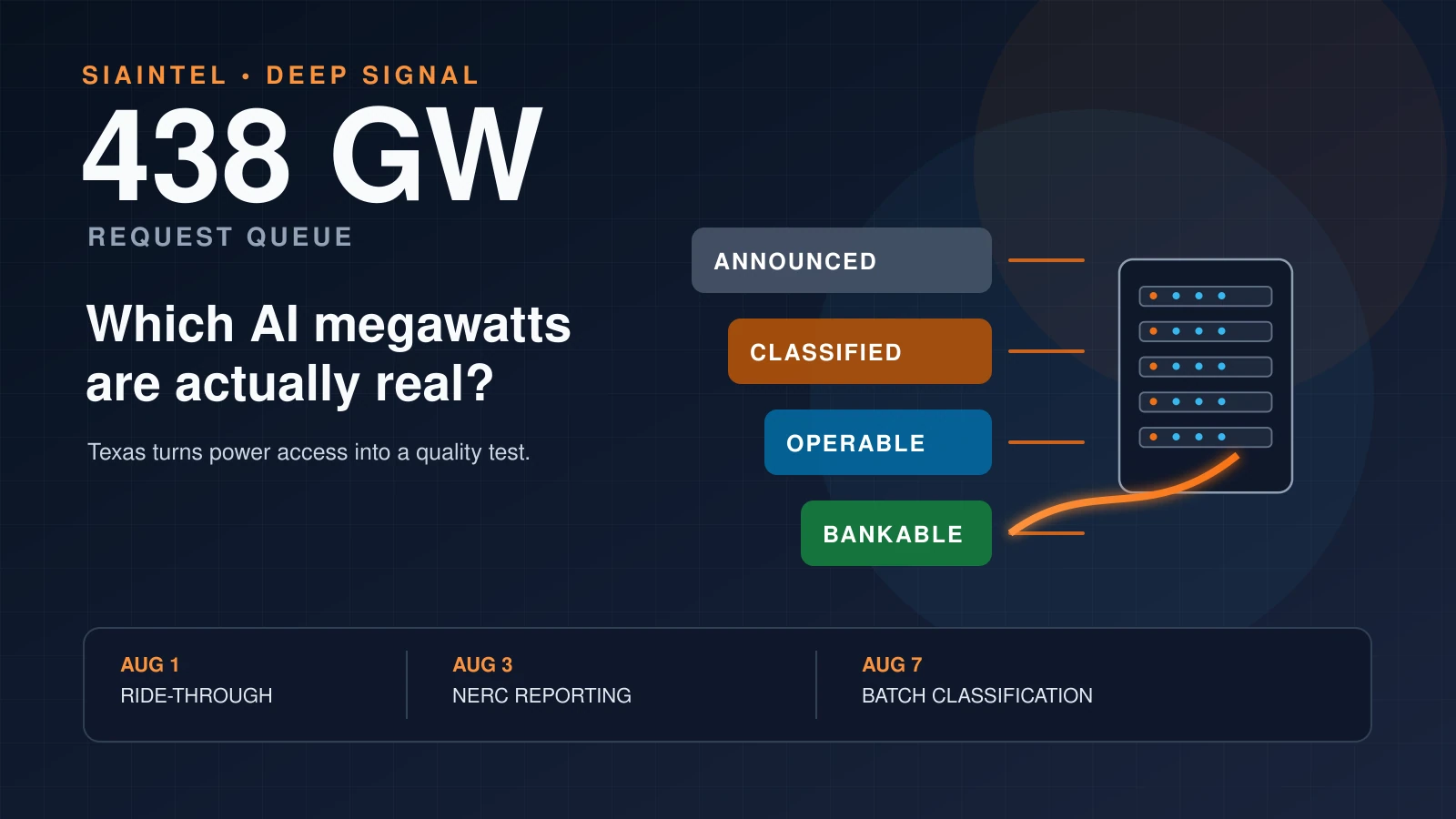
To prevent gross capacity from being mistaken for executable capacity, SIAIntel applies a five-stage conversion ladder:
A public pipeline or queue request. No assumption of delivery.
Eligible for the applicable study path, with evidence of deposits or site progress.
Receives full or partial grid capacity under a coordinated study.
Meets modeling, protection, ramping, curtailment and ride-through requirements.
Has an executable build schedule, committed capital and contracted or demonstrable demand.
The model is intentionally conservative. It forces every capacity claim through the same evidence sequence and labels missing proof instead of treating it as failure. The practical implication is that one Stage-4 megawatt can carry more strategic value than several Stage-0 megawatts.
Cipher worked example — disclosure evidence score, not a company rating
Cipher disclosed approximately 3.3 GW of grid pipeline capacity. McLennan (500 MW), Colchis (1,000 MW) and Mikeska (500 MW) represent 2.0 GW explicitly identified as expected or targeted for Batch Zero treatment—about 61% of that disclosed grid pipeline. Cipher’s SEC-filed presentation supports the arithmetic.
Illustrative evidence score: 2/5. One point is recorded for disclosed MW and one for a named study path. No point is recorded yet for final allocation, project-level ride-through proof, or contracted and financed delivery across the full 2.0-GW subset. Missing points mean “not yet established in the cited disclosure,” not “failed.”
Data-Backed Framework
The framework separates confirmed institutional facts from company forward-looking disclosures and SIAIntel inference. Confirmed facts include ERCOT’s queue size and calendar, the effective dates of its ride-through rules, NERC’s documented load-loss incident, and the deadlines in federal reliability and tariff proceedings. Company pipeline figures remain management disclosures subject to execution risk. The conversion ladder is the analytical layer applied to those facts; it is not an ERCOT, NERC or FERC rating.
Visual Intelligence
The publication visual encodes the core relationship without presenting a false forecast: a 438-GW request queue narrows through four gates—announced, classified, operable and bankable. The graphic does not estimate how many gigawatts will survive. That quantity cannot be known before ERCOT’s classifications, studies and 2027 allocations.
August 7 Is a Classification Event, Not a Capacity Award
ERCOT’s Batch Zero design creates three immediate buckets. Base-load projects preserve qualifying capacity from earlier studies or approved planning work. Studied-load projects enter a system-wide assessment and may receive their full request, a partial allocation or a deferral. Excluded projects wait for a future batch. ERCOT also says Batch Zero developers are expected to face a 2027 commitment deadline to post financial security and demonstrate appropriate site control. The official process is designed to distinguish projects that can advance from requests that may never be built.
This creates two dates investors should not confuse:
- August 7, 2026: ERCOT tells applicants whether they are base, studied or excluded.
- Spring 2027: ERCOT provides the amount of electricity that can reliably be allocated to each Batch Zero user.
August can re-rank the credibility of a project pipeline. It cannot yet prove the final quantity, cost or energization date of that pipeline.
Risk Trigger: Ride-Through Turns Power Quality Into Asset Quality
Interconnection is only half the test. Beginning August 1, 2026, ERCOT’s approved NOGRR282 establishes voltage- and frequency-ride-through requirements for large computational loads, while NPRR1308 defines the covered load category. The engineering question is whether a facility’s UPS systems, protection settings, cooling equipment and controls remain coordinated with the grid during disturbances rather than dropping a large block of demand at once.
The risk is not theoretical. A NERC review of a July 10, 2024 Eastern Interconnection incident found that a 230-kV fault and six voltage depressions over 82 seconds coincided with the customer-side loss of about 1,500 MW of data-center-type load. Roughly 1,260 MW did not return for hours. System frequency rose to 60.047 Hz and voltage reached 1.07 per unit. NERC’s incident review shows why a data center can be both a large customer and a grid event.
These figures describe different things: 1,500 MW is the approximate load actually lost during the documented 2024 Eastern Interconnection incident; 3,200 MW is ERCOT’s steady-state load-loss limit in a separate Texas study case. The second number is not a revised estimate of the first event and neither number is a forecast of Batch Zero allocations.
ERCOT’s own system-operations update identifies a 3,200 MW steady-state load-loss limit in its study case. It also concludes that a modeled fast-frequency-response-down service would provide only marginal improvement relative to implementation effort and would not replace ride-through requirements. ERCOT’s June system-operations materials make the hierarchy clear: curtailment flexibility is useful, but fault performance is a separate asset characteristic.
The Federal Layer Is Moving Below Texas’s 75-MW Screen
Texas defines a large user for Batch Zero at 75 MW or more. NERC’s current computational-load work reaches lower. Its May 4 Level 3 alert says the proposed Computational Load Entity framework would currently include loads of at least 20 MW, connected at 60 kV, and containing more than 1 MW of IT load. Registered entities must report their implementation status by August 3, 2026. The alert is not itself a Reliability Standard and does not create penalties for failing to implement the listed actions, but it is a direct data-collection and readiness signal. NERC’s Level 3 alert calls for modeling, instrumentation, commissioning, protection and control changes.
The threshold remains contested. In filed comments, AEP supported 75 MW and 100 kV, while PJM recommended raising NERC’s proposed load threshold from 20 MW to 50 MW. The NERC comment record is evidence that the compliance perimeter is still being negotiated.
SIAIntel inference: a sub-75-MW design may avoid ERCOT’s batch pathway, yet a qualifying facility could still enter a broader NERC registration and modeling perimeter if the final federal criteria reach lower. That does not erase the speed advantage of smaller projects. It means “below the Texas batch threshold” is not automatically the same as “outside the emerging reliability regime.”
Capital Channel
The capital-market transmission mechanism is a sequence of haircuts:
- Queue haircut: remove projects that are excluded or not eligible for the applicable study.
- Allocation haircut: reduce studied requests to the MW the grid can reliably serve.
- Operability haircut: account for ride-through, ramping, modeling and curtailment costs.
- Schedule haircut: account for transmission upgrades, equipment lead times and site-control milestones.
- Financing haircut: distinguish contracted, collateralizable capacity from merchant or speculative pipeline.
That sequence can change how lenders, infrastructure funds, utilities and hyperscalers compare projects. Gross MW remains useful as an opportunity set. It is not a substitute for executable capacity. The credit question becomes: how many disclosed MW survive every layer?
Company Lens
Cipher Digital: The Footnote Is Becoming the Valuation Variable
Cipher’s May business update presented about 4.2 GW of total portfolio capacity and approximately 3.3 GW of grid pipeline capacity, while explicitly noting that gross pipeline capacity is subject to the ERCOT batch process. The presentation identifies McLennan at 500 MW, Colchis at 1,000 MW and Mikeska at 500 MW as expected or targeted for Batch Zero treatment. Cipher’s SEC-filed presentation also distinguishes already approved interconnection at projects such as Ulysses and Reveille from batch-dependent pipeline.
Cipher’s quarterly filing separately lists batch interconnection, grid stability, voltage and frequency ride-through, and curtailment obligations among its electricity-market risks. The 10-Q risk language matters because it connects the technical screen directly to cost, delay and operating constraints. It does not prove that any named project will be rejected; it proves that management considers the regime financially material.
Soluna: Speed Below 75 MW, Compliance Above the Headline
Soluna says Projects Annie and Fei are advancing outside ERCOT’s large flexible-load batch study by using the sub-75-MW interconnection pathway. Its SEC-filed operating update makes the strategy explicit. This is a real development advantage if it shortens the path to power.
Yet Soluna is also investing in operability. Its filing says the 2-MW Project Grace AI pilot began technical simulations with Siemens to test grid stability and low-voltage ride-through requirements. Soluna’s quarterly filing suggests that speed-to-interconnection and disturbance performance are being developed together rather than treated as substitutes.
IREN: Flexibility Has Cash-Flow Value, but It Is Not Ride-Through
IREN reported that the increase in demand-response income at Childress contributed $1.1 million for the March quarter and $3.7 million for the nine-month period. The company also disclosed a plan to retrofit parts of Childress for AI Cloud Services and develop another 150 MW of direct-to-chip liquid-cooled data centers. IREN’s quarterly filing demonstrates why former mining campuses can carry a flexibility advantage.
But the distinction must remain precise. Demand response means a load can reduce consumption when instructed or when market conditions reward it. Ride-through means protection and controls behave predictably during a disturbance measured in cycles or seconds. A site can be strong at one and incomplete at the other.
Bank/Credit/Capital Lens
For credit markets, the emerging unit of collateral quality is not nameplate MW. It is contracted and operable MW with an evidenced path to energization. The practical diligence package is likely to become more technical: classification status, study milestones, network-upgrade responsibility, site control, posted security, ride-through test results, curtailment rights, backup-generation configuration, tenant credit and construction funding.
This can produce a split inside the same company. Contracted campuses with approved interconnection and financed construction may retain premium treatment, while early-stage pipeline is discounted more heavily. The result is not necessarily lower enterprise value across the board. It is a wider internal spread between high-quality and low-quality megawatts.
At the national level, FERC’s June 18 show-cause orders require six regional grid operators and their transmission owners to justify within 60 days why their tariffs remain just and reasonable without clearer large-load provisions, or propose changes. The reform categories include study processes, cost-shift prevention, co-location, flexible transmission service and nearby generation. The same orders require generation-adequacy information within 30 days. FERC’s fact sheet does not govern ERCOT’s Batch Zero process, but it shows that the firm-MW question is becoming a national tariff issue.
Country Lens
United States: Texas is the live classification laboratory, while the FERC proceedings push other regions toward clearer rules for studies, flexible service and cost allocation. Regional designs will differ, but disclosure quality should converge.
Developed markets: Europe, Japan and other grid-constrained economies face the same underlying distinction between announced compute capacity and deliverable electricity. Jurisdictions that price network upgrades and operating behavior early may reduce speculative queues but could also slow projects that lack balance-sheet depth.
Developing markets: sovereign AI and data-center announcements should be tested against transmission capacity, system reserves, equipment supply, foreign-currency financing and grid-code maturity. Cheap generation is not enough if the network cannot connect or stabilize concentrated electronic load.
Türkiye: the relevant opportunity is not to replicate Texas-scale queue volume. It is to design credible industrial and data-center zones where power availability, grid reinforcement, fiber, cooling, permitting and currency-risk allocation are disclosed as one package. A smaller but executable firm-MW offer can be more competitive than a larger headline commitment.
Strategic Impact Matrix
Capital, Risk and Strategic Priority Lens: the matrix below consolidates the capital channel, principal risk and monitoring priority in one decision surface, avoiding a second card block that repeats the same analysis.
| Channel | Immediate signal | Time horizon | Magnitude |
|---|---|---|---|
| AI developers | Batch classification separates preserved, studied and deferred capacity. | 30 days | High |
| Utilities and grids | Ride-through and dynamic models become connection-quality evidence. | 30–90 days | High |
| Lenders | Gross MW receives larger diligence and schedule haircuts. | 60–180 days | High |
| Former miners | Demand flexibility helps, but ride-through proof remains separate. | 60–180 days | Medium–High |
| Households and SMEs | Cost-allocation rules determine whether network upgrades shift into wider bills. | 6–24 months | Medium |
Analyst Intelligence Box
The hidden repricing variable is the conversion rate from announced MW to bankable MW.
- Primary Signal: ERCOT’s August classification begins the first public quality split inside the AI-power queue.
- Capital Channel: grid status flows into schedule certainty, collateral quality and financing cost.
- Risk Trigger: exclusion, partial allocation, ride-through redesign or delayed energization.
- Watch Indicator: the share of disclosed pipeline that companies identify as classified, allocated and contracted.
- 90-Day Implication: wider valuation and credit spreads between executable campuses and early-stage pipeline.
- Internal Link Bridge: AI’s Credit Grid Squeeze.
Companies that report classification status, partial allocations, posted security, site control, ride-through validation and contracted tenant demand separately can reduce ambiguity. Companies that continue to aggregate every stage into one pipeline number may invite a larger market haircut.
30/60/90 Watchlist
This 30/60/90 Day Watchlist separates near-term rule dates from later financing and disclosure effects.
- 30 days: ERCOT ride-through rules take effect on August 1; NERC Level 3 reporting is due August 3; Batch Zero classification notices follow on August 7. Watch for company disclosures that distinguish base, studied and excluded projects.
- 60 days: Watch the six FERC-jurisdictional grid operators for tariff defenses or proposed reforms, especially on cost allocation, flexible service, co-location and readiness deposits.
- 90 days: Watch earnings calls, financing documents and development updates for explicit MW reclassification, revised energization schedules, additional security commitments and ride-through engineering costs.
Counter-Thesis
The bearish interpretation may be too aggressive. Queue inflation is widely understood, and sophisticated lenders may already discount early pipeline. ERCOT’s framework could improve execution by removing uncertainty rather than destroying value. Projects with land, deposits, prior studies and strong counterparties may emerge with a credibility premium. Ride-through upgrades may also be manageable relative to total campus cost, especially when designed before procurement and commissioning.
There is also a scale argument. AI demand may grow fast enough that even a heavily haircut pipeline still supports substantial construction. A lower conversion rate does not mean the AI power buildout is false; it means the buildout must be measured with a better denominator.
Break-This-Thesis
The firm-MW repricing thesis weakens if three things occur together: Batch Zero classifications largely preserve disclosed pipelines; ride-through compliance produces minimal schedule or capex changes; and lenders continue financing early-stage MW without stronger collateral, security or disclosure. It also weakens if hyperscalers increasingly bring dedicated generation and network investment that bypass the scarcity channel assumed here.
The thesis strengthens if companies begin reducing gross pipeline totals, splitting full from partial allocations, extending energization dates, raising project-level capital, or disclosing new protection and control costs after the August milestones.
Investor Action Table — Monitoring Only
This is a diligence table, not a trading recommendation.
| Monitoring action | Evidence | Interpretation limit |
|---|---|---|
| Separate MW stages | Approved, base, studied, allocated, contracted and operating capacity | Classification is not final allocation. |
| Test operability | Ride-through models, commissioning tests, ramp rates and protection settings | Demand response is not a substitute for fault performance. |
| Test bankability | Site control, posted security, tenant contract, funding and energization path | A target date is not completion evidence. |
Audience Impact
| Audience | Why it matters | Signal to watch |
|---|---|---|
| General Reader | Large data centers can influence grid investment, reliability planning and future electricity costs. | Who pays for upgrades and whether large loads stay connected during faults. |
| Investors | Gross MW may no longer be comparable across developers. | Base versus studied status, partial allocations and contracted MW. |
| Companies | Transparent project-stage disclosure can become a cost-of-capital advantage. | Site control, deposits, security, energization evidence and ride-through tests. |
| Developing Markets | Sovereign AI plans can outrun grids and hard-currency financing. | Firm-power contracts, network reinforcement and equipment funding. |
| Developed Markets | The policy challenge is connecting strategic load without socializing avoidable costs. | Tariff reform, cost allocation and flexible-service design. |
| Credit Markets | Power rights and operating compliance affect collateral quality and completion risk. | Covenants tied to grid milestones, tenant contracts and capex contingencies. |
| Policymakers | Commitment screens can reduce speculative queues but may favor the largest balance sheets. | Whether rules improve delivery without blocking credible smaller projects. |
Evidence Stack and Sources
Evidence Sources: the stack below prioritizes grid operators, reliability bodies, regulators and SEC-filed company disclosures.
- ERCOT — New Batch Connection Process for Large Electricity Users, June 18, 2026
- ERCOT — NOGRR282 Large Computational Load Ride-Through Requirements
- ERCOT — NPRR1308 Definition of Large Computational Load
- NERC — Incident Review: Simultaneous Voltage-Sensitive Load Reductions
- ERCOT — System Operations Update, June 2026
- NERC — Level 3 Computational Load Alert, May 4, 2026
- FERC — Large-Load Show-Cause Orders Fact Sheet, June 18, 2026
- SEC — Cipher Digital Business Update, May 5, 2026
- SEC — Cipher Digital Form 10-Q for the Quarter Ended March 31, 2026
- SEC — Soluna Operating Update on Projects Annie and Fei
- SEC — Soluna Holdings Form 10-Q for the Quarter Ended March 31, 2026
- SEC — IREN Form 10-Q for the Quarter Ended March 31, 2026
- NERC — Public Comments on Proposed Computational Load Entity Criteria
SIAIntel Bottom Line
Texas’s 438-GW queue is not a forecast of electricity demand that will all be served. It is an inventory of ambition entering a credibility test. August 1 tests operating behavior. August 3 tests institutional readiness. August 7 begins separating preserved, studied and deferred projects. Spring 2027 will begin answering the harder quantity question.
The durable signal is bigger than Texas: AI capacity is being repriced from a marketing number into an infrastructure claim that must survive engineering, regulation and credit. The companies and countries that can prove firm MW—not merely announce it—will hold the stronger position in the next stage of the AI industrial cycle.
Editorial credit: SIAIntel Editorial Desk. Editorial oversight: Elanur Karahan, Founder & Editor-in-Chief.
Method note: Company pipeline figures are forward-looking disclosures, not guaranteed allocations. SIAIntel identifies analytical inferences explicitly and distinguishes ERCOT rules from NERC and FERC processes.
Disclosure: This article is strategic market intelligence, not investment advice or a buy/sell recommendation.
Source Map
6 highlighted sources
Editorial Credit
This intelligence brief was prepared by the SIAIntel Editorial Desk.
Some contributors work in sensitive public-sector, regulatory, market, or editorial roles. Their identities may be withheld when professional duties, source protection, or safety require confidentiality.
Editorial and publishing accountability: Sefa Karahan, Founder & Publisher
Related Intelligence
Related intelligence in this category · 3 briefs

3 GW Vanished: Data Centers Shock America’s Largest Grid
More than 3 GW of data-center load vanished from PJM. See the hidden AI grid risk, investor impact, Virginia tax cost and next regulatory catalysts.
AI’s Dollar-Watt Squeeze: Fed Meets PJM’s 6.8 GW Gap
A 9–3 Fed split and PJM’s 6.8 GW reliability gap show why AI infrastructure is being repriced through both capital and firm power.

AI’s Megawatt Margin Call Has Begun: Ofgem Turns Grid Access Into a Credit Test
Ofgem’s £71.3m collateral proposal, Oracle’s BBB- rating and a 73 GW queue turn AI data-centre grid access into a live credit test.