"Nvidia’s reported $250B OpenAI guarantee talks, project bonds and BIS warnings confirm SIAIntel’s early map of AI’s hidden credit circuit."
SIAINTEL INTELLIGENCE DOSSIER
Analysis Brief
SIAIntel Verification Panel
Analysis, data context, source mapping and editorial boundaries are presented as one evidence chain.
Key Takeaways
- Nvidia is reportedly discussing roughly $250 billion of financing guarantees connected to OpenAI’s planned Ohio data-center leases.
- The talks are not a completed agreement and Reuters could not independently verify them..
- A separate report identifies Nvidia as the investment-grade tenant behind Hut 8’s Texas campus, where $19.6 billion of base-term leases support a project that has already issued $4.25…
SIAIntel Perspective
SIAIntel frames this development not as a standalone headline, but as an intelligence brief shaped by source quality, structural implications and observable risk channels.
Data Snapshot
Coverage Area
Editorial category
AI
Read Time
Approximate duration
~27 min
Source Base
Visible evidence profile
Article context
Published
Updated: Jul 28, 2026
Jul 28, 2026
Evidence Frame
This layer summarizes visible sources, article context and editorial framing. It is analytical context, not transactional guidance.
Key Takeaways
- Nvidia is reportedly discussing roughly $250 billion of financing guarantees connected to OpenAI’s planned Ohio data-center leases. The talks are not a completed agreement and Reuters could not independently verify them.
- A separate report identifies Nvidia as the investment-grade tenant behind Hut 8’s Texas campus, where $19.6 billion of base-term leases support a project that has already issued $4.25 billion of senior secured notes.
- Nvidia’s own 2026 Form 10-K had already disclosed that customers and partners were asking it for data-center financing support—and warned that such arrangements could increase credit risk.
- Meta’s newly disclosed El Paso venture provides a company-confirmed control case: $12.5 billion of project debt, a long-term Meta lease and a residual-value guarantee capped by a declining threshold of about $13 billion.
- The Bank for International Settlements calls this wider structure “shadow borrowing”: debt-like obligations sit in project vehicles while leases, offtake contracts and guarantees reconnect the risk to investment-grade technology companies.
- The distribution channel into private credit, insurers and retirement capital is now documented. A systemic default cycle or broad realized household loss is not.
Signal Confirmed: The SIAIntel Intelligence Record
SIAIntel is not claiming ownership of the underlying facts. The editorial achievement is timing and synthesis: the platform connected chip demand, data-center power, project finance and the ultimate risk holder before the latest Nvidia reports made the balance-sheet backstop visible.
| Date | Published intelligence | What SIAIntel identified | What the new evidence adds |
|---|---|---|---|
| July 15, 2026 | Wall Street Is Opening a Door From AI Debt to Your 401(k) | AI infrastructure loans can travel through private credit, structured finance and insurers toward retirement capital | The current evidence connects that documented distribution channel to transaction-level origination through leases, project notes and supplier support |
| July 22, 2026 | AI’s Closed Capital Circuit Just Hit the Power Grid | Suppliers, customers, investors and financiers were becoming one risk network; the unanswered question was who ultimately absorbs a failed project | Reported Nvidia support, filed Hut 8 project debt and Meta’s disclosed guarantee structure make the risk-absorber layer visible |
| July 26–28, 2026 | Independent transaction and market evidence | The SIAIntel model moved from structural warning to observable market test | Nvidia–OpenAI backstop talks, the reported Texas tenant, the BIS scale data, Fitch’s credit-risk classification and wider CDS pricing expose the same circuit across multiple markets |
That verifiable sequence is why this is a SIAIntel Signal Confirmed analysis rather than a conventional Nvidia deal story. The success is not a prediction of default. It is the early identification of the transmission mechanism now appearing in reported transactions, securities filings and credit-market pricing.
Executive Signal
The AI chip boom is becoming a credit market—and SIAIntel mapped the transmission mechanism before the reported backstop became visible.
Nvidia’s commercial advantage has historically been described through processor performance, software lock-in and supply. The next layer is financial: if a customer or data-center developer cannot independently finance the buildings, power systems and long-term leases needed to absorb Nvidia hardware, the supplier has an incentive to help make that demand bankable.
That incentive is now visible in three different forms.
First, the Wall Street Journal reported, via Reuters, that Nvidia was discussing roughly $250 billion of guarantees for lease and debt financing tied to OpenAI’s planned 10-gigawatt Ohio project. The reported support would exclude Nvidia chips; separate talks cover as much as $350 billion of possible chip-purchase financing. Neither amount is a completed transaction, and they are not additive.
Second, the Financial Times reported, via Reuters, that Nvidia is the previously undisclosed investment-grade tenant behind Hut 8’s Beacon Point campus in Texas. Hut 8’s filings establish the lease and financing economics, but not the tenant’s identity: two 15-year leases cover 704 megawatts of critical IT capacity and carry a combined base-term value of $19.6 billion. The often repeated $50.2 billion figure assumes every five-year renewal option is exercised.
Third, Meta disclosed a parallel structure directly. Its BlackRock venture in El Paso combines an 80% infrastructure-investor stake, $12.5 billion of project debt, a Meta lease and a residual-value guarantee subject to an aggregate threshold initially near $13 billion.
These are not identical deals. Together, however, they reveal a repeatable architecture:
Investment-grade lease or guarantee → project debt → powered data center → long-duration chip demand.
SIAIntel’s July 22 analysis, AI’s Closed Capital Circuit Just Hit the Power Grid, asked who absorbs the loss if announced capacity arrives late, remains underused or cannot refinance. The new evidence reaches that fifth gate. The risk absorber is increasingly an investment-grade technology balance sheet, sometimes directly and sometimes through a lease, guarantee or project vehicle.
The Evidence Has Three Confidence Levels
| Evidence | What is established | What remains unconfirmed | Confidence |
|---|---|---|---|
| Nvidia–OpenAI Ohio talks | WSJ reported roughly $250B of lease and debt-financing guarantees under discussion; separate chip-financing talks could reach $350B | Final agreement, legal cap, triggers, collateral, syndication, fee, expected loss and closing | Medium |
| Hut 8 Beacon Point | Hut 8 filed two 15-year leases, 704 MW of IT load, $19.6B base value and $50.2B only with all renewals; a project subsidiary issued $4.25B of notes | Tenant name; Nvidia’s identity is reported but not disclosed by Hut 8 | High on structure; medium on tenant identity |
| Meta–BlackRock El Paso | Meta disclosed venture ownership, $12.5B debt, full-campus lease and residual-value guarantee mechanics | Complete private loan covenants and future utilization | High |
| Nvidia financing-risk disclosure | Nvidia disclosed requests for customer and partner financing support and warned of lower upfront cash flow and higher credit risk | Whether any specific later transaction uses those exact terms | High |
| BIS / FSB / Fitch context | Official institutions document AI private-credit growth, shadow borrowing, insurer exposure and correction risk | A company-specific default forecast | High |
This classification matters because the thesis is stronger than any one headline. Even if the proposed OpenAI guarantee is reduced or never closes, the filed Hut 8 financing, the Meta structure and the institutional evidence still show that AI demand is being converted into credit through long leases, special vehicles and investment-grade support.
Texas Data-Center Financing Shows How a Lease Becomes a Bond
Hut 8’s Beacon Point filings make the financing mechanism unusually visible.
The company disclosed a second 15-year lease on July 20 for 352 megawatts of critical IT capacity. It doubled the same tenant’s contracted footprint to 704 megawatts. The two leases have a combined base-term contract value of $19.6 billion, including 3% annual rent escalation. Three five-year renewal options on each lease could lift the potential value to $50.2 billion, but only if every option is exercised.
The physical figures also require discipline. The tenant has contracted 704 megawatts of IT capacity; Beacon Point has 1,000 megawatts of utility capacity. Contracted computing load and the campus power ceiling are not interchangeable.
The credit transformation occurred before the second lease. A Hut 8 project subsidiary issued $4.25 billion of 6.129% senior secured notes due in 2042. The proceeds finance a 352-megawatt data center and its substation. The notes amortize, are secured at the project level and contain restrictions tied to the lease, collateral, additional debt and project operations.
The tenant was disclosed only as a company rated AA- or higher. That credit quality is central. It allows investors to underwrite long-dated construction and operating risk against contracted cash flows from a stronger counterparty rather than against Hut 8’s stand-alone promise alone.
Reuters reported on July 28 that Nvidia was behind leases worth as much as $50 billion. The wording must remain precise:
- Hut 8 confirms the leases and the values.
- Hut 8 does not publicly name Nvidia.
- $19.6 billion is the combined 15-year base value.
- $50.2 billion requires all extension options and should not be presented as today’s fixed obligation.
- The $4.25 billion notes are project financing, not Nvidia debt.
The important market signal is therefore not a single “$50 billion Nvidia cheque.” It is the conversion of a credible tenant commitment into investment-grade project paper.
Nvidia–OpenAI $250B Guarantee Talks Could Create an Explicit Backstop
The reported Ohio structure is larger and more consequential because it could make Nvidia an explicit financing backstop for a customer.
Reuters relayed reporting that Nvidia was discussing roughly $250 billion of guarantees for lease and debt financing connected to OpenAI’s planned 10-gigawatt data-center project with SB Energy in southern Ohio. The first phase is expected to be roughly 800 megawatts and to begin in 2028. The wider project has been estimated at more than $500 billion including chips.
The distinctions are decisive:
- The reported $250 billion covers lease and debt-financing support, not Nvidia GPUs.
- Separate discussions could provide as much as $350 billion of financing for OpenAI’s chip purchases.
- The two amounts describe different possible legal and commercial channels.
- Reuters could not independently verify the report, and Nvidia and OpenAI did not comment.
- No public document supplies the guarantee cap, duration, draw conditions, recourse, collateral, syndication, fee or expected-loss treatment.
That means the $250 billion figure cannot be treated as cash leaving Nvidia, a funded loan, a booked liability or a probable loss. A guarantee is contingent credit support: its economic value comes from allowing another borrower or project to obtain financing on terms it might not receive alone.
The incentive is equally important. OpenAI is a large potential buyer of Nvidia systems, but it is not profitable and lacks an investment-grade credit rating. If Nvidia’s balance sheet helps project lenders fund the campuses where OpenAI will deploy Nvidia hardware, the supplier is no longer only responding to demand. It is helping manufacture the credit capacity that makes the demand executable.
That is the hidden circuit:
Nvidia credit support makes infrastructure financeable → the infrastructure hosts OpenAI compute → OpenAI purchases Nvidia systems → Nvidia revenue depends partly on the financed customer ecosystem.
This is not proof of manipulation or inevitable loss. Supplier finance is common in capital-intensive industries. It becomes strategically important when the supplier, customer, project lender and physical infrastructure are exposed to the same demand forecast.
Nvidia Warned About This Risk Before the Headlines
Nvidia’s own filing supplies the most important primary-source anchor.
In its fiscal 2026 Form 10-K, the company disclosed that customers and partners had asked it to offer financing arrangements supporting data-center construction. As of January 25, Nvidia said it had not entered such financing arrangements.
The filing also explained the risk mechanism. Commercial arrangements can expose Nvidia to a counterparty’s inability to obtain financing or infrastructure, project delays, financial distress or insolvency. If Nvidia provides financing, extended terms can reduce upfront cash flow and increase credit risk.
That disclosure does not confirm the later Texas tenant report or the OpenAI talks. It does something analytically stronger: it shows that Nvidia had already identified customer-infrastructure financing as a live commercial request and a balance-sheet risk.
The sequence is therefore observable:
- customers ask the chip supplier for infrastructure financing support;
- Nvidia warns investors that such support could change cash-flow timing and credit risk;
- a reported Nvidia lease is linked to a debt-financed Texas campus;
- Nvidia is reported to be discussing a far larger OpenAI guarantee structure.
The risk factor appears to be moving from hypothetical disclosure toward reported commercial negotiation.
Meta Provides the Company-Confirmed Control Case
The Nvidia reports do not stand alone. Meta’s El Paso agreement demonstrates the same economic architecture with company-disclosed numbers.
Meta and BlackRock formed a venture for a one-gigawatt campus expected to come online in 2028. BlackRock will fund 80% of the equity and Meta 20%. Meta disclosed approximately $14 billion of development costs and $12.5 billion of debt financing. Meta will lease the entire campus for an initial four years, with four extension options that can take the relationship to 20 years.
Meta also agreed to residual-value guarantees subject to an aggregate threshold initially near $13 billion and declining over time. The maximum payment would be the shortfall if contractual conditions are met—not an automatic $13 billion cash payment.
This structure shows why the Nvidia thesis is not simply about one aggressive semiconductor company. Across the industry, an investment-grade technology company can:
- place a minority equity contribution;
- sign a long lease or capacity commitment;
- support a project vehicle through guarantees;
- attract infrastructure equity and debt;
- keep much of the project debt outside its consolidated corporate borrowings; and
- regain economic exposure if a guarantee or lease obligation is triggered.
SIAIntel has already analyzed the broader mechanism by which Meta lease promises can become project debt in Meta’s $12.3B Bond Exposes Wall Street’s AI Debt Machine. The newly disclosed El Paso venture is a separate transaction. Here, it functions as the control case that confirms a sector pattern rather than the lead story.
AI Shadow Borrowing: BIS Has a Name for the Structure
The Bank for International Settlements’ March 2026 Quarterly Review describes the same architecture.
A dedicated project vehicle owns or develops a data center. Infrastructure investors supply equity. Private lenders or bond investors provide debt. A hyperscaler signs a long lease or capacity agreement and can add a guarantee. Banks may fund the vehicle or the private-credit managers. The hyperscaler converts a large upfront build into multiyear operating payments while much of the formal debt remains at project level.
The BIS calls these debt-like commitments outside the technology company’s balance sheet “shadow borrowing.”
The term does not mean the obligations are necessarily hidden, fraudulent or unmanageable. It means a standard corporate-bond screen can miss economically debt-like commitments carried through leases, purchase obligations, guarantees and special-purpose vehicles.
The structure creates three transmission channels:
- Refinancing risk: project debt may have to be rolled over after construction, before full utilization or during a weaker credit market.
- Private-credit cyclicality: lenders may retreat together if valuations fall, construction slips or projected demand is revised.
- Guarantee re-entry: risk that appeared to sit in a project vehicle can return to the technology company when a guarantee, lease termination provision or residual-value support is triggered.
The BIS’s July 28 bulletin shows the scale of the transition. Private-credit lending to AI-related firms rose from near zero in 2016 to about $200 billion in 2025, increasing from less than 2% to roughly 8% of the market. AI-related firms issued about $243 billion of bonds in 2025, compared with $79 billion in 2023. The BIS warns that overly optimistic expectations can create overinvestment, capital misallocation and weaker credit quality.
Those figures are different measures and must not be combined into a single AI-debt total.
AI Credit Markets Are Beginning to Price the Risk
The next confirmation is not default. It is price.
Axios reported that Oracle’s five-year credit-default-swap spread reached 212 basis points. At that spread, insuring $10 million of Oracle debt would cost about $212,000 per year before contract-specific adjustments. Microsoft, Alphabet, Amazon and Meta spreads also moved higher, though by less.
Oracle’s spread does not establish a causal link to Nvidia or OpenAI. It shows that investors are demanding more compensation for exposure to a company whose AI infrastructure expansion is unusually capital-intensive.
The same Axios analysis reports that Alphabet, Amazon, Meta, Microsoft and Oracle raised approximately $302 billion through debt and equity by July 22. Because the measure includes both debt and equity, it is not a pure borrowing figure. Goldman Sachs estimated $489 billion of AI-related global corporate bond and loan supply in 2026 to date, compared with an estimated $322 billion for all of 2025. That is financing supply, not completed AI investment.
Fitch then elevated the issue from company-level repricing to a global risk category. Reuters reported that Fitch’s third-quarter outlook described an AI market correction as an emerging major credit risk. Six AI-linked companies—Amazon, Alphabet, Meta, Nvidia, Oracle and SpaceX—had issued approximately $182 billion of investment-grade bonds. Fitch also projected 2026 capital spending by four hyperscalers at about $700 billion.
The correct interpretation is not that default is imminent. It is that AI infrastructure has become large enough, interconnected enough and increasingly debt-financed enough to affect credit spreads, ratings analysis and capital-market conditions.
AI Credit Risk Can Reach Insurers and Retirement Capital
The distribution channel is now documented more strongly than the realized-loss claim.
The Financial Stability Board’s private-credit report describes pension funds and insurers as major capital providers to private credit. It also shows that private-equity-linked insurers held structured securities equal to roughly 27% of portfolios at the end of 2024, compared with about 12% at other large insurers. A proxy measure suggests private-credit exposure near 10% at North American life insurers, compared with approximately 3% at non-life insurers.
Those percentages are not AI-debt shares. They describe the broader balance-sheet channels through which privately originated loans and structured assets can be held.
The FSB also reports that private-equity-backed insurers controlled close to $900 billion of insurance liabilities, up from $67 billion in 2012. This does not prove that those liabilities are backed by troubled AI assets. It shows why the destination of project debt matters: a loan originated against a data-center lease can be distributed into funds and structured securities held by insurers, pension investors or other institutions.
That is the precise confirmation of SIAIntel’s July 15 analysis, Wall Street Is Opening a Door From AI Debt to Your 401(k):
- Confirmed: the distribution route from AI infrastructure into private credit, structured finance, insurers and retirement capital exists.
- Not confirmed: broad direct ownership of AI debt in every 401(k).
- Not confirmed: a systemic AI default wave or realized household loss.
The risk has a route. It has not yet produced the outcome.
Quantitative Evidence Board
Non-additivity rule: The figures below represent different legal claims, time periods and physical measures. Lease value, project debt, guarantees, chip finance, bond issuance and megawatts cannot be added into one “total AI exposure” number.
| Figure | What it represents | What it does not represent | Status |
|---|---|---|---|
| ~$250B | Reported Nvidia financing guarantees under discussion for OpenAI’s Ohio leases and project debt | A completed guarantee, cash payment, funded loan or booked loss | Reported talks |
| Up to $350B | Separately reported possible financing for OpenAI chip purchases | An amount to add to $250B as one deal | Reported talks |
| $19.6B | Combined 15-year base value of two Hut 8 Beacon Point leases | Today’s fixed $50.2B obligation | SEC-filed |
| $50.2B | Potential Beacon Point value if all renewal options are exercised | Base-term value | Company-disclosed, conditional |
| $4.25B | Beacon Point project-company senior secured notes, 6.129%, due 2042 | Nvidia corporate debt or incremental lease value | SEC-filed |
| 704 MW | Contracted critical IT capacity at Beacon Point | The campus’s 1,000 MW utility limit | SEC-filed |
| 1,000 MW | Beacon Point utility capacity | Billable tenant IT load | SEC-filed |
| $12.5B | Debt financing for Meta’s El Paso project vehicle | Meta corporate-bond issuance | Company-disclosed |
| ~$13B | Initial aggregate threshold for Meta’s declining residual-value guarantees | Automatic cash payment | Company-disclosed, contingent |
| ~$200B | BIS estimate of private-credit lending to AI-related firms in 2025 | Total AI infrastructure debt | Institutional estimate |
| $243B | AI-related bond issuance in 2025 | Private credit or 2026 issuance | Institutional estimate |
| 212 bp | Reported five-year Oracle CDS spread | A 2.12% default probability or realized loss | Market-pricing signal |
| $182B | Investment-grade bonds issued by six AI-linked companies in Fitch’s cited set | Project debt for one company | Rating-agency context |
| 27% / 12% | Structured securities as a portfolio share at PE-linked / other large insurers | AI-debt allocation | FSB portfolio context |
SIAIntel Model: The Hidden AI Credit Circuit
| Gate | Question | New visible evidence | Failure signal |
|---|---|---|---|
| 1. Demand | Is there an economically independent buyer for the compute? | OpenAI demand; reported Nvidia tenancy; Meta internal demand | Demand depends mainly on supplier or sponsor support |
| 2. Contract | What makes the forecast bankable? | 15-year leases, capacity commitments, guarantees | Weak minimum payments, easy termination or opaque recourse |
| 3. Project debt | Who funds construction and power infrastructure? | Hut 8 notes; Meta venture debt; private credit | Refinancing closes, spreads widen or lenders retreat |
| 4. Physical delivery | Can the site be built, energized and operated on schedule? | Secured interconnection, phased data halls, long-lead equipment | Grid, transformer, permitting or construction delay |
| 5. Risk absorber | Who pays if utilization, value or delivery misses? | Investment-grade tenant, Nvidia support talks, Meta residual-value guarantee | Guarantee activation, lease stress or sponsor cash-flow pressure |
| 6. Distribution | Where does the financed risk ultimately sit? | Bonds, private credit, insurers, pension capital and bank facilities | Opaque leverage, liquidity mismatch or correlated selling |
The new evidence does not prove that the circuit will fail. It proves that the circuit now has a credit architecture.
Why This Can Work
A balanced analysis must state the constructive case.
Long leases and investment-grade guarantees can align the life of a data center with the capital needed to build it. Project-level debt can match repayment with contracted rent. Infrastructure funds can absorb construction risk better than a software company. A triple-net lease can allocate operating costs clearly. A fully amortizing bond can reduce refinancing exposure over time. If AI demand converts into recurring cash flow, this architecture can finance productive infrastructure at enormous scale.
The strongest technology companies also possess deep liquidity, market access and operating cash flow. A contingent guarantee is not equivalent to a funded loan, and project debt outside a corporate balance sheet is not automatically concealed leverage.
The structure becomes fragile under a narrower set of conditions:
- projected AI demand is not independently profitable;
- the same supplier supports both the customer and the infrastructure that buys its products;
- hardware becomes obsolete faster than the debt amortizes;
- construction or power delivery misses the contracted schedule;
- private lenders assume investment-grade lease cash flows are equivalent to risk-free cash flows;
- guarantees are activated across several projects during the same downturn; or
- exposure is distributed into vehicles whose ultimate holders cannot see or price the concentration.
The question is not whether circularity exists. It is whether independent end-customer cash flow can service the circuit without continual supplier, sponsor or capital-market support.
Strategic Impact Matrix
| Audience or market | Transmission channel | Opportunity | Principal risk | Horizon |
|---|---|---|---|---|
| Nvidia and chip suppliers | Lease, guarantee and customer finance support future hardware demand | Lock in multiyear deployment and ecosystem control | Customer credit replaces part of independent demand quality | Now–10 years |
| AI model companies | Supplier-supported financing lowers the barrier to infrastructure scale | Build capacity before profitability or investment-grade status | Long-duration obligations outrun revenue and model economics | Now–15 years |
| Data-center developers | Investment-grade leases unlock project bonds and private credit | Finance larger powered campuses | Tenant concentration, construction delay and lease termination | 1–20 years |
| Bond and private-credit investors | Project cash flows are supported by long contracts and guarantees | Long-duration contracted yield | Obsolescence, refinancing, opaque recourse and common counterparties | Now–20 years |
| Insurers and pension capital | Funds and structured securities distribute project exposure | Access infrastructure yield | Concentration and liquidity mismatch become difficult to observe | 2–15 years |
| Utilities and ratepayers | Large-load contracts support power and grid investment | New anchor demand and cost recovery | Delayed load creates stranded assets or cost shifting | 2–30 years |
| Regulators and rating agencies | Leases and guarantees can sit outside headline corporate debt | Improve risk mapping and disclosure standards | Standard leverage metrics understate contingent obligations | Now–5 years |
Capital, Risk and Strategic Priority Lens
Primary signal: Nvidia may be moving from selling the scarce component to supporting the credit structure that finances its own future demand.
Capital channel: Investment-grade lease or guarantee → project vehicle → bond or private-credit funding → construction and power → deployed GPUs.
Risk trigger: A widening gap between contracted capacity and independently profitable, energized and utilized compute.
Watch indicator: Final OpenAI terms, Hut 8 tenant disclosure, guarantee accounting, project-bond spreads, lease covenants, insurer allocation and data-center delivery milestones.
Strategic priority: Rank evidence in this order:
- energized and operational megawatts;
- enforceable minimum payments and guarantee triggers;
- independent end-customer revenue;
- utilization and operating cash flow;
- refinancing needs;
- headline valuation and “up to” contract values.
SIAIntel Key Metric: A chip order becomes durable demand only when independent cash flow can service the building, power contract and credit structure around it.
30 / 60 / 90-Day Watchlist
Next 30 days
- Watch for Nvidia or OpenAI confirmation, denial or securities disclosure regarding the Ohio guarantee talks.
- Track whether Hut 8 identifies the Beacon Point tenant or files additional lease or guarantee detail.
- Monitor rating-agency treatment of Nvidia’s reported lease exposure and any contingent OpenAI support.
- Separate the $19.6 billion Beacon Point base term from the $50.2 billion all-renewal scenario in all subsequent coverage.
Next 60 days
- Look for loan syndication, bond issuance, collateral or guarantee-fee details tied to the Ohio project.
- Track construction draws, covenant disclosure and secondary-market pricing for Beacon Point project notes.
- Compare Oracle and peer CDS spreads with new capex, debt and data-center commitments; do not infer causality from correlation alone.
- Watch for further hyperscaler leases, residual-value guarantees or capacity offtake structures matching the BIS model.
Next 90 days
- Test whether reported financial support produces funded construction and credible energization milestones.
- Compare project debt growth with delivered AI capacity, utilization and customer revenue.
- Track insurer and private-credit disclosures for AI data-center concentration, structured products and bank funding lines.
- Watch whether regulators or accounting standard-setters demand clearer disclosure of guarantees, long leases and purchase obligations.
What Would Break This Thesis?
First, the OpenAI discussions may not close. If Nvidia declines to provide support, or if lenders finance the Ohio project without meaningful Nvidia recourse, the headline case weakens.
Second, the reported Texas tenant identity may be wrong. Hut 8’s filed financing structure would remain valid, but it would no longer demonstrate Nvidia using a lease to support data-center finance.
Third, independent AI cash flow may grow quickly enough to make supplier support temporary. If OpenAI and other model companies achieve durable profitability, investment-grade status and broad customer-funded demand, the circuit would look more like normal early-stage infrastructure finance.
Fourth, project structures may distribute risk effectively. Fully amortizing debt, conservative loan-to-value ratios, enforceable leases, diversified funding and transparent guarantees could prevent losses from becoming correlated.
Fifth, the strongest balance sheets may absorb contingent exposure without material stress. Nvidia’s revenue, liquidity and market access can make a large nominal guarantee economically manageable if triggers are remote, shared or collateralized.
Sixth, credit markets may already price the risk. Wider CDS and project spreads can compensate lenders before a loss occurs. A high spread is not proof of underpricing.
The thesis is therefore falsifiable. It strengthens if supplier support expands faster than independent customer cash flow, if guarantees become necessary for repeated projects, or if project debt reaches insurers and pensions without transparent concentration data. It weakens if customers finance themselves, facilities deliver on schedule and obligations are repaid from diversified operating demand.
Decision Monitor
| Exposure | Constructive confirmation | Adverse confirmation |
|---|---|---|
| Nvidia–OpenAI | Limited, priced and syndicated support tied to funded milestones | Open-ended guarantee, weak collateral or repeated customer rescues |
| Beacon Point | On-time energization, lease performance and bond amortization | Tenant dispute, construction delay, termination or refinancing stress |
| Nvidia balance sheet | Clear contingent-liability disclosure and immaterial expected loss | Rising guarantees, extended payment terms and weaker cash conversion |
| AI customers | Independent revenue and improving credit quality | Supplier finance grows faster than operating cash flow |
| Private credit | Transparent leverage, covenants, risk retention and end holders | Opaque structures, bank-funded leverage and correlated withdrawals |
| Insurers / pensions | Measured allocation and matched long-duration liabilities | Concentrated structured exposure without look-through disclosure |
| Utilities | Large-load costs recovered from the customer | Abandoned load shifts costs to ordinary ratepayers |
This table is a monitoring framework, not a recommendation to buy, sell or hold any security.
Source Coverage Summary
| Evidence layer | Core sources | What it proves | What it does not prove |
|---|---|---|---|
| Securities filings | Nvidia 10-K; Hut 8 8-K and exhibit | Financing requests and risk disclosure; lease terms; project-note terms | Nvidia’s identity as Hut 8 tenant or final OpenAI terms |
| Company disclosure | Hut 8; Meta | Base and conditional lease values; Meta venture, debt, lease and guarantee structure | Private covenants or future operating performance |
| Institutional research | BIS; FSB | Shadow borrowing architecture; AI private-credit growth; insurer and pension channels | Company-specific default or realized household loss |
| Rating and market context | Fitch via Reuters; Axios market data | AI correction as a credit risk; CDS repricing; financing supply | Causation or imminent default |
| Reported transactions | Reuters relaying WSJ and FT | Reported Nvidia–OpenAI talks and reported Nvidia tenant identity | Independently verified or completed contracts |
| Internal intelligence | Two prior SIAIntel analyses | Continuity of the closed-circuit and retirement-distribution theses | Independent evidence by itself |
The evidence stack should remain visible in the published version. Reported facts, filed facts and SIAIntel inference must never be collapsed into one certainty level.
Frequently Asked Questions
Has Nvidia guaranteed $250 billion for OpenAI?
No. The reported figure concerns talks over possible guarantees for lease and debt financing tied to OpenAI’s planned Ohio data-center project. The agreement is not completed, its legal terms are not public and Reuters could not independently verify the report.
What would the reported Nvidia–OpenAI guarantee cover?
The reported $250 billion would support leases and project debt, not Nvidia GPUs. Separate discussions reportedly concern as much as $350 billion of financing for chip purchases. The two figures describe different possible channels and must not be added into one $600 billion commitment.
What is AI shadow borrowing?
The BIS uses “shadow borrowing” for debt-like obligations created through long leases, purchase commitments, guarantees and project vehicles that may sit outside a technology company’s headline corporate debt. The obligations are not automatically hidden or unsafe, but standard leverage screens can miss their economic effect.
Why does the Hut 8 Texas data-center deal matter?
It shows how an investment-grade tenant commitment can support long-duration project finance. Hut 8 disclosed $19.6 billion of base-term lease value and a project subsidiary’s $4.25 billion of senior secured notes. Nvidia’s identity as the tenant is reported, not company-confirmed.
Can AI credit risk reach retirement accounts?
The route exists through private-credit funds, structured securities, insurers and pension capital. That does not prove broad direct AI-debt ownership in every 401(k), a systemic default wave or realized household losses. The channel is documented; the adverse outcome is not.
Related SIAIntel Intelligence
- AI’s Closed Capital Circuit Just Hit the Power Grid — the July 22 map of the supplier–customer–financier loop.
- Wall Street Is Opening a Door From AI Debt to Your 401(k) — the July 15 analysis of the private-credit and retirement-capital channel.
- Meta’s $12.3B Bond Exposes Wall Street’s AI Debt Machine — the project-finance control case showing how lease promises become debt.
SIAIntel Bottom Line
Nvidia’s next competitive advantage may not be a faster chip. It may be the ability to lend its balance-sheet quality to the infrastructure that creates future chip demand.
The reported OpenAI talks would be the largest expression of that model, but they are not yet a completed deal. Texas shows the mechanism in filed form: a long lease from an investment-grade tenant supports billions of dollars of project debt. Meta shows the same architecture in company-confirmed form. The BIS supplies the analytical label, while Fitch and market spreads show that credit investors are beginning to treat AI infrastructure as a balance-sheet risk rather than a pure growth story.
This confirms the transmission mechanism, not the crash.
The circuit is productive when independent customer revenue pays for energized, utilized infrastructure. It becomes fragile when supplier support substitutes for customer credit, when hardware ages faster than debt, or when guarantees and structured exposure reconnect simultaneously during a downturn.
SIAIntel identified the capital circuit before the risk absorber became visible. The next question is no longer whether AI demand can attract financing. It is whether that financing can remain solvent without the companies selling the chips also supporting the credit that buys them.
Important notice: This article is provided for information and analysis only. It is not investment, financial, legal or tax advice.
Visual methodology
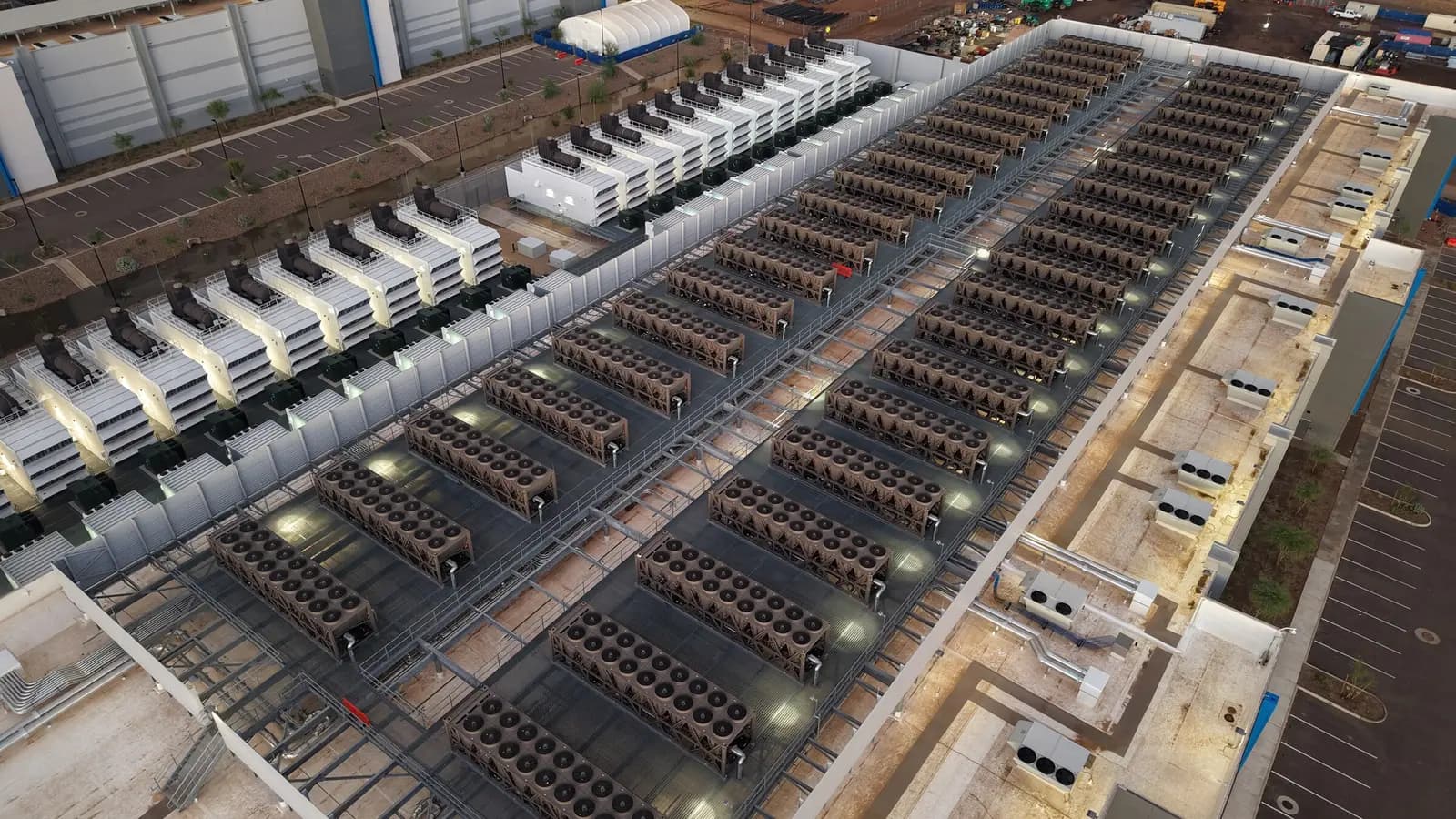
The hero is a real aerial photograph of a data-center roof with cooling and backup-power equipment. It is representative infrastructure and does not depict an Nvidia or OpenAI facility. Photo: Rsparks3 / Wikimedia Commons; CC0 public-domain dedication.
Editorial Credit
This intelligence brief was prepared by the SIAIntel Editorial Desk.
Some contributors work in sensitive public-sector, regulatory, market, or editorial roles. Their identities may be withheld when professional duties, source protection, or safety require confidentiality.
Editorial and publishing accountability: Sefa Karahan, Founder & Publisher
Related Intelligence
Related intelligence in this category · 6 briefs
Korea’s $950B AI Framework Reveals the Power Wall
Korea’s reported $950B AI framework links Nvidia, SK Hynix, Samsung, HBM4, sovereign AI factories and infrastructure finance to the power bottleneck.
Meta’s $12.3B Bond Exposes Wall Street’s AI Debt Machine
Meta’s $12.3B data-center bond shows how Wall Street is turning Big Tech lease promises into investment-grade AI debt—and pricing a new risk premium.

3 GW Vanished: Data Centers Shock America’s Largest Grid
More than 3 GW of data-center load vanished from PJM. See the hidden AI grid risk, investor impact, Virginia tax cost and next regulatory catalysts.

AI’s Closed Capital Circuit Just Hit the Power Grid
AMD’s Anthropic investment, Amazon’s milestone-linked financing and OpenAI’s 25-year Georgia power deal expose the closed capital circuit behind AI infrastructure.
Wall Street May Be Underpricing the New AI Grid Rule
A five-stock event study and SEC-filed contracts show no durable equity discount after FERC—while power terms already reach project finance.
The AI War Enters the Age of Power and Collateral
China is institutionalising AI access while the United States turns large-scale electricity access into a test of grid readiness, operating flexibility and financial collateral.