AMD’s Anthropic investment, Amazon’s milestone-linked financing and OpenAI’s 25-year Georgia power deal expose the closed capital circuit behind AI infrastructure.
Executive Briefing
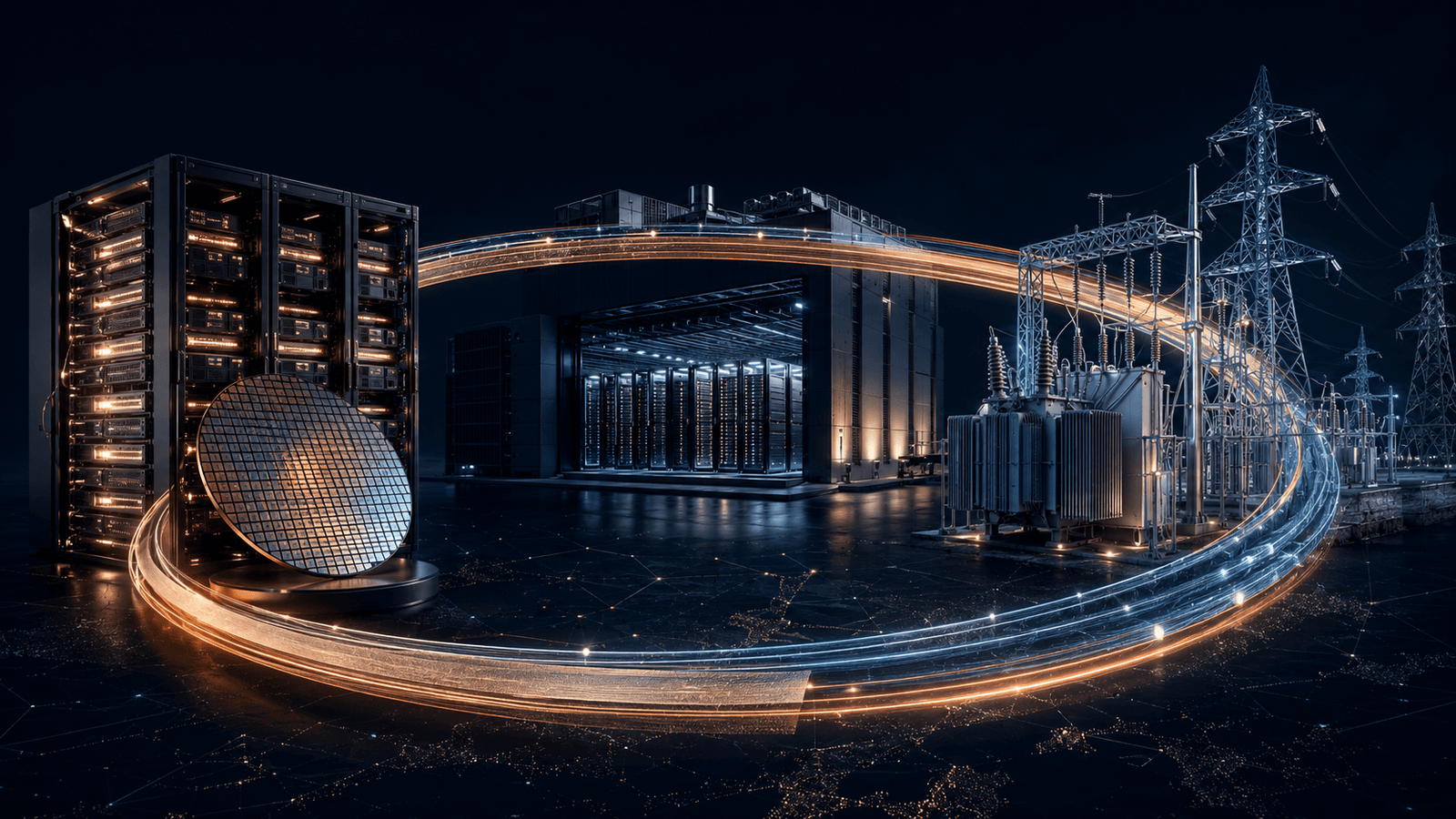
AI infrastructure has crossed from a sequence of large purchases into a connected capital-and-power circuit. On July 22, AMD paired a future strategic investment of up to $5 billion with an Anthropic deployment of up to 2 gigawatts of Helios rack-scale systems. The same day, OpenAI disclosed a 25-year agreement for 3.2 gigawatts of Georgia Power service at Project Camellia, including up to 1 gigawatt of flexible demand response.
The two agreements are not the same transaction and their gigawatt figures must not be added. The AMD announcement is a supplier investment, compute deployment and engineering partnership. The OpenAI announcement is a regulated utility contract with cost-allocation and curtailment protections. Their common signal is deeper: AI growth is being made financeable by coupling equity, compute, physical infrastructure and long-duration power rights.
- Primary signal: supplier capital and customer capacity commitments are increasingly written into the same relationship.
- Capital channel: equity, convertible facilities, private credit, equipment finance and utility contracts now sit in one infrastructure stack.
- Risk trigger: a missed deployment milestone, weak utilization, widening financing spreads or stranded grid investment can transmit stress across several counterparties at once.
- What matters next: delivered and energized capacity—not announced gigawatts—will determine whether the circuit creates cash flow or only reinforces expectations.
Two Deals, Two Different Mechanisms
AMD–Anthropic: capital returns through the compute stack
Anthropic plans to deploy up to 2 gigawatts of AMD Instinct MI450-series GPUs in Helios rack-scale systems, with the first gigawatt beginning in the first half of 2027. The stack is broader than GPUs: AMD names MI455X accelerators, EPYC “Venice” CPUs, Pensando networking and ROCm software. AMD and Anthropic will also use Claude to optimize workloads and accelerate ROCm development, while AMD adopts Claude across engineering and product teams.
That produces three reciprocal flows. AMD supplies the infrastructure. Anthropic becomes a large compute customer. Anthropic also supplies software to AMD, while AMD commits future equity capital to Anthropic. Reuters reports that the server value runs into the tens of billions of dollars, that some systems will be bought directly while other capacity will be leased through cloud or neocloud providers, and that AMD’s investment is tied to deployment milestones.
The qualification is essential. AMD calls its investment a future commitment “up to” $5 billion. The public company release does not disclose a closing date, valuation, cash schedule or minimum purchase obligation. This is a major commercial signal, not proof that all capital and capacity are already committed, installed or revenue-producing.
OpenAI–Georgia Power: power becomes a financeable operating contract
Project Camellia is a different mechanism. OpenAI says 3.2 gigawatts will be delivered in phases between 2028 and 2032. Georgia Power says the agreement runs for 25 years and gives the utility the ability to reduce delivery during defined periods of system stress. OpenAI will pay the full infrastructure and electric-service costs required to serve the site and provide financial assurances designed to protect existing customers.
The maximum 1,000-megawatt flexible-demand commitment equals 31.25% of the stated 3,200-megawatt requirement. It is one of the largest single-facility demand-response commitments disclosed in the United States. But it is not a permanent reduction to a 2.2-gigawatt site. It is an event-based operating option that turns a data center from an inflexible load into a conditional grid resource.
The Circuit Was Already in Place
Amazon disclosed the clearest milestone-linked financing loop
The strongest evidence is not in a press release. It is in Amazon’s Q1 2026 Form 10-Q. Amazon disclosed a $5 billion investment in Anthropic nonvoting preferred stock and an amended commercial arrangement centered on AWS services and AWS chips. It also created a financing facility of up to $20 billion.
The facility began with nothing available to draw. Capacity becomes available only as Amazon reaches compute-delivery milestones under the commercial arrangement. Anthropic can then draw through new convertible notes or, after a defined liquidity event, through common stock issued to Amazon for cash. Amazon also holds an option to invest up to another $5 billion in future Anthropic equity financings; exercising that option reduces the amount available under the facility.
Anthropic disclosed the reciprocal commercial obligation in its April 20 Amazon announcement: more than $100 billion of spending on AWS technologies over ten years in exchange for up to 5 gigawatts of new capacity, with nearly 1 gigawatt of Trainium2 and Trainium3 capacity expected online by the end of 2026. The announcement also described Amazon’s $5 billion investment that day and up to $20 billion of additional future investment. These are long-duration, “up to” commitments—not proof that all cash has been drawn or all capacity delivered—but they expose both sides of the exchange.
This is the closed circuit in documentary form: the supplier delivers compute, delivery unlocks customer financing, and the customer can use the financing while remaining inside the supplier’s commercial ecosystem. It is not automatically abusive. It is, however, more interconnected than an ordinary vendor sale.
Valuation gains feed back into the supplier’s reported earnings
The circuit also touches accounting. Amazon’s Q1 earnings release says net income included $16.8 billion of pre-tax gains from its Anthropic investments. The 10-Q separately describes a $12.3 billion upward adjustment to Anthropic preferred stock during the quarter.
Those gains are not AWS revenue, customer cash receipts or evidence that the underlying compute contracts are profitable. They are non-operating valuation effects. Yet they show why the circuit matters to public-market analysis: a private AI lab’s valuation can move a hyperscaler’s reported earnings while the same hyperscaler invests in the lab and sells it infrastructure.
Microsoft, NVIDIA, Google and Broadcom show this is a pattern
In November 2025, Microsoft’s official announcement said NVIDIA would invest up to $10 billion and Microsoft up to $5 billion in Anthropic. Anthropic, in turn, committed to purchase $30 billion of Azure compute and contract additional capacity of up to 1 gigawatt using NVIDIA Grace Blackwell and Vera Rubin systems. The release states the 1-gigawatt figure twice but never says the two references are additive. Because the NVIDIA systems run within the Azure arrangement, SIAIntel treats this as one up-to-1-gigawatt commitment—not 2 gigawatts.
In April 2026, Broadcom filed a Form 8-K stating that Anthropic would access approximately 3.5 gigawatts of next-generation TPU capacity through Broadcom beginning in 2027. The filing contains a crucial condition: consumption depends on Anthropic’s continued commercial success. Operational and financial partners were still under discussion on April 6; the June 9 platform launch later identified Apollo and Blackstone as initial anchor investors for the first financing tranche.
Anthropic’s own compute strategy identifies AWS Trainium, Google TPUs and NVIDIA GPUs as a diversified hardware base and calls Amazon its primary cloud provider and training partner. AMD now adds another full-stack architecture. This is not four identical financing deals. It is a portfolio of equity, cloud, chip, lease and engineering relationships that converge on the same requirement: enough capacity to keep Claude at the frontier.
The IPO Pressure Point
Anthropic raised $65 billion at a $965 billion post-money valuation on May 28. On June 1, the company submitted a confidential draft S-1 for a possible initial public offering. The number of shares and price are not set, and an offering still depends on SEC review, market conditions and other factors.
This timing changes how infrastructure deals should be read. Locking multiple compute architectures before a possible IPO can strengthen the claim that future product demand will not be constrained by supply. It can also make the prospectus more complex: investors will need to separate contracted access from delivered capacity, supplier equity from independent financing, and gross commitments from minimum cash obligations.
The near-term question is not whether Anthropic has access to announced gigawatts. It is how much capacity becomes installed, energized, utilized and converted into revenue before investors are asked to price the company in public markets.
Private Credit Extends the Circuit Beyond Big Tech
Bloomberg first reported on May 28 that Apollo and Blackstone were marketing roughly $36 billion of debt to finance Google-designed TPUs that Anthropic would lease, with Broadcom expected to support the largest portions. That was the original report; Reuters subsequently relayed it.
The transaction then moved from reported talks to a publicly confirmed platform launch. On June 9, Broadcom, Apollo and Blackstone formally launched the AI XPV Platform with an initial $35 billion transaction led by Apollo. The companies said the first tranche would support more than 1 gigawatt of Anthropic compute infrastructure at Fluidstack-operated sites beginning in mid-2026, inside a platform designed for more than 20 gigawatts of AI deployments through 2028.
Pricing shows how the backstop changed the market’s view of risk. Before the final launch, Bloomberg reported that a roughly $25 billion Broadcom-supported portion was being discussed around a 5.75% yield, while unsupported debt was being marketed around 8% to 9%. Those were marketing indications, not a complete public term sheet. The June 9 company release confirmed the $35 billion launch but did not disclose final tranche pricing, covenants, draw mechanics or who ultimately retained each layer of risk.
The circuit has therefore already crossed into institutional private credit. The next question is no longer whether the package closes; it is how quickly the capital is drawn, how the leases perform, how much risk is distributed, and whether aging TPUs retain enough value when a payment or utilization assumption fails.
This is the next phase mapped in SIAIntel’s analysis of AI debt moving toward household portfolios: the more infrastructure is leased, financed through special structures or distributed through private markets, the less useful a simple corporate-debt screen becomes.
SIAIntel Model: The AI Capital–Grid Circuit
SIAIntel tracks the circuit through five contractual gates. The framework does not label every reciprocal deal a bubble. It asks whether capital can be traced from financing to physical capacity, and whether the risk absorber is visible when the capacity is late, underused or stranded.
| Gate | Question | Visible evidence | Failure signal |
|---|---|---|---|
| 1. Capital | Who supplies equity or credit? | AMD future equity; Amazon preferred stock and facility; Microsoft and NVIDIA commitments | Commitment delayed, repriced or never funded |
| 2. Compute | What capacity is purchased, leased or accessed? | AMD Helios, Azure/NVIDIA, AWS chips, Google/Broadcom TPU capacity | Announced gigawatts fail to become delivered systems |
| 3. Physical infrastructure | Where do chips, buildings and electrical equipment sit? | Owned data centers, cloud capacity, neocloud leases and Project Camellia | Permitting, equipment or construction delay |
| 4. Grid | Is power contracted, phased and operable under stress? | 3.2 GW phased from 2028 to 2032; up to 1 GW flexible demand | Interconnection delay, curtailment conflict or generation shortfall |
| 5. Risk absorber | Who pays when demand or delivery misses? | Supplier backstops, customer assurances, minimum bills, utility and regulatory protections | Opaque obligations, weak collateral or cost transfer to outsiders |
The AMD–Anthropic agreement is strongest at Gates 1 and 2. Amazon–Anthropic makes the financing link between those gates explicit. Project Camellia is strongest at Gates 3 through 5. Taken together, the deals show how the AI stack is trying to close the distance between a valuation promise and a powered, billable unit of compute.
Why Project Camellia Changes Utility Finance
A 25-year load contract can underwrite generation and grid assets
Georgia Power’s utility disclosure says OpenAI will meet long-term contract requirements and provide financial assurances. A contract spanning 25 years can support investment in generation, transmission and distribution that would be difficult to justify against short-term or speculative load.
The trade-off is duration risk. AI hardware can become obsolete much faster than a power plant or transmission asset. If a model company’s demand falls, the grid investment does not disappear. The contract, minimum-payment structure and credit support therefore matter as much as the headline megawatts.
Georgia’s regulator is explicitly targeting stranded-asset risk
The Georgia Public Service Commission’s January 2025 large-load rule allows special terms for customers above 100 megawatts, including recovery of site-specific and upstream generation, transmission and distribution costs, longer contracts and minimum bills. The purpose is explicit: prevent a large customer from leaving before paying for infrastructure built to serve it.
A later PSC final order adopted a stipulated generation portfolio and required revenue and construction protections for 2029, 2030 and 2031. The Commission’s 2025 annual report records the approved portfolio as 9,885 megawatts and explains that Georgia Power would backstop expected large-load revenue to reduce stranded-asset risk.
Source-control note: a March 2026 PSC fact sheet prints 9,985 megawatts, 100 megawatts above both the docket-linked December release and the later annual report. SIAIntel uses 9,885 megawatts because it is repeated in the filing chronology and annual report; it does not silently average the conflicting figures.
This does not make every risk disappear. It identifies who is supposed to carry it. For investors, utilities and policy makers, that is the difference between a growth forecast and a bankable large-load regime.
Macro-Financial Risk: Interconnection, Not Circularity Alone
The International Monetary Fund’s April 2026 Global Financial Stability Report, especially Figures 1.17 and 1.18, describes an AI structure in which developers, chipmakers and large technology companies simultaneously act as customers, investors and financiers. The IMF’s concern is not a label. It is the opacity and potential nonlinear transmission created when a shock at one firm moves through correlated suppliers, investors and operators.
The report also supplies the necessary balance. Core AI firms did not then show the same balance-sheet vulnerabilities as weaker operators, and near-term systemic risk remained contained. The warning is forward-looking: expected capital expenditure, debt issuance, rapid hardware obsolescence and higher return correlations can make future shocks more difficult to isolate.
Boxes 1.3 and 1.4 of the full GFSR text connect that financial circuit to physical assets. The IMF highlights tenant concentration, speculative development timing, grid delays, power constraints and rapid hardware obsolescence. In its stylized scenario, shortening assumed useful life from seven years to three cuts aggregate EBIT margins by more than 9 percentage points; under high obsolescence and capital intensity, new-investment depreciation can erase the aggregate EBIT margin. That is a scenario—not a forecast for these companies—but it shows why a supplier backstop and a 25-year power contract solve different risks.
That is why the Georgia agreement belongs beside the AMD agreement. A chip commitment can be large and still fail to create usable compute if the building, transformer, interconnection or risk allocation arrives late. SIAIntel’s earlier AI Credit–Grid Squeeze mapped that transmission from megawatts into utility capex and bond risk. July 22 adds contractual evidence on both ends of the chain.
Quantitative Evidence Board
Non-additivity rule: This table does not produce a “total AI gigawatt” figure. The rows describe different companies, architectures, delivery periods and legal commitments. Access, deployment and utility service are not interchangeable units of completed capacity.
| Relationship | Capital signal | Capacity signal | Condition or protection | Status |
|---|---|---|---|---|
| AMD–Anthropic | Future equity investment up to $5B | Up to 2 GW; first 1 GW begins H1 2027 | Investment tied to deployment milestones, per Reuters | Announced; forward-looking |
| Amazon–Anthropic | $5B invested; facility up to $20B | >$100B AWS commitment over 10 years; up to 5 GW | Facility unlocks as compute is delivered | Company- and SEC-disclosed |
| Microsoft/NVIDIA–Anthropic | Investments up to $15B combined | $30B Azure purchase; up to 1 GW | Repeated 1 GW references treated as one non-additive block | Company-announced |
| Google/Broadcom–Anthropic | No direct equity investment disclosed | Approximately 3.5 GW beginning 2027 | Consumption depends on Anthropic’s commercial success | SEC-disclosed; conditional |
| Broadcom/Apollo/Blackstone platform | $35B initial transaction | >1 GW at Fluidstack sites from mid-2026 | Full tranche pricing, draws and risk retention not public | Formally launched June 9 |
| OpenAI–Georgia Power | Full project-specific infrastructure and service costs | 3.2 GW phased 2028–2032 | 25 years; financial assurances; up to 1 GW flexible demand | Utility and sponsor announced |
Strategic Impact Matrix
| Audience or market | Transmission channel | Opportunity | Principal risk | Horizon |
|---|---|---|---|---|
| AI model companies | Supplier capital plus multi-architecture compute access | Reduce capacity bottlenecks and vendor concentration | Overcommitment, underutilization and contract complexity | 6–36 months |
| Chip and cloud suppliers | Equity exposure converts customer growth into potential asset gains | Anchor long-duration demand and co-design workloads | Vendor-financing losses and correlated valuation risk | Now–36 months |
| Utilities and grid investors | Long contracts and minimum payments underwrite infrastructure | Finance generation and network upgrades | Stranded assets if AI load fails to arrive or persist | 2–25 years |
| Private credit | Leases, chip finance and structured data-center debt | Long-dated contracted yield | Opaque leverage, technology obsolescence and tenant concentration | 1–7 years |
| Households and businesses | Utility rate cases and indirect retirement-fund exposure | Rate benefits if large loads pay above cost and improve utilization | Cost shifting if contractual protections fail | 2–10 years |
| Developing markets | Competition for bankable power, chips and project finance | Integrated power-and-compute industrial zones | Foreign-currency debt, imported equipment and weaker grids | 2–8 years |
Audience Impact
- General readers: the AI boom is no longer only a software or semiconductor story. It is becoming a long-duration infrastructure and electricity contract story.
- Investors: announced gigawatts should be discounted until delivery, energization, utilization and customer cash obligations are visible.
- Companies: compute procurement must now be evaluated together with power contracts, curtailment rights, supplier concentration and financing covenants.
- Credit markets: supplier commitments, leases and private debt can move risk away from visible corporate bonds without eliminating it.
- Policy makers: minimum bills, financial assurances, contract review and demand response are becoming the operating language of AI industrial policy.
- Developed markets: the advantage shifts toward grids that can allocate cost and curtailment risk before construction begins.
- Developing markets: cheap electricity alone is insufficient; projects need reliable delivery, hard-currency finance, grid equipment and enforceable long-term contracts.
Capital, Risk and Strategic Priority Lens
Capital channel: Follow equity commitments, convertible facilities, supplier backstops, cloud purchase obligations, equipment leases, utility minimum bills and private-credit syndication as one stack. The public equity headline is only the top layer.
Risk trigger: The first material warning would be a gap between announced and delivered capacity: delayed first-gigawatt deployment, widening private-credit spreads, a facility that never becomes drawable, or a utility filing that shifts stranded costs toward customers.
Strategic priority: Rank evidence in this order: energized megawatts, contractual minimum payments, utilization, operating cash flow, then valuation.
SIAIntel Key Metric: Valuation can finance expansion; only cash flow and energized megawatts can sustain a data center.
Internal intelligence bridge: The Power-Collateral framework showed how grid access becomes financeable collateral. Today’s contracts reveal the reciprocal capital relationships forming around that collateral.
Analyst Intelligence Box
| Primary Signal | Supplier investment and customer capacity are being contracted together. |
|---|---|
| Capital Channel | Equity → compute commitments → leases/private credit → long-term power contracts. |
| Risk Trigger | A widening gap between announced, delivered, energized and utilized capacity. |
| Watch Indicator | Facility draws, delivery milestones, public S-1 disclosures, utility filings and demand-response performance. |
| 90-Day Implication | Markets should begin separating AI demand backed by enforceable capacity and power from demand backed mainly by strategic announcements. |
30 / 60 / 90-Day Watchlist
Next 30 days
- Watch for AMD securities filings that disclose investment structure, timing or material commercial obligations.
- Track Georgia PSC documents for Project Camellia contract-review evidence, financial assurances and curtailment terms.
- Track draw timing, lease onboarding, secondary distribution and covenant disclosure for the launched $35 billion AI XPV transaction.
Next 60 days
- Look for supplier capex or backlog disclosures that translate announced gigawatts into production and delivery schedules.
- Watch for Anthropic disclosures that separate owned infrastructure, cloud purchases and leased neocloud capacity.
- Track rating-agency treatment of AI leases, guarantees and off-balance-sheet obligations.
Next 90 days
- Compare facility draws and debt issuance with actual compute-delivery milestones.
- Review any public IPO filing for customer concentration, infrastructure commitments, related-party exposure and cash requirements.
- Test whether utilities outside Georgia adopt similar minimum bills, exit protections and demand-response obligations.
What Would Break This Thesis?
First, reciprocal contracts may prove to be ordinary industrial alliances. Acadian Asset Management argues that circularity alone does not establish overvaluation. Suppliers and customers have formed cross-holdings and long-term alliances for more than a century. The stronger warning signals are external cash extraction, hidden leverage, distorted fundamentals and risk that is not priced by the ultimate holder.
Second, the contracts may work as designed. If Anthropic converts capacity into durable revenue, if Amazon and AMD deliver on time, and if OpenAI’s minimum payments and flexible load reduce system costs, the circuit will have funded productive infrastructure rather than financial excess.
Third, the strongest firms may absorb the risk. The IMF finds current balance-sheet vulnerabilities more contained at core hyperscalers and chip companies than among smaller operators. A high degree of interconnection does not guarantee a systemic event.
Fourth, public disclosure may improve. Anthropic’s possible IPO could expose commitments, related-party economics and liquidity needs to a level of scrutiny unavailable in private markets. Transparent terms would reduce the opacity premium in this thesis.
Fifth, off-balance-sheet risk may be overstated or already adjusted for. A recent Federal Reserve staff paper studies operating leases and intra-period borrowing across nonfinancial companies from 1980 to 2025; it is not an AI-sector empirical study. Its introduction cites reporting of more than $120 billion in off-balance-sheet debt tied to AI data-center construction, including the underlying Financial Times investigation. The $120 billion is therefore cited motivation, not a number estimated by the Fed paper. The paper also does not represent the Board’s views or prove that today’s agreements conceal liabilities.
Decision Monitor
| Exposure | Monitor | Constructive confirmation | Adverse confirmation |
|---|---|---|---|
| AMD | Helios delivery, Instinct revenue and investment terms | First-gigawatt schedule holds and cash demand broadens | Deployment slips or investment substitutes for weak third-party demand |
| Anthropic | Cash use, utilization, supplier concentration and IPO disclosures | Capacity converts into recurring enterprise revenue | Commitments grow faster than revenue and liquidity |
| Amazon and other hyperscalers | Investment marks, facility draws and cloud performance obligations | Compute delivery produces cash and diversified customers | Private valuation gains reverse or customer risk concentrates |
| Southern / Georgia Power | Contract filings, generation procurement and curtailment | Large-load revenue covers incremental system cost | Delay or demand shortfall creates stranded assets |
| Private credit | Debt structure, collateral, sell-down and covenants | Risk is transparent and matched to contracted cash flows | Leverage migrates into opaque or liquidity-mismatched vehicles |
This table is a monitoring framework, not a recommendation to buy, sell or hold any security.
Source Coverage Summary
| Evidence layer | Coverage | What it proves | What it does not prove |
|---|---|---|---|
| Corporate and utility primary sources | AMD, Microsoft, Anthropic, OpenAI, Georgia Power, Broadcom/Apollo/Blackstone | Announced capacity, investments, engineering scope, private-credit launch and power commitments | Undisclosed pricing, final cash schedules or completed delivery |
| Securities filings | Amazon 10-Q and earnings exhibit; Broadcom 8-K | Milestone-linked financing, valuation effects and conditional capacity | Anthropic’s complete private liabilities or future IPO terms |
| Regulatory sources | Georgia PSC rule, final order and annual report | Cost allocation, minimum bills, review and stranded-asset backstops | The confidential economics of Project Camellia |
| Macro and credit context | IMF GFSR and Federal Reserve staff research | Interconnection, obsolescence, private-credit and disclosure channels | A company-specific default forecast |
| Neutral reporting and counter-thesis | Reuters, Bloomberg, Financial Times and Acadian Asset Management | Reported commercial detail, tranche pricing, hidden-debt provenance and analytical balance | Complete confidential contracts or company-specific default forecasts |
The evidence stack contains 23 sources, 18 of them primary, regulatory, institutional or primary research. Source limitations remain visible because the central investment and power agreements are forward-looking and their full contracts are not public.
SIAIntel Bottom Line
The AI boom is not merely consuming capital and electricity. It is building contracts that make each one conditional on the other. AMD’s investment can deepen Anthropic’s compute demand; delivered compute can unlock financing; supplier stakes can gain value as the lab’s valuation rises; private credit can fund the physical assets; and a 25-year utility agreement can turn projected model demand into generation and grid investment.
The circuit becomes productive when announced capacity is delivered, energized, utilized and paid for by independent end demand. It becomes fragile when valuation substitutes for cash flow, financing obscures who bears loss, or grid assets outlive the customer economics that justified them. July 22 did not prove either outcome. It made the transmission mechanism visible.
Source Map
6 highlighted sources
Editorial Credit
This intelligence brief was prepared by the SIAIntel Editorial Desk.
Some contributors work in sensitive public-sector, regulatory, market, or editorial roles. Their identities may be withheld when professional duties, source protection, or safety require confidentiality.
Editorial and publishing accountability: Sefa Karahan, Founder & Publisher
Related Intelligence
Related intelligence in this category · 4 briefs
Nvidia–OpenAI $250B Talks Expose AI’s Hidden Credit Circuit
Nvidia’s reported $250B OpenAI guarantee talks, project bonds and BIS warnings confirm SIAIntel’s early map of AI’s hidden credit circuit.
AI’s Dollar-Watt Squeeze: Fed Meets PJM’s 6.8 GW Gap
A 9–3 Fed split and PJM’s 6.8 GW reliability gap show why AI infrastructure is being repriced through both capital and firm power.
Bitcoin Miners Are Selling Their Power to AI—Google and NVIDIA Are Financing the Shift
More than $70 billion in AI/HPC contracts is turning bitcoin miners into energy-backed data-centre companies financed by Big Tech.

3 GW Vanished: Data Centers Shock America’s Largest Grid
More than 3 GW of data-center load vanished from PJM. See the hidden AI grid risk, investor impact, Virginia tax cost and next regulatory catalysts.