More than $70 billion in AI/HPC contracts is turning bitcoin miners into energy-backed data-centre companies financed by Big Tech.
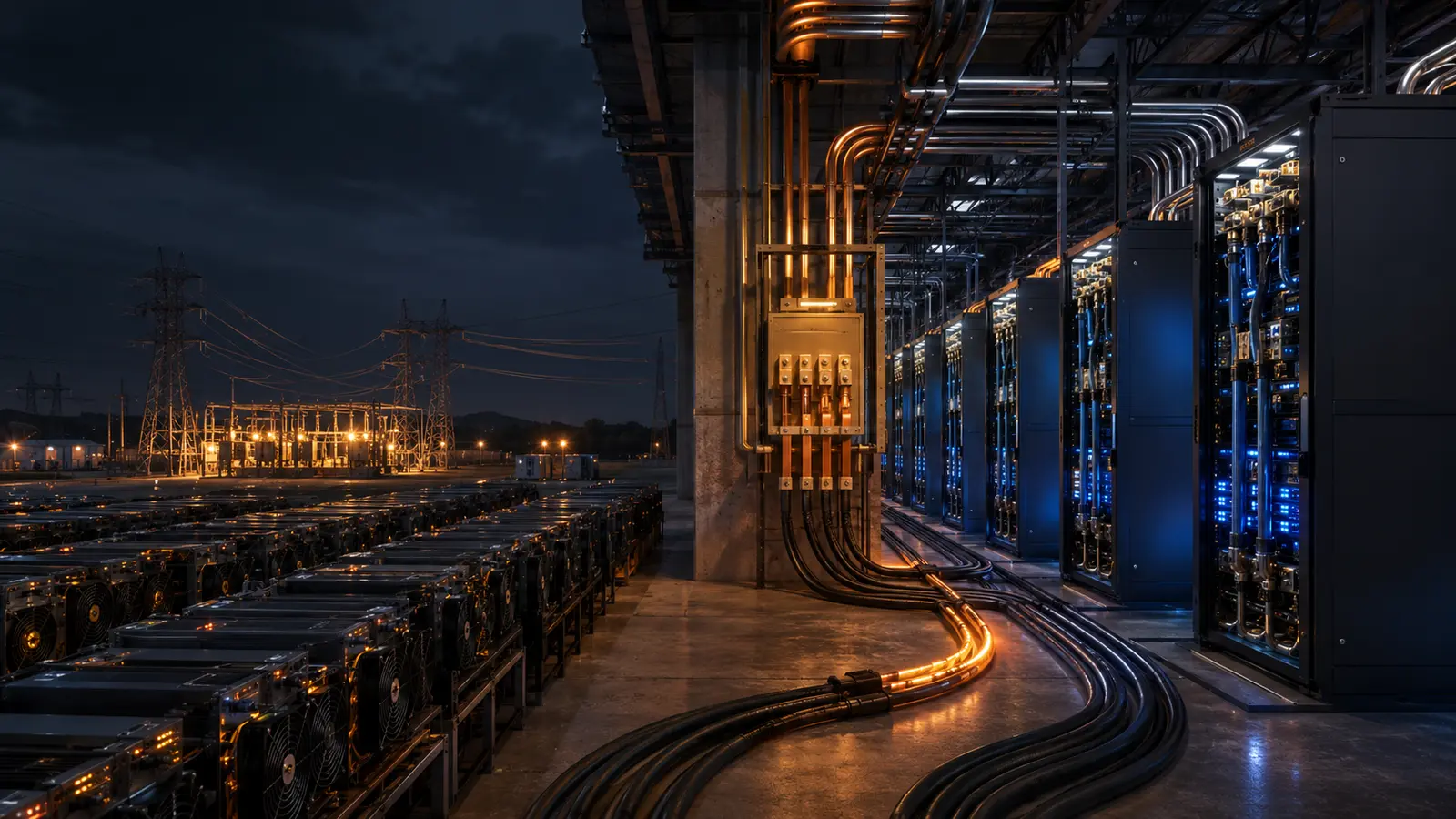
Bitcoin miners were once valued through a familiar set of variables: bitcoin’s price, network difficulty, fleet efficiency and the cost of electricity. That model is breaking.
Across the listed mining sector, companies that accumulated substations, transmission access and large blocks of power during the crypto boom are converting those assets into artificial-intelligence infrastructure. The change is not simply a diversification of revenue. It is turning former miners into a new class of energy-linked financing vehicle—one that allows technology companies to secure future computing capacity without owning every site outright.
CoinShares estimates that public miners have announced more than $70 billion of cumulative AI and high-performance-computing contracts. It describes TeraWulf, Core Scientific, Cipher Mining and Hut 8 as data-centre operators that happen to mine bitcoin. Companies with secured HPC contracts were valued at about 12.3 times next-twelve-month sales in its March market update, compared with 5.9 times for pure-play miners.
The market is no longer assigning the largest premium to hash rate. It is assigning it to contracted megawatts, connection certainty and counterparty credit.
The hidden asset is not the mining machine
Mining equipment can be bought, moved and replaced. A large, energised site with transmission access, land, cooling potential and a path to hundreds of megawatts cannot be reproduced nearly as quickly.
That distinction explains why former miners are suddenly strategically useful to AI companies. They possess something that GPU buyers increasingly lack: sites that have already passed at least part of the physical and regulatory journey from an electricity request to an operating load.
The conversion is not automatic. Bitcoin facilities often lack the fibre, redundancy, cooling density and service standards required for AI workloads. Retrofitting can cost millions of dollars per critical megawatt. But a miner with credible power access begins that race several years ahead of a greenfield developer.
The emerging business is therefore less like cryptocurrency mining and more like energy-rights transformation:
- Secure land, a substation and grid-connected power.
- Convert low-redundancy mining capacity into higher-specification HPC space.
- Anchor the project with a long-term AI customer.
- Use that contract—and sometimes the customer’s credit—to raise construction debt.
- Give the strategic customer equity upside in exchange for lowering financing risk.
TeraWulf and IREN show how far this structure has evolved.
Google turned a lease into financeable infrastructure
TeraWulf’s agreements with Fluidstack cover more than 200 MW of critical IT load and approximately $3.7 billion of contracted revenue over the initial ten-year terms. Extension options could raise the total to about $8.7 billion.
Those figures cover the initial Fluidstack agreements at Lake Mariner, not TeraWulf’s entire HPC platform. In its full-year 2025 results, the company said it had signed more than $12.8 billion of long-term, credit-enhanced customer contracts during 2025.
The portfolio changed again shortly before this article was published. On July 6, 2026, TeraWulf announced a separate 20-year Anthropic lease at its Justified Data campus, expected to generate approximately $19 billion over the initial term and support about 401 MW of critical IT load. At the same time, it agreed to sell its 50.1% interest in the Abernathy joint venture to a Fluidstack-led investor group. The new transaction strengthens the power-scarcity thesis while changing TeraWulf’s exposure: capital is being redirected toward campuses where it expects direct ownership, customer relationships and operational control.
The decisive feature is behind the tenant.
Google agreed to backstop $1.8 billion of Fluidstack obligations. In return, TeraWulf issued Google warrants covering 73.58 million shares at an exercise price of $0.01 per share. TeraWulf initially described the package as representing roughly an 8% equity stake.
The company’s 2026 Form 10-K provides the accounting and financing detail. It valued the warrants at $515.5 million when issued and recorded that value as a deferred charge to be amortised over the leases. The warrants were also pledged for the benefit of construction lenders until the relevant Google backstop became effective.
This is not conventional cloud procurement. Google’s credit support improves the bankability of a third party’s lease; that lease supports debt used to build TeraWulf’s infrastructure; and Google receives equity-linked upside for helping make the financing possible.
The result is a circular but economically intelligible structure:
AI demand → customer credit support → cheaper or more available project debt → new powered capacity → additional AI supply → equity upside for the strategic customer.
The risk is that the same loop can transmit disappointment in reverse if delivery slips, construction costs rise or AI demand fails to support the contracted economics.
NVIDIA is both customer and potential shareholder
IREN provides a second, more direct version of the model.
Under its five-year agreement with NVIDIA, IREN is due to provide dedicated GPU cloud services from its Childress, Texas campus. The stated contract value is approximately $3.4 billion.
At the same time, NVIDIA received a five-year right to purchase as many as 30 million IREN shares at $70 each. Full exercise would represent an investment of as much as $2.1 billion, subject to conditions and regulatory limitations.
The distinction matters: NVIDIA has not already invested the entire $2.1 billion. It holds a conditional equity right. Nevertheless, the arrangement links NVIDIA’s demand for cloud capacity to the value of the infrastructure provider delivering it.
IREN’s March 2026 quarterly filing says the services will be delivered in three tranches targeted for 2027. Execution therefore depends on construction, GPU deployment, financing and operational milestones that have not yet been completed.
This is the central tension. A multibillion-dollar contract may validate demand, but it is not the same as delivered capacity or collected cash.
Core Scientific shows the revenue migration
Core Scientific’s transition demonstrates how rapidly the income statement can change after capacity becomes billable.
In the first quarter of 2026, the company reported $77.5 million of colocation revenue against $115.2 million of total revenue, compared with only $8.6 million of colocation revenue a year earlier. Colocation therefore represented roughly two-thirds of quarterly revenue.
That should not be carelessly labelled pure “AI revenue”: colocation is the company’s accounting category, and the precise workload mix matters. But the direction of travel is unambiguous. Contracted data-centre capacity is overtaking mining as the economic centre of the business.
Core Scientific also illustrates concentration risk. Large commitments can create a premium valuation while leaving the infrastructure provider dependent on a narrow set of customers, delivery dates and financing assumptions.
The valuation split conceals a balance-sheet split
The premium awarded to HPC-linked miners is not free.
CoinShares reports that IREN carried approximately $3.7 billion of convertible notes, TeraWulf about $5.7 billion of total debt and Cipher Mining $1.7 billion of senior secured notes at the time of its Q1 analysis. The sector’s risk is migrating from bitcoin-price volatility toward a hybrid of:
- construction and commissioning risk;
- customer concentration;
- secured and convertible debt;
- GPU obsolescence;
- grid-delivery and curtailment risk;
- contract-performance conditions;
- dilution from warrants and equity issuance.
That migration changes how these companies should be compared. A miner with a signed AI contract is not automatically a high-quality data-centre operator. Investors must distinguish headline contract value from contracted annual revenue, backlog from cash flow, gross megawatts from billable critical IT load, and a customer name from enforceable credit support.
Bitcoin’s stress is accelerating the search for another buyer of power
The pivot is occurring while mining economics are deteriorating.
JPMorgan analysts were reported in June as estimating bitcoin’s all-in production cost at roughly $78,000 and noting that the asset had traded below that level for five consecutive months. Citing CoinShares, the analysis estimated that approximately 20% of miners were unprofitable. These are model estimates—not a universal cost applicable to every mine—but they capture the pressure on higher-cost operators.
The network registered a 10.09% downward difficulty adjustment in June, from 138.96 trillion to 124.93 trillion. The decline indicates that block production in the preceding adjustment period had slowed as effective hash power fell.
It would be premature to claim that AI conversion caused this decline. Bitcoin price weakness, weather, electricity prices, machine efficiency and ordinary fleet shutdowns can all move hash rate. Difficulty adjustment also performs its intended function by restoring the target block interval after hash power changes.
But the strategic incentive is now visible: when the expected return on a megawatt of AI hosting exceeds the expected return on mining, capital will try to reassign that megawatt. The speed of reassignment depends on technical conversion costs and contractual constraints, not simply management preference.
Strategic Impact Matrix
| Actor | Immediate benefit | Embedded risk | Signal to watch |
|---|---|---|---|
| Former bitcoin miners | Higher-value, longer-duration revenue opportunity | Heavy capex, leverage and delivery risk | Billable MW versus announced MW |
| Hyperscalers and chip companies | Faster access to grid-connected capacity | Counterparty and construction dependence | Guarantees, prepayments and equity rights |
| Project lenders | Long leases supported by stronger counterparties | Technology, concentration and residual-value risk | Covenant packages and completion guarantees |
| Utilities and grid operators | Large, identifiable customers | Sudden ramps, curtailment and cost-allocation disputes | New large-load tariffs and performance standards |
| Bitcoin network | Difficulty adjustment absorbs miner exits | Lower hash rate can reduce the cost of attacking the network at the margin | Hash-rate trend, pool concentration and ASIC shutdowns |
| Local communities | Tax base and construction activity | Power-price, land, water and transmission pressures | Ratepayer protections and infrastructure cost allocation |
Investor Interpretation Table
This table is analytical, not a recommendation to buy or sell securities.
| Headline metric | What must be verified |
|---|---|
| Total contract value | Initial term, extensions, termination rights and milestones |
| Secured power portfolio | Energised power versus planned or optioned capacity |
| Contracted MW | Gross site power versus critical IT load and billable MW |
| Named strategic customer | Direct obligor, guarantor, backstop provider or end user |
| Warrant value | Exercise price, dilution, vesting, regulatory and performance conditions |
| AI/HPC revenue | Recognised revenue versus backlog or projected annualised revenue |
| EBITDA outlook | Interest, stock compensation, construction capex and maintenance needs |
30/60/90-Day Watchlist
Next 30 days
- Bitcoin hash rate and difficulty after the June adjustment.
- Miner bitcoin sales and treasury depletion.
- Updates to construction timelines and billable capacity.
- Any revision to AI/HPC revenue guidance.
Next 60 days
- Financing terms secured against AI leases.
- Disclosure of completion guarantees, prepayments or additional warrants.
- Utility and grid-operator proposals for large-load deposits and curtailment.
- Evidence that announced megawatts have become energised critical IT load.
Next 90 days
- Customer concentration in former miners’ recognised revenue.
- Contract amendments caused by delivery delays or equipment availability.
- Further acquisitions of powered sites by hyperscalers, neo-clouds or chip suppliers.
- Whether pure-play miners close the valuation gap or become acquisition targets for their power assets.
Counter-Thesis
The “shadow power bank” thesis can fail in four ways.
First, AI compute could become oversupplied before the converted sites are operational. A long contract reduces—but does not necessarily eliminate—renegotiation, termination and counterparty risks.
Second, mining sites may prove less convertible than headline megawatts imply. HPC requires much higher uptime, network connectivity, cooling and redundancy.
Third, grid regulators may impose deposits, curtailment standards or cost-allocation rules that lower project returns.
Fourth, rising leverage and equity-linked financing may transfer much of the upside from existing shareholders to lenders and strategic counterparties.
The bearish case is therefore not that AI demand disappears. It is that the market prices every mining megawatt as premium AI capacity before the physical and financial conversion has occurred.
Audience Impact
General readers: The AI buildout is being financed through assets originally assembled for cryptocurrency mining. This helps explain why electricity access—not only advanced chips—is becoming a determinant of where AI services can expand and what they may cost.
Investors: Former miners require a new valuation framework. Contract quality, billable power, debt structure and dilution can matter more than headline hash rate.
Companies: Firms seeking AI capacity may gain faster access through converted mining campuses, but they inherit construction, grid and counterparty risks.
Developing economies: Cheap power alone will not guarantee participation in the AI infrastructure boom. Grid reliability, fibre, financing and enforceable contracts determine whether energy can be converted into high-value compute.
Developed economies: The policy question is who pays for transmission, substations and reliability measures when private AI contracts transform local electricity demand.
Crypto participants: Mining economics are becoming entangled with AI credit conditions. Hash supply may grow more sensitive to the relative return available from alternative uses of electricity infrastructure.
SIAIntel Bottom Line
Bitcoin miners are not abandoning energy. They are changing the buyer.
Google’s Fluidstack backstop and TeraWulf warrants, together with NVIDIA’s IREN contract and equity rights, show that scarce powered capacity is being financed through combinations of leases, credit enhancement, project debt and strategic ownership options.
The next dividing line will not be between bitcoin miners and AI data centres. It will be between companies that can convert a claimed megawatt into financed, billable and reliable compute—and those whose power portfolios remain presentation slides.
Evidence Stack
- CoinShares — Bitcoin Mining Report Q1 2026
- CoinShares — Market Update, March 27, 2026
- TeraWulf — Fluidstack hosting agreements
- TeraWulf — 2025 Form 10-K filed in 2026
- TeraWulf — Q1 2026 Form 10-Q
- NVIDIA — strategic partnership with IREN
- IREN — $3.4 billion NVIDIA cloud contract
- IREN — quarter ended March 31, 2026 filing
- Core Scientific — Q1 2026 results
- Core Scientific — CoreWeave expansion
- TeraWulf — full-year 2025 results and $12.8 billion contracted platform
- TeraWulf — July 2026 Anthropic lease and Abernathy transaction
Key Takeaways
- Bitcoin miners were once valued through a familiar set of variables: bitcoin’s price, network difficulty, fleet efficiency and the cost of electricity.
- Across the listed mining sector, companies that accumulated substations, transmission access and large blocks of power during the crypto boom are converting those assets into…
- It is turning former miners into a new class of energy-linked financing vehicle—one that allows technology companies to secure future computing capacity without owning every site outright.
Data Snapshot
Coverage Area
MARKET / MACRO / AI INFRASTRUCTURE
Editorial category
Read Time
~11 min
Approximate duration
Source Base
21 visible source citations
Source Map highlights 6 unique sources
Published
Jul 12, 2026
Updated: Jul 12, 2026
Source Map
6 highlighted sources
Evidence Frame
This layer summarizes visible sources, article context and editorial framing. It is analytical context, not transactional guidance.
Editorial Credit
This intelligence brief was prepared by the SIAIntel Editorial Desk.
Some contributors work in sensitive public-sector, regulatory, market, or editorial roles. Their identities may be withheld when professional duties, source protection, or safety require confidentiality.
Editorial and publishing accountability: Sefa Karahan, Founder & Publisher
Related Intelligence
Related intelligence in this category · 3 briefs
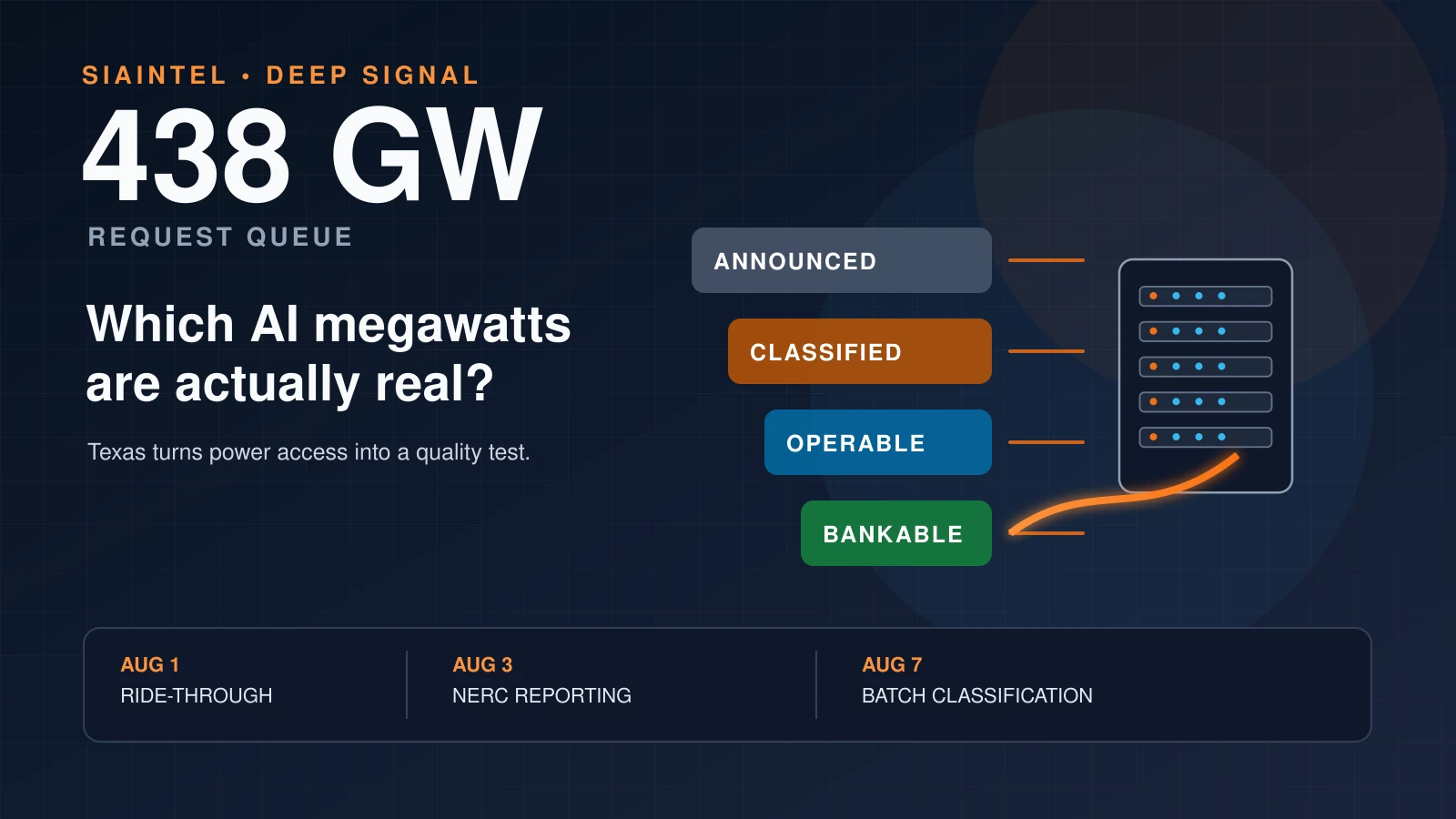
Texas Has 438 GW of Data-Center Requests. How Much Is Real?
Nearly 90% of ERCOT’s 438 GW queue comes from data centers. On August 7, Batch Zero will show which AI projects advance—and which remain speculative.
AI’s Closed Capital Circuit Just Hit the Power Grid
AMD’s Anthropic investment, Amazon’s milestone-linked financing and OpenAI’s 25-year Georgia power deal expose the closed capital circuit behind AI infrastructure.

3 GW Vanished: Data Centers Shock America’s Largest Grid
More than 3 GW of data-center load vanished from PJM. See the hidden AI grid risk, investor impact, Virginia tax cost and next regulatory catalysts.