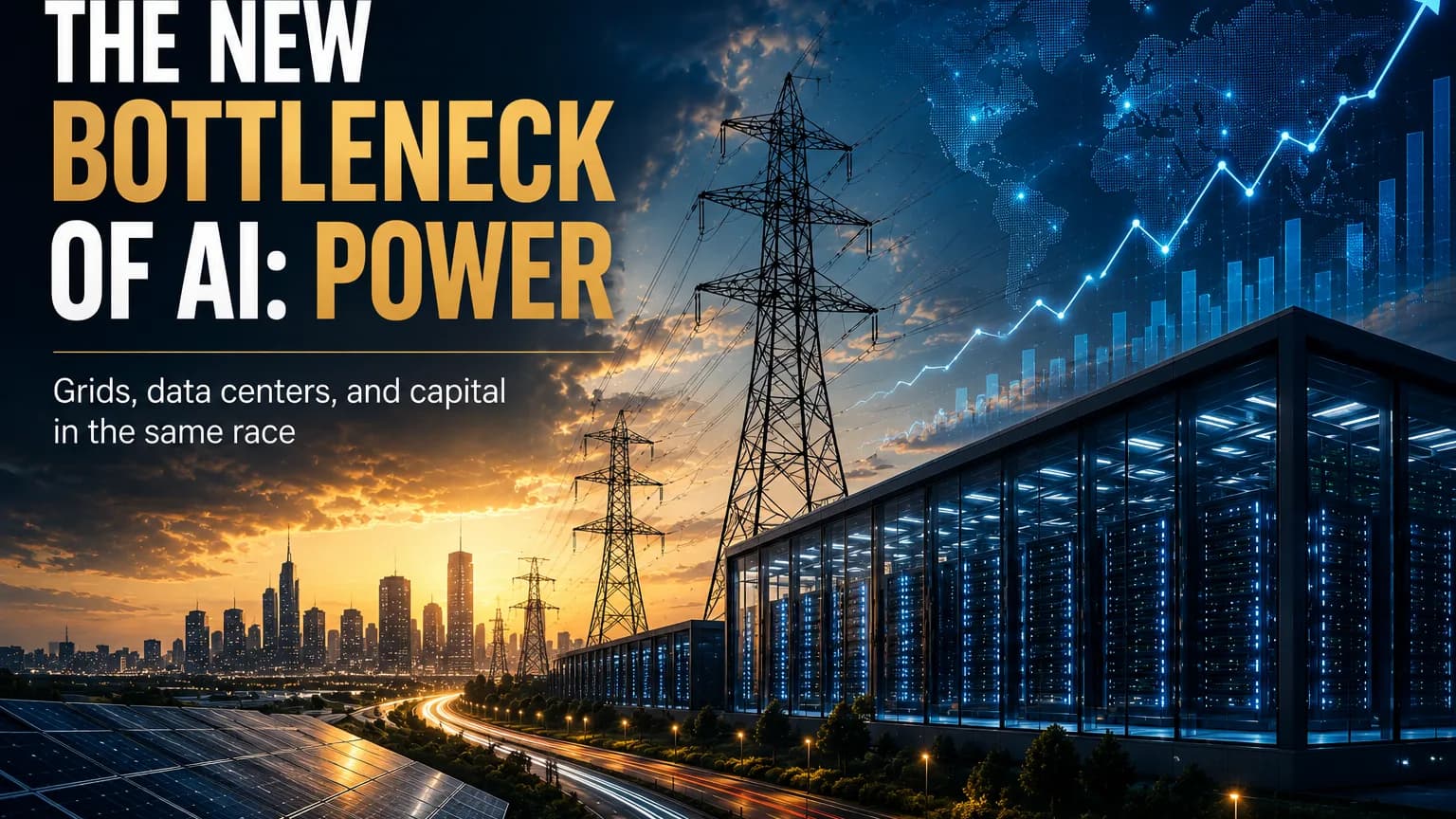
"AI’s next bottleneck is moving beyond chips toward power grids, data-center infrastructure, nuclear energy agreements and capital intensity."
SIAINTEL INTELLIGENCE DOSSIER
Analysis Brief
SIAIntel Verification Panel
Analysis, data context, source mapping and editorial boundaries are presented as one evidence chain.
Key Takeaways
- Executive Briefing Everyone is still reading the AI race through chips.
- But the quieter bottleneck is forming outside the silicon layer: in power grids, data-center land, cooling infrastructure and the balance sheets strong enough to finance the buildout.
- The next phase of artificial intelligence can no longer be explained only by who has the most advanced model or the largest GPU supply.
SIAIntel Perspective
SIAIntel frames this development not as a standalone headline, but as an intelligence brief shaped by source quality, structural implications and observable risk channels.
Data Snapshot
Coverage Area
Editorial category
AI
Read Time
Approximate duration
~8 min
Source Base
Visible evidence profile
6 visible sources
Published
Updated: Jun 09, 2026
Jun 09, 2026
Evidence Frame
This layer summarizes visible sources, article context and editorial framing. It is analytical context, not transactional guidance.
Executive Briefing
Everyone is still reading the AI race through chips. But the quieter bottleneck is forming outside the silicon layer: in power grids, data-center land, cooling infrastructure and the balance sheets strong enough to finance the buildout.
The next phase of artificial intelligence can no longer be explained only by who has the most advanced model or the largest GPU supply. The question is changing: who can secure electricity, reliable grid access, clean-energy contracts and multibillion-dollar capital capacity at the same time?
That is why AI competition is turning from a technology race into a test of energy security, industrial policy and macroeconomic resilience. The nuclear and long-term power deals pursued by Microsoft, Google and Amazon are not side stories; they are early signals that in the AI era, the strategic asset is no longer just the chip, but continuous power.
Infrastructure Signal
SIAIntel Signal
The new frontier in the AI race is not model performance, but power continuity and balance-sheet capacity. The IEA's electricity consumption projections for data centers indicate a new geopolitical era where AI is shifting from digital optimization to hard physical infrastructure constraints.
Main Analysis
1. The New Math of Data Centers: Why Now?
To understand the future of AI, one must look at global energy projections rather than chip processing speeds. Data from the International Energy Agency (IEA) highlights the upcoming macro constraint:
- 2025 Projection: Global data center electricity consumption stands at approximately 485 TWh.
- 2030 Projection: This figure is expected to nearly double, reaching 950 TWh.
This surge is driven by AI-focused data centers, which are growing faster and demanding significantly more power than standard cloud infrastructure. As the trajectory climbs, the tech world faces a stark reality: even if you write the best algorithm, you are out of the race without the power to run it.
2. From Silicon to Uranium: Tech Giants' Energy Bets
Tech giants are no longer just waiting in line for GPUs from Nvidia; they are also working to secure long-term power supplies as a strategic asset. This demonstrates that a theoretical risk has turned into a concrete operational necessity:
- Microsoft & Constellation: Microsoft signed a long-term agreement to purchase energy from Constellation’s planned restart of Three Mile Island Unit 1 as the Crane Clean Energy Center, aiming to match its data center consumption in the PJM region with carbon-free energy.
- Google & Kairos Power: Google entered into a long-term agreement with Kairos Power involving advanced nuclear energy technologies to meet the reliable and clean energy needs of its AI operations.
- Amazon: Amazon has also begun taking positions on the energy front through nuclear energy projects and long-term power purchase agreements to support its data center and AI operations.
3. The Geography of AI Infrastructure: The New Map
This race is no longer only about how much power is available, but where that power is located. AI data centers are increasingly being drawn toward regions that can offer strong grid connections, cooling advantages, water access, suitable land and regulatory stability.
Cold climates, low-carbon electricity and predictable policy environments are becoming strategic advantages in the next generation of AI infrastructure. Recent academic research also notes that clustering data centers in specific regions can push local grid stress to critical levels. As a result, the data-center map is shifting from a corporate real-estate decision into a geography of energy security and industrial policy.
4. The Macro Perspective: Interest Rates, Balance Sheets and Regulations
The macroeconomic core of this shift tests national industrial policies and financial resilience far beyond individual corporate performance.
Cost of Capital and Balance Sheet Intensity: Building these massive data centers and connecting them to power grids requires billions of dollars in capital expenditure. In a high-interest-rate environment, very few global balance sheets can absorb these investments and carry this financial leverage. This raises the barriers to entry in the AI market to unprecedented heights.
Regulation and Grid Security: The issue can no longer be explained solely by corporate clean energy targets. The European Union’s move to introduce minimum energy efficiency standards, sustainability labels, and metrics like water and clean energy usage for data centers shows that AI infrastructure has moved into the realm of public policy. Driven by projections that EU data center capacity could surge from 12 GW in 2025 to 28 GW by 2030, states are preparing to use regulatory tools more actively to manage the pressure of data centers on electricity costs, grid capacity, and clean energy goals. Power is no longer just an operational cost; in the AI era, it is a matter of industrial policy and national security.
5. Strategic Conclusion: Securing the Infrastructure Wins the Race
The first act of the AI competition was about software, model quality, and chip supply. The second act is increasingly taking shape over physical infrastructure: power, grid connections, data-center land, cooling capacity, cost of capital, and regulation.
Therefore, the future winners may not be solely those who develop the most powerful models. The ultimate advantage could concentrate among companies and countries that secure energy through long-term contracts, lock in grid connections early, absorb the cost of capital, and build regulatory-compliant infrastructure.
SIAIntel’s reading is clear: In the AI era, strategic dominance will belong not just to those who write the algorithm, but to those who control the physical infrastructure that runs it.
Practical Impact
This analysis matters for energy planners, cloud buyers, infrastructure operators, policymakers and capital allocators because the AI bottleneck is moving from software performance alone into electricity availability, grid connection timelines, cooling capacity and financing strength.
SIAIntel Watch
- Data center electricity demand projections and realization rates.
- Regulatory approval processes for nuclear and long-term power purchase agreements.
- Grid interconnection delays and utility capacity constraints.
- European Union data center energy-efficiency and sustainability labeling frameworks.
- Hyperscaler capital expenditure trends and balance-sheet pressure metrics.
What Changes Next
What changes next is not only the cost structure of AI companies. If power demand rises faster than grid expansion, AI infrastructure can begin to affect electricity planning, local permitting, cooling investment and household-level energy politics.
For people, consumers and households, the signal is indirect but important: data-center growth can influence electricity prices, grid investment priorities, water and cooling debates, local land-use decisions and the reliability expectations around digital services. AI may feel like software, but its next constraints can show up in the physical infrastructure communities use every day.
Country and Bloc Impact Map
SIAIntel Impact Map
- Japan: Japan's AI infrastructure exposure should be read through power availability, nuclear restart politics, imported energy dependence and data-center siting constraints.
- Turkey: Türkiye can read the same signal through grid investment, regional data-center positioning, energy import sensitivity and industrial policy optionality.
- Developed Markets: Developed markets face faster AI infrastructure demand, stricter energy regulation, higher grid congestion and larger hyperscaler CapEx cycles.
- Emerging Markets: Emerging markets may compete through lower-cost land, energy corridors and regional cloud demand, but grid reliability and financing costs remain binding constraints.
- Companies: Microsoft, Google, Amazon, Constellation and energy supply-chain actors.
- Sectors: Data centers, power grids, nuclear energy, cooling infrastructure and cloud services.
- Countries/Regions: United States, European Union, Germany and regions facing AI data center concentration.
- Indicators: Data center electricity demand, grid interconnection timelines, PPA approvals, CapEx and energy-efficiency standards.
- Risk Channel: If power supply and grid capacity lag AI demand, growth can turn into balance-sheet, regulatory and energy-security pressure.
Editorial Safety Note
This article is an infrastructure and macro-intelligence analysis, not investment advice. It describes source-backed signals, uncertainty boundaries and follow-up indicators rather than making a guaranteed market or policy forecast.
Sources
- IEA — Key Questions on Energy and AI — the core data basis for data center electricity demand rising from about 485 TWh in 2025 to 950 TWh in 2030.
- Constellation — Crane Clean Energy Center announcement — explains the carbon-free energy matching dimension of the Microsoft and Constellation agreement.
- Google — Kairos Power nuclear energy agreement — links Google's Kairos Power agreement to reliable clean energy needs for AI operations.
- Amazon — Nuclear energy and small modular reactors — shows Amazon's nuclear and SMR activity in connection with data center growth.
- Reuters — EU data center energy standards — reports EU data center energy standards, sustainability labels, and capacity projections from 12 GW to 28 GW.
- arXiv — Concentrated AI data center siting and grid stress — provides academic background on regional grid stress from concentrated AI data center siting.
Editorial Credit
This intelligence brief was prepared by the SIAIntel Editorial Desk.
Some contributors work in sensitive public-sector, regulatory, market, or editorial roles. Their identities may be withheld when professional duties, source protection, or safety require confidentiality.
Editorial and publishing accountability: Sefa Karahan, Founder & Publisher
Related Intelligence
Related intelligence in this category · 6 briefs
Korea’s $950B AI Framework Reveals the Power Wall
Korea’s reported $950B AI framework links Nvidia, SK Hynix, Samsung, HBM4, sovereign AI factories and infrastructure finance to the power bottleneck.
Meta’s $12.3B Bond Exposes Wall Street’s AI Debt Machine
Meta’s $12.3B data-center bond shows how Wall Street is turning Big Tech lease promises into investment-grade AI debt—and pricing a new risk premium.

3 GW Vanished: Data Centers Shock America’s Largest Grid
More than 3 GW of data-center load vanished from PJM. See the hidden AI grid risk, investor impact, Virginia tax cost and next regulatory catalysts.
AI’s Closed Capital Circuit Just Hit the Power Grid
AMD’s Anthropic investment, Amazon’s milestone-linked financing and OpenAI’s 25-year Georgia power deal expose the closed capital circuit behind AI infrastructure.
Wall Street May Be Underpricing the New AI Grid Rule
A five-stock event study and SEC-filed contracts show no durable equity discount after FERC—while power terms already reach project finance.
The AI War Enters the Age of Power and Collateral
China is institutionalising AI access while the United States turns large-scale electricity access into a test of grid readiness, operating flexibility and financial collateral.