"More than 3 GW of data-center load vanished from PJM. See the hidden AI grid risk, investor impact, Virginia tax cost and next regulatory catalysts."
SIAINTEL INTELLIGENCE DOSSIER
Analysis Brief
SIAIntel Verification Panel
Analysis, data context, source mapping and editorial boundaries are presented as one evidence chain.
Key Takeaways
- ET on July 22, a Northern Virginia transmission line went out of service.
- Data-center protection systems transferred facilities to backup power and abruptly removed more than 3 GW of demand from PJM Interconnection—about 3% of system load at that moment.
- Dominion Energy said normal operating conditions returned within minutes; Ting Labs’ distributed sensors indicated full stabilization took roughly 10 minutes.
SIAIntel Perspective
SIAIntel frames this development not as a standalone headline, but as an intelligence brief shaped by source quality, structural implications and observable risk channels.
Data Snapshot
Coverage Area
Editorial category
AI
Read Time
Approximate duration
~13 min
Source Base
Visible evidence profile
Article context
Published
Updated: Jul 24, 2026
Jul 24, 2026
Evidence Frame
This layer summarizes visible sources, article context and editorial framing. It is analytical context, not transactional guidance.
Executive Signal
At about 7:55 a.m. ET on July 22, a Northern Virginia transmission line went out of service. Data-center protection systems transferred facilities to backup power and abruptly removed more than 3 GW of demand from PJM Interconnection—about 3% of system load at that moment. Dominion Energy said normal operating conditions returned within minutes; Ting Labs’ distributed sensors indicated full stabilization took roughly 10 minutes. PJM reported no reliability impact. Reuters’ event account keeps those statements separate.
This was not a blackout. It was the mirror image of one: a concentrated customer block withdrew from the public grid at power-plant scale. The grid held, but the investment thesis changed because individually rational uptime controls became a correlated system event.
SIAIntel thesis: the next AI-infrastructure premium will not be paid only for firm megawatts. It will be paid for grid-friendly load—computational demand that can ride through ordinary disturbances, disclose its dynamic behavior and reconnect without creating a second shock. “Grid-friendly load” is a SIAIntel analytical term, not a current regulatory classification.
The 3-GW Event Was a Reverse Outage
What happened
Northern Virginia is the world’s most concentrated data-center market. When the transmission event occurred, customer-side controls disconnected multiple facilities from the grid and shifted them to UPS systems and onsite generation. The customer protection layer worked; the public system absorbed the collective response.
Why sudden load loss matters
Power systems continuously balance generation and demand. A generation loss creates shortage; a load loss creates the opposite imbalance—too much generation for remaining demand. Frequency and voltage can rise until operators, generators and controls rebalance. Three gigawatts is comparable to several large generating units changing state together, and the customer-controlled origin makes the event difficult to model without accurate facility data.
Three Virginia Events Reveal a Pattern
Do not add these figures together. They are separate events, not components of one cumulative loss.
| Date | Documented area | Sudden load loss | Evidence that matters |
|---|---|---|---|
| July 10, 2024 | Loudoun County; initiating fault near Fairfax | ~1,500 MW | Data-center-type load; frequency 60.047 Hz; voltage 1.07 pu; about 1,260 MW stayed off-grid for hours |
| February 2025 | Loudoun and Fairfax counties | ~1,800 MW | A second major voltage-sensitive computational-load event |
| July 22, 2026 | Northern Virginia | >3,000 MW | About 3% of PJM load; broad voltage disturbance; PJM reported no reliability impact |
The NERC incident review found that the 2024 reduction was exclusively data-center-type load and was disconnected by customer protection and controls, not utility equipment. Frequency reached 60.047 Hz, voltage reached 1.07 per unit, and about 1,260 MW remained off-grid for hours. The wider footprint of 60 load points and 25 substations is documented in the subsequent large-load review record.
The 2026 event is larger than either predecessor. It does not prove a smooth growth curve because fault conditions, facility loads and protection settings differed. It does establish recurrence at increasing scale in the same data-center region.
How Uptime Protection Became a Grid Risk
The customer system can work while the public system absorbs the shock
Data centers use UPS systems, onsite generation and multiple control layers to protect computing and cooling. That design is rational at facility level. NERC’s 2024 work showed why similar settings can become collectively destabilizing: static UPS systems may return quickly, while some diesel rotary systems stay separated until manual reconnection. Protection logic may also count repeated voltage depressions and transfer load after a threshold.
That historical mechanism is not proof of the exact equipment used on July 22, 2026. An event-specific engineering report is still needed. It does explain the risk class: facilities designed to avoid local interruption can react similarly to the same grid waveform.
Reconnection is a second operating problem
The first challenge is load disappearing; the second is load returning. If several gigawatts reconnect without coordination, the grid can face a new imbalance, voltage stress or reserve requirement. A financeable AI campus therefore needs more than an interconnection agreement and a headline megawatt figure.
- Ride-through: tested voltage and frequency envelopes for normally cleared faults.
- Observability: SCADA points, dynamic fault records and high-resolution telemetry.
- Model quality: validated models matching commissioned UPS, cooling and protection systems.
- Return behavior: a sequenced restoration plan agreed with the utility.
- Change control: disclosure when tenant equipment or protection settings materially change.
ERCOT Modeled It; PJM Lived It
ERCOT’s May 21 assessment identified four groups of large loads with insufficient voltage ride-through capability that could each produce modeled losses above 3,200 MW at full approved capacity. The June 19 update repeated the result, and Market Notice M-A013126-02 said none of those groups was then operating above the threshold.
Eight weeks after the Texas assessment, PJM recorded an actual loss exceeding 3 GW. The numbers are close, but the metrics are not identical: ERCOT modeled potential group losses and a Texas frequency-stability threshold; PJM measured an event in the Eastern Interconnection. The confirmation is the mechanism, not a shared system limit.
ERCOT has also moved from study to requirements. NOGRR282 establishes large computational-load ride-through rules with an August 1, 2026 effective date. That Texas rule does not automatically govern PJM, but it shows how quickly ride-through can move from engineering discussion to connection condition.
The New Investor Metric: Grid-Friendly Load
| Dimension | Underwriting question | Evidence investors should request |
|---|---|---|
| Ride-through | Does the campus remain connected through normally cleared faults? | Tested envelopes; protection coordination study |
| Observability | Can the utility see facility behavior in real time? | SCADA, dynamic fault records, high-resolution telemetry |
| Model quality | Do planning models match the commissioned facility? | Validated dynamic models; change-control history |
| Return behavior | Can separated load reconnect without a second shock? | Sequenced restoration plan; operating agreement |
| Cost responsibility | Who pays for special network or reliability measures? | Tariff, upgrade allocation, minimum bill, tax and insurance terms |
Two projects with the same 500-MW headline capacity may deserve different valuations if their controls, telemetry and operating agreements create different common-mode risk. SIAIntel expects lenders and insurers to begin treating ride-through readiness as an engineering covenant rather than a technical appendix.
The PJM Credit Split Is Already Visible
On the same day, Moody’s said high PJM capacity prices may be credit negative for regulated utilities and load-serving entities that must balance pass-through costs against affordability and political pressure. The latest auction cleared at $325 per MW-day, while independent generators may benefit from capacity revenue. Reuters reported the Moody’s assessment.
The auction did not cause the load-loss event, and the event did not cause Moody’s view. Together they expose a two-sided repricing: scarce generation supports some producers; affordability and network obligations pressure utilities; and large-load behavior adds an operating cost not summarized by a single capacity price. “PJM exposure” is therefore not one trade.
Virginia Turned Electricity Into a Data-Center P&L Line
Virginia’s data-center electricity consumption tax began July 1, 2026 at $0.011 per kWh and is scheduled to run through June 30, 2028. The budget estimates $600 million of annual revenue, provides for first collection in September and allows pro-rata refunds above the annual cap. The Virginia budget language contains the rate and mechanics. The tax predates the July 22 disturbance and must not be described as a response to it.
Illustrative gross annual exposure: constant consumption, before any pro-rata refund, and not a forecast of an individual operator’s bill.
| Average facility load | At 90% load factor | At 100% load factor |
|---|---|---|
| 100 MW | ~$8.67 million | ~$9.64 million |
| 500 MW | ~$43.36 million | ~$48.18 million |
| 1 GW | ~$86.72 million | ~$96.36 million |
The strategic issue is copycat risk. Other states may choose a consumption tax, a special utility tariff or performance conditions. The exact policy is uncertain; the direction is clearer—AI campuses are being asked to internalize more of their power-system cost.
B2B Strategic Impact
| Stakeholder | Immediate signal | Decision now | Upside / risk channel |
|---|---|---|---|
| Hyperscalers | Uptime controls can create correlated grid exposure | Audit ride-through, telemetry, backup transfer and reconnection | Better credibility versus retrofit, tariff and delay risk |
| Colocation landlords | Tenant equipment can create common-mode campus behavior | Require model disclosure and change control | Verified power-quality premium versus hidden tenant risk |
| Utilities and grid operators | Large loads are demand and contingency | Acquire dynamic models; test commissioning; define restoration protocols | Visibility versus reserve, voltage and political-cost exposure |
| Power producers | Capacity scarcity can support revenue | Separate auction upside from affordability backlash | Credit support versus intervention risk |
| Equipment and services | The compliance gap creates a retrofit market | Productize testing, fault recording, SCADA and coordinated controls | New AI-infrastructure demand pool |
| Lenders and insurers | Secured megawatts do not prove operability | Add engineering diligence and operating covenants | Better risk selection versus unpriced common-mode loss |
| States and municipalities | Benefits compete with bill and reliability concerns | Choose taxes, special tariffs or performance conditions | Revenue protection versus site-selection leakage |
Regulation Is Moving, but the Core Gap Remains
NERC Level 3 today; mandatory standards filing next
NERC’s Level 3 computational-load alert requires covered registered entities to acknowledge and report, with responses due August 3. NERC also states that the Essential Actions are not Reliability Standards and carry no penalty for non-implementation. The Large Loads Action Plan tracks the accelerated work. Reporting is required; the principal technical mitigations remain nonbinding today.
On July 16, FERC used Federal Power Act section 215(d)(5) to direct NERC to file new or modified standards and registry revisions by December 31, 2026. The FERC meeting summary makes the filing deadline binding. December 31 is not the automatic effective date of an enforceable regime; FERC review, approval and implementation still follow.
The July 23 PJM conference was not an event investigation
FERC’s PJM governance conference focused on board authority, stakeholder processes and reforms that could speed action. It was not an inquiry into the July 22 disturbance, and specific pending large-load proceedings were excluded. The signal is timing and institutional pressure, not a false event attribution.
The White House pledge is broader, but still not ride-through
The Ratepayer Protection Pledge asks operators to build, bring or buy power, pay for network upgrades, accept separate rate structures, pay whether they use the electricity and make backup generation available during scarcity when possible. It does not require a facility to remain connected through an ordinary voltage disturbance.
The coalition expanded, but its commitments remain voluntary; Reuters’ follow-up highlights that limitation. A second obstacle is tariff execution: FirstEnergy’s FERC proposal argued that current transmission rules can spread data-center-driven upgrades across existing customers even when a large-load customer is willing to pay. A pledge cannot by itself rewrite an approved tariff.
Six regional grids must answer tariff questions
FERC’s June 18 action ordered PJM, MISO, SPP, CAISO, ISO New England and NYISO to justify or reform their large-load tariffs within 60 days. The five categories cover study processes, cost shifting, co-location, flexible service and nearby generation. Tariffs, governance and reliability performance are moving on separate tracks; the 3-GW event exposes the gap between them.
Catalyst Calendar
| Date | Catalyst | Why it matters |
|---|---|---|
| July 23, 2026 | FERC PJM governance conference | Tests whether decision processes can accelerate; not an event investigation |
| August 3, 2026 | NERC Level 3 responses due | First broad implementation-status map for computational-load controls |
| Mid-August 2026 | Six RTO/ISO tariff responses | May reveal cost-allocation and flexible-service structures |
| No public date | PJM, Dominion or NERC event review | Needed for exact facilities, protection behavior and waveform sequence |
| December 31, 2026 | FERC-ordered standards and registry filing deadline | Binding filing deadline; approval and implementation still required |
| June 30, 2028 | Virginia tax scheduled to end | Tests whether the levy expires, extends or becomes a model |
Counter-Thesis: Why This May Not Become a Systemic Crisis
First, the grid worked. PJM reported no reliability impact and Dominion restored normal operating conditions within minutes. A resilient system is supposed to absorb unusual events.
Second, facility protection may have performed exactly as designed. Rules cannot require ride-through beyond equipment capability without increasing customer damage or service risk. The standard must coordinate facility safety with system reliability.
Third, rapid load reduction can be valuable during generation scarcity. The problem is uncontrolled, correlated movement during a disturbance—not flexibility itself. Deliberate curtailment with coordinated controls could turn the same asset class into a reliability resource.
Finally, the events do not prove every data center has the same profile. UPS topology, tenants, controls and operating modes differ. Attribution to a named company would be unsupported without an event-specific report. Engineering and tariff reform may close the gap before capital markets assign a permanent valuation discount.
Audience Impact
| Audience | What changes now |
|---|---|
| General reader | AI’s power problem is not only consumption; concentrated data centers can also stop consuming together. |
| Equity investors | Separate generation-price beneficiaries from utilities, landlords and equipment vendors. |
| Credit investors | Test whether tariffs, taxes, network costs and operating covenants migrate into credit. |
| Data-center companies | Prove ride-through, model quality, telemetry and reconnection—not just contracted megawatts. |
| Utilities and power markets | Treat computational loads as demand, contingency and potential flexibility resource. |
| Policymakers | Cost-sharing pledges do not substitute for enforceable modeling, protection and restoration standards. |
SIAIntel Bottom Line
The premium shifts from “power secured” to power secured and grid-compatible. The 3-GW PJM event is not evidence that America’s largest grid failed. It is evidence that the market’s AI power model is incomplete. The next premium campus will not be the one with the largest queue position; it will be the one that can prove grid-friendly load.
FAQ
What happened on the PJM grid on July 22, 2026?
A Northern Virginia transmission line went out of service and data-center protection systems transferred facilities to backup power. More than 3 GW of demand—about 3% of PJM load at the time—left the grid. PJM reported no reliability impact.
Why can losing data-center load threaten stability?
When several gigawatts of demand disappear together, generation temporarily exceeds remaining load. Frequency and voltage can rise until controls and operators rebalance the system.
Was it a blackout?
No. It is better described as a reverse outage or a large customer-side load-loss event. The facilities withdrew from the public grid and used backup power.
Is NERC’s Level 3 alert mandatory?
Acknowledgement and reporting are required for covered registered entities, but the Essential Actions are not Reliability Standards and carry no penalty for non-implementation. FERC separately ordered a standards and registry filing by December 31.
What should investors watch next?
Watch for an event-specific engineering report, NERC’s August 3 responses, RTO tariff filings, enforceable ride-through rules, utility charges, insurance or lending covenants and state-level electricity taxes.
Source Coverage Summary
The evidence stack combines current-event reporting, market-credit reporting, NERC incident and alert documents, ERCOT ride-through assessments, FERC orders and conference records, White House commitments, Virginia budget language and tariff analysis. Every external source is embedded above as an orange clickable anchor.
Editorial Credit
This intelligence brief was prepared by the SIAIntel Editorial Desk.
Editorial oversight: Elanur Karahan, Founder & Editor-in-Chief
LinkedIn: View ProfileRelated Intelligence
Related intelligence in this category · 6 briefs

AI’s Closed Capital Circuit Just Hit the Power Grid
AMD’s Anthropic investment, Amazon’s milestone-linked financing and OpenAI’s 25-year Georgia power deal expose the closed capital circuit behind AI infrastructure.
Wall Street May Be Underpricing the New AI Grid Rule
A five-stock event study and SEC-filed contracts show no durable equity discount after FERC—while power terms already reach project finance.
The AI War Enters the Age of Power and Collateral
China is institutionalising AI access while the United States turns large-scale electricity access into a test of grid readiness, operating flexibility and financial collateral.
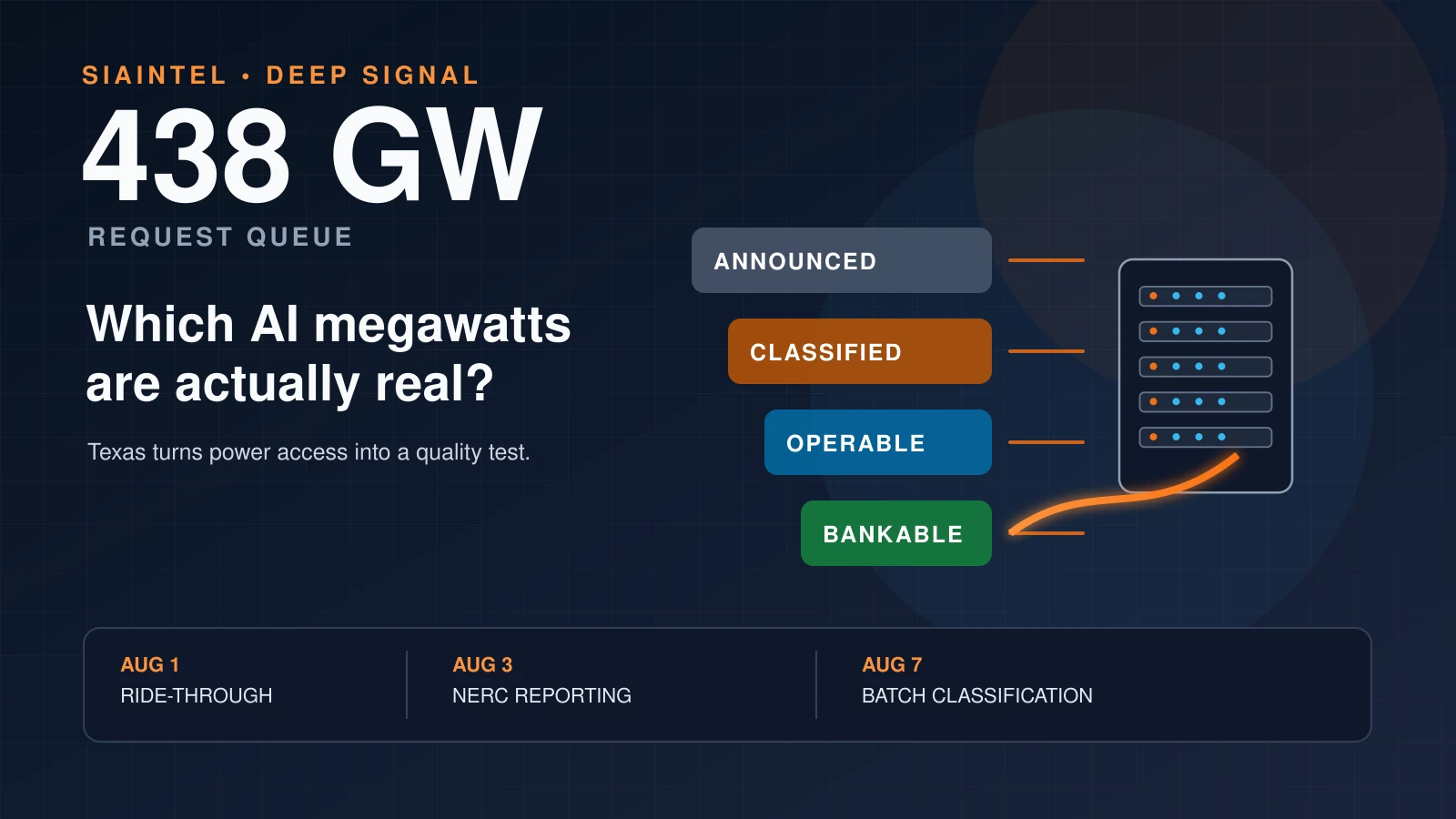
Texas Has 438 GW of Data-Center Requests. How Much Is Real?
Nearly 90% of ERCOT’s 438 GW queue comes from data centers. On August 7, Batch Zero will show which AI projects advance—and which remain speculative.

While Everyone Watches Chips, AI’s Next Bottleneck Is Power, Grids and Capital
AI’s next bottleneck is moving beyond chips toward power grids, data-center infrastructure, nuclear energy agreements and capital intensity.
Beyond Chips: Why Infrastructure Is AI’s Ultimate Bottleneck
AI growth is moving beyond chips as electricity, water, grid access, transformers and cooling capacity become the next strategic bottlenecks.