"A five-stock event study and SEC-filed contracts show no durable equity discount after FERC—while power terms already reach project finance."
SIAINTEL INTELLIGENCE DOSSIER
Analysis Brief
SIAIntel Verification Panel
Analysis, data context, source mapping and editorial boundaries are presented as one evidence chain.
Key Takeaways
- Wall Street still values much of the AI buildout through familiar variables: contracted megawatts, GPU supply, tenant credit and time to energization.
- This is not yet a final rule imposing a known cost on every data center.
- It is the start of a mandatory framework that may make grid behavior a condition of access and compliance..
SIAIntel Perspective
SIAIntel frames this development not as a standalone headline, but as an intelligence brief shaped by source quality, structural implications and observable risk channels.
Data Snapshot
Coverage Area
Editorial category
AI
Read Time
Approximate duration
~9 min
Source Base
Visible evidence profile
Article context
Published
Updated: Jul 22, 2026
Jul 21, 2026
Evidence Frame
This layer summarizes visible sources, article context and editorial framing. It is analytical context, not transactional guidance.
The signal
Wall Street still values much of the AI buildout through familiar variables: contracted megawatts, GPU supply, tenant credit and time to energization. A fifth variable is moving into view: can a computational-load campus prove how it behaves when the grid is disturbed—and can it finance the equipment, controls and contractual protections required to keep that behavior compliant?
On July 16, the Federal Energy Regulatory Commission directed NERC in Docket RD26-7-000 to file new or modified reliability standards for computational loads and revise its Rules of Procedure, including registration criteria, by December 31, 2026. The FERC meeting summary confirms both year-end filings. This is not yet a final rule imposing a known cost on every data center. It is the start of a mandatory framework that may make grid behavior a condition of access and compliance.
That distinction is the opportunity. Equity prices do not need to fall immediately for risk to be mispriced. The repricing can first appear in interconnection agreements, completion guarantees, debt covenants, contingency budgets, insurance exclusions and discount rates.
Market pricing check: a shock, then no lasting risk premium
SIAIntel tested the headline against prices instead of assuming that a quiet regulatory story had been ignored. The event window runs from the July 15 close—the last close before FERC's July 16 vote—to July 21. The five-name basket spans data-center landlords, AI/HPC developers and grid-equipment exposure. Returns use unadjusted closing prices displayed by S&P Global Market Intelligence; the basket is equal-weighted.
| Exposure | July 15 close | July 16 return | July 21 close | July 15–21 return |
|---|---|---|---|---|
| Vertiv (VRT) | $304.57 | −3.43% | $304.50 | −0.02% |
| Digital Realty (DLR) | $176.07 | −1.40% | $179.31 | +1.84% |
| Equinix (EQIX) | $1,022.60 | −1.32% | $1,027.88 | +0.52% |
| Applied Digital (APLD) | $29.03 | −8.92% | $30.05 | +3.51% |
| IREN | $38.28 | −9.01% | $41.29 | +7.86% |
| Equal-weight basket | — | −4.82% | — | +2.74% |
| SPY benchmark | $754.81 | −0.54% | $748.28 | −0.87% |
The basket sold off sharply on the decision day, but it recovered to finish 3.61 percentage points ahead of SPY over the full window. That is not proof that FERC caused either move: July 16 included a broad AI selloff, and IREN later rallied on company-specific contract news. It is evidence of a narrower claim—by July 21, public equities showed no durable, sector-wide compliance discount. Credit spreads, private-loan terms and insurance pricing remain unobserved, so “may be underpricing” is the defensible conclusion.
Why the grid moved
The technical evidence is no longer hypothetical. ERCOT's December 2025 board paper records 26 events since the beginning of 2023 in which data-center or crypto-mining loads tripped during normal transmission-voltage disturbances. An earlier official NERC/ERCOT event presentation documented 21 large power-electronic-load events from November 2023 through 2024: Central Texas aggregate reductions ranged from roughly 17% to 67%, while several individual Far West Texas loads fell to zero. These primary records explain the regulator's urgency; they are not a valuation model.
NERC’s March gap assessment says existing standards and practices are inadequate for emerging large loads and identifies gaps in interconnection studies, real-time data, ramping, ride-through and load models. It also notes that phasor-domain models may not capture the nonlinear behavior of UPS systems and AI facilities. The NERC gap assessment therefore points toward more instrumentation, validated models, operational coordination and disturbance performance—not merely more electricity.
The hidden financing transmission
The order can reach finance through five channels:
- Interconnection conditions: utilities may require validated EMT models, ride-through capability, telemetry, staged commissioning or operating limits before full energization.
- CAPEX and completion risk: UPS settings, controls, protection systems, meters, batteries and engineering studies can become schedule-critical scope. A missed test can delay lease commencement or debt drawdown.
- Credit covenants: lenders may ask whether registration, reporting and operational obligations are conditions precedent, representations or ongoing covenants.
- Insurance: equipment breakdown and business-interruption underwriters may demand clearer evidence that a campus will ride through faults without cascading equipment trips or long outages.
- Valuation: two sites with the same contracted MW may deserve different discount rates if one has validated grid behavior and the other carries unresolved compliance and commissioning risk.
This logic fits an already tightening funding market. Moody’s data-center credit research emphasizes leverage and risk allocation, while Fitch has highlighted rising completion risk and stronger lease protections. Morgan Stanley estimates a $1.5 trillion medium-term data-center financing gap. Grid compliance does not create that gap, but it can change which projects cross it.
The contractual channel is already visible. In an SEC-filed Galaxy Helios credit agreement, the Power Agreements, CoreWeave lease and construction agreement are Material Project Documents; the borrower cannot terminate the Power Agreements or CoreWeave lease without the administrative agent's consent. An Applied Digital data-center lease calculates each data hall's base rent from its electricity-demand threshold and commencement date. Neither filing proves the July FERC order has changed a loan price. Together they prove that power performance, energization and lease cash flow already sit inside financeable contract architecture—the route through which a new reliability obligation can travel.
Texas is the live test
On June 2, the ERCOT Board adopted NOGRR282 and NPRR1308, establishing voltage- and frequency-ride-through requirements for Large Computational Loads. The Public Utility Commission of Texas approved both revision requests at its July 9 Open Meeting, according to ERCOT’s June 2026 monthly recap. ERCOT’s interim technical assessment also identified four large-load groups that could collectively trip more than 3,200 MW during a system fault, while stressing that none currently operates above the cited risk threshold. Texas has therefore approved a regional framework that turns the federal debate into a concrete operating and financing catalyst; no unverified effective date is asserted here.
The investor question is no longer only “how many megawatts are secured?” It is: what share is financeable, insurable and operable under the performance envelope?
The disclosure gap: compliance-ready MW
Most public disclosures stop at announced, contracted or energized capacity. The next investable metric is the compliance-ready MW ratio: megawatts supported by an as-built validated model, high-resolution telemetry, documented ride-through performance and contracts that allocate retrofit, delay and curtailment risk—divided by contracted critical IT megawatts.
This is a SIAIntel monitoring framework, not a FERC or NERC test. Companies do not yet disclose enough comparable data to assign credible scores, which is itself the signal. Until disclosure improves, investors should use a five-step ladder: announced → contracted → energized → performance-tested → compliance-ready. Treating every rung as equal overstates bankable capacity.
Strategic impact matrix
| Exposure | New diligence question | Possible financial transmission | Signal to monitor |
|---|---|---|---|
| AI campus developer | Can the site ride through and provide validated models? | Added CAPEX, delay reserve, lower land value | Test results and commissioning milestones |
| Hyperscaler/tenant | Can contracted capacity energize on schedule? | Lease delay, guarantee or termination exposure | Conditions precedent in leases |
| Bitcoin miner/HPC converter | Do power electronics meet the new envelope? | Retrofit cost, curtailment, stranded conversion value | ERCOT compliance disclosures |
| Utility/grid operator | Who pays for studies, telemetry and upgrades? | Deposits, tariffs, collateral, cost allocation | Large-load tariff filings |
| Lender/private credit | Is compliance a draw condition or covenant? | Higher spread, reserve account, lower advance rate | New loan language |
| Insurer | Can fault behavior amplify equipment loss? | Deductibles, exclusions, premium change | Engineering surveys and exclusions |
Catalyst calendar
| Date | What happens | What it does not mean |
|---|---|---|
| May 4, 2026 | NERC issued its Level 3 Essential Action Alert | Not a final federal standard |
| June 2, 2026 | ERCOT Board adopted NOGRR282 and NPRR1308 | Not nationwide implementation |
| July 9, 2026 | PUCT approved both revision requests | Not proof of a specific effective date |
| August 3, 2026 | Registered entities’ responses on seven essential actions are due, per NERC’s FAQ | Not a penalty or universal compliance start date |
| December 31, 2026 | NERC Phase I standards and registration-criteria filings due to FERC | Not necessarily the effective date of final obligations |
| March 2027 | Action plan for later standards | No specific day stated here until verified in the official order text |
Counter-thesis
The market may be right to wait. NERC could adopt targeted thresholds, grandfather existing sites, phase implementation or place most duties on already registered grid entities. Large operators may absorb controls and studies with little effect on enterprise value. Better rules could even reduce uncertainty and make compliant projects easier to finance.
But waiting for a final penalty schedule misses how project finance works. Lenders price uncertainty before regulation is final when that uncertainty can move completion dates, energization rights or insured loss severity. The asymmetric risk sits with projects whose valuation assumes every announced megawatt is equally bankable.
Audience impact
- General reader: the AI power bottleneck is becoming a performance test, not just a supply shortage.
- Investors: separate announced, contracted, energized and compliance-ready MW.
- Companies: preserve evidence—models, settings, event data and commissioning results—that can satisfy utilities, lenders and insurers.
- Developed markets: expect faster standardization and higher engineering discipline.
- Developing markets: flexible power access may attract projects, but weak reliability rules can raise financing costs.
- Credit markets: watch conditions precedent, completion support, reserve accounts and collateral.
- Policymakers: allocate upgrade costs without shifting failed-project risk to ordinary customers.
- SIAIntel Bottom Line: the premium multiple may migrate from “power secured” to “power proven.”
FAQ
Are data centers now regulated like power plants?
No. FERC ordered NERC to develop standards and registration criteria; it did not declare every data center a generator or set final obligations.
Is August 3 a compliance or penalty start date?
No. It is the response deadline for registered entities addressed by NERC’s alert.
What happens on December 31?
NERC must file Phase I standards and Rules of Procedure revisions, including registration criteria, with FERC.
Why does ride-through matter to lenders?
Because failed tests or retrofits can delay energization, lease commencement and debt draws, and can increase contingency or insurance requirements.
What is the most important metric now?
Compliance-ready MW: capacity supported by validated models, telemetry, ride-through performance, permits, contracts and financeable completion terms.
SIAIntel bottom line
FERC has not yet written a known compliance bill into every AI campus. It has done something earlier and potentially more consequential: it has put computational-load behavior on the path toward mandatory standards and direct registration criteria. The next AI-grid premium will not belong merely to whoever reserves the most electricity. It will belong to whoever can prove that the load can stay connected, behave predictably and remain bankable when the grid is under stress.
Editorial Credit
This intelligence brief was prepared by the SIAIntel Editorial Desk.
Editorial oversight: Elanur Karahan, Founder & Editor-in-Chief
LinkedIn: View ProfileRelated Intelligence
Related intelligence in this category · 6 briefs
The AI War Enters the Age of Power and Collateral
China is institutionalising AI access while the United States turns large-scale electricity access into a test of grid readiness, operating flexibility and financial collateral.
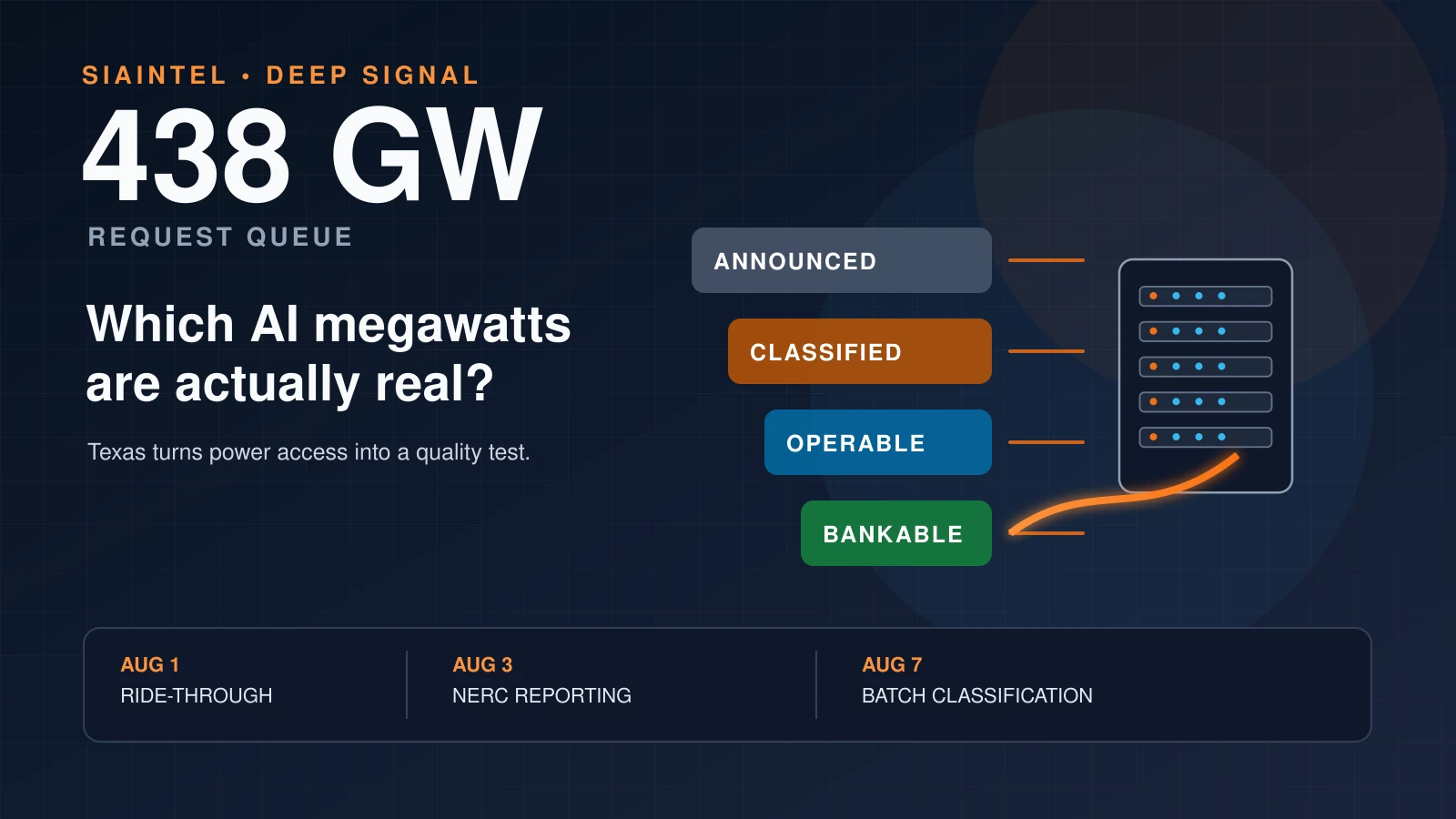
Texas Has 438 GW of Data-Center Requests. How Much Is Real?
Nearly 90% of ERCOT’s 438 GW queue comes from data centers. On August 7, Batch Zero will show which AI projects advance—and which remain speculative.

While Everyone Watches Chips, AI’s Next Bottleneck Is Power, Grids and Capital
AI’s next bottleneck is moving beyond chips toward power grids, data-center infrastructure, nuclear energy agreements and capital intensity.
Beyond Chips: Why Infrastructure Is AI’s Ultimate Bottleneck
AI growth is moving beyond chips as electricity, water, grid access, transformers and cooling capacity become the next strategic bottlenecks.

Google's Hidden Power: The New Infrastructure Revealed
Google's energy and infrastructure partnerships reflect a shift toward securing carbon-free baseload power for large-scale AI computation.
OpenAI's $1 Trillion AI Valuation Test Moves Toward Public Markets
OpenAI's reported IPO preparations could reshape how public markets evaluate frontier AI. Investors will scrutinize infrastructure costs, energy demands, governance, and regulatory risks.