"Korea’s reported $950B AI framework links Nvidia, SK Hynix, Samsung, HBM4, sovereign AI factories and infrastructure finance to the power bottleneck."
SIAINTEL INTELLIGENCE DOSSIER
Analysis Brief
SIAIntel Verification Panel
Analysis, data context, source mapping and editorial boundaries are presented as one evidence chain.
Key Takeaways
- South Korea’s reported $950 billion AI framework is not one cheque, one order or a fully financed investment programme..
- The figure combines long-term memory plans, letters of intent, a semiconductor memorandum, proposed sovereign AI factories and conditional infrastructure finance.
- Nvidia, SK Group, SK Hynix, Samsung Electronics, Broadcom, Naver and Brookfield occupy different layers of the same industrial stack..
SIAIntel Perspective
SIAIntel frames this development not as a standalone headline, but as an intelligence brief shaped by source quality, structural implications and observable risk channels.
Data Snapshot
Coverage Area
Editorial category
AI
Read Time
Approximate duration
~15 min
Source Base
Visible evidence profile
Article context
Published
Updated: Jul 27, 2026
Jul 26, 2026
Evidence Frame
This layer summarizes visible sources, article context and editorial framing. It is analytical context, not transactional guidance.
Executive Briefing
South Korea’s reported $950 billion AI framework is not one cheque, one order or a fully financed investment programme.
The figure combines long-term memory plans, letters of intent, a semiconductor memorandum, proposed sovereign AI factories and conditional infrastructure finance. Nvidia, SK Group, SK Hynix, Samsung Electronics, Broadcom, Naver and Brookfield occupy different layers of the same industrial stack.
The decisive signal is structural: the AI race is moving beyond GPU procurement toward control of HBM4, advanced manufacturing, packaging, powered data centers, grid connections and long-duration capital.
- Legal reality: $950 billion is an umbrella of company estimates with different status and time horizons.
- Physical reality: announced megawatts are not financed, interconnected, energized and billable megawatts.
- Financial reality: AI funding is spreading from Big Tech cash into equity, bonds, project finance, infrastructure funds and long leases.
- The bottleneck: useful compute exists only when chips, memory, packaging, cooling and electricity arrive on the same schedule.
SIAIntel’s conclusion is clear: the AI bottleneck is no longer only inside the chip. It is at the point where the chip meets the grid.
◆ SIAINTEL SIGNAL CONFIRMED
The four earlier intelligence links
The HBM Silicon Shield — July 3, 2026 identified high-bandwidth memory as a sovereign strategic asset and Korea’s production concentration as a financial and geopolitical shield. (SIA Intelligence)
Forget GPUs. The Real AI War Is Over Electricity — June 29, 2026 showed how powered sites, electricity contracts and data-center leases were becoming financial collateral. (SIA Intelligence)
Bitcoin Miners Are Selling Their Power to AI — July 12, 2026 argued that grid-connected power—not mining hardware—was becoming the critical crypto-infrastructure asset. (SIA Intelligence)
AI’s Closed Capital Circuit Just Hit the Power Grid — July 22, 2026 mapped the loop connecting strategic equity, chip supply, customer finance, construction and long-term electricity contracts. (SIA Intelligence)
The Korean announcements provide new evidence that these four theses are converging inside one economic structure. They do not guarantee that every plan will be financed, built or converted into revenue.
What Actually Happened in San Francisco
President Lee Jae-myung hosted an AI summit at The Midway in San Francisco on July 24, bringing Korean industrial groups together with executives connected to Nvidia, Broadcom, OpenAI, Anthropic, Samsung, SK Group, Hyundai and Naver. (Korean Presidency; Reuters)
Chief of Staff for Policy Kim Yong-beom put the proposed semiconductor cooperation at about $950 billion: roughly $750 billion connected to SK and about $200 billion tied to Samsung–Broadcom. The official briefing also described around 5 GW of prospective AI data-center cooperation; that pipeline is not financed, interconnected or energized.
| Announced component | Reported scale | Legal/economic status |
|---|---|---|
| SK Group and SK Hynix framework | Approximately $750B | Long-term frameworks and letters of intent |
| Nvidia–SK initiative | More than $500B | Included within the wider $750B SK framework |
| Samsung Electronics–Broadcom | More than $200B through 2030 | Memorandum of understanding |
| Headline total | Approximately $950B | Not one payment, firm order or recognized revenue |
Nvidia says the parties signed letters of intent to formalize their agreement. The strategic direction is real, but every projected dollar has not become legally binding revenue. (NVIDIA Newsroom)
Samsung and Broadcom likewise signed an MOU covering HBM, advanced memory, foundry technology at two nanometers and below, and advanced packaging, with an estimated value above $200 billion through 2030. (Samsung Global Newsroom)
The correct reading is not “Korea received one $950 billion order.” Global AI companies are attempting to reserve the memory, manufacturing, power and financing capacity required for the next infrastructure cycle.
Signal One: HBM Is Becoming a Sovereign Asset
HBM has moved beyond the economics of an ordinary component. It influences accelerator delivery schedules, the bargaining power of producer countries, industrial policy, access to global capital and systemic concentration risk.
The previously announced multiyear Nvidia–SK Hynix technology partnership linked future AI memory to a common expansion roadmap. The July framework places that relationship inside a far larger industrial and financial package. (NVIDIA Newsroom)
- An accelerator architecture alone does not create usable compute.
- HBM, packaging, networking, cooling and electricity must be ready together.
- A delay in one layer can strand capital invested in every other layer.
- Korea’s concentration creates strategic leverage and concentrated execution risk at the same time.
SIAIntel interpretation: HBM4 connects memory to the grid
SK Telecom’s proposed Nvidia infrastructure is expected to combine Vera Rubin DSX systems with SK Hynix HBM4. This is SIAIntel’s analytical interpretation of the announced chain, not a contractual term used by the companies.
- Nvidia defines the accelerated-computing platform.
- SK Hynix supplies the advanced memory required to operate it.
- SK Telecom must deliver the powered facilities where the systems can run.
HBM’s value therefore depends not only on its market price, but on whether memory, accelerator, packaging, cooling, data hall and grid connection can be delivered together.
Korea Is Converting Memory Leadership Into Capital-Market Power
SK Hynix began Nasdaq trading on July 10 after offering 177.9 million American Depositary Shares at $149. Gross proceeds were $26.507 billion. The final SEC prospectus shows about $26.25 billion after underwriting discounts but before estimated offering expenses. Nasdaq described it as the second-largest U.S. share sale and the largest American offering by a foreign company. It was an ADS offering by a company already listed in Korea—not the company’s IPO. (SEC Form 424B4; Nasdaq)
Its preliminary, consolidated K-IFRS figures—before completion of the independent audit—were extraordinary: KRW 52.576 trillion of revenue, KRW 37.610 trillion of operating profit, KRW 40.346 trillion of net income and a 72% operating margin. The company cited AI demand and high-value memory including HBM, while warning the figures could change. (SK hynix Q1 2026; SK hynix 2025 results)
Market stress test: strategic scarcity is not price stability
Three days after the Nasdaq debut, the Seoul shares fell 15.4%—their biggest one-day drop on record. The Kospi lost 9% and trading was halted for 20 minutes. Profit-taking, caution before results and concern that the expected increase in HBM4 shipments had not yet appeared at scale all contributed. (Reuters)
Creating new ADSs from Korean ordinary shares is restricted and costly, limiting arbitrage between the listings. Part of the U.S. premium may therefore reflect access scarcity rather than a cleaner fundamental verdict. (Reuters Breakingviews)
Investors must price structural HBM demand, HBM4 volume timing and yields, future overcapacity risk and the two listings’ market structure separately.
Signal Two: The AI Bottleneck Has Moved From Chips to Power
The Nvidia–SK announcement describes up to 2 GW in the long run for SK Telecom’s Nvidia-linked AI factory. Continuous 2 GW operation would theoretically consume 17.52 TWh a year; that is not a 2027 forecast.
Nvidia targets 2027 for the first factory to begin operation. SK Telecom’s June 8 SEC filing, however, says the first facility will not be gigawatt-scale and expansion will occur in phases. (SK Telecom 6-K)
A separate 6-K discloses a larger conditional company-wide portfolio: 5 GW opening in stages from 2029 and up to 10 GW more from 2035, depending on first-phase progress and demand, for as much as 15 GW. Investment, financing, timing and participants remain undetermined; power, land, permits and funding are explicit obstacles. (SK Telecom 15 GW filing)
The correct capacity map
| Stage/figure | Correct interpretation |
|---|---|
| 2027 | Initial Nvidia-linked facility; not gigawatt-scale |
| Later phases | Expansion of the Nvidia-linked initiative toward gigawatt scale |
| Up to 2 GW | Nvidia-linked ambition, not SKT’s company-wide ceiling |
| 5 GW from 2029 | First phase under review in a separate company portfolio |
| +10 GW from 2035 | Conditional expansion tied to demand and first-phase progress |
| 17.52 TWh | Theoretical annual energy at continuous 2 GW |
The 2 GW, the summit’s approximately 5 GW pipeline and SKT’s 5 GW portfolio phase must not be added. Public documents do not reconcile project overlap, so SIAIntel treats the scopes as potentially overlapping.
The Grid and the AI Capital Cycle Run on Different Clocks
The IEA expects global data-center electricity use to rise from about 485 TWh in 2025 to 950 TWh in 2030. AI facilities grow faster than the wider market, while bottlenecks in power equipment, grids and chips reduce the probability of the most aggressive buildout scenarios. (IEA Energy and AI)
U.S. electricity use is expected to increase by more than 420 TWh through 2030, with data centers accounting for roughly half of that growth. (IEA Electricity 2026)
A technology company can raise capex within a quarter. Transmission lines, substations, transformers, gas plants, nuclear capacity, storage and grid upgrades can take years. The bottleneck is not a lack of investment announcements; it is the mismatch between the two schedules.
Sovereign AI Is Becoming an Infrastructure Asset Class
Naver, Nvidia and Brookfield propose expanding the Nvidia DSX deployment at GAK Sejong from 55 MW to 200 MW by 2028, with a longer path to 1 GW. Nvidia plans $1 billion; Brookfield signed a nonbinding term sheet for up to $9 billion; Naver would fund the balance. Nvidia’s investment depends on Naver securing at least $9 billion of committed financing from outside Nvidia. (Naver–Nvidia–Brookfield)
Brookfield says it manages about $100 billion across the AI infrastructure value chain and roughly $12 billion of assets in Korea. It also launched a $100 billion global programme in November 2025. These are company-reported figures, not capital already invested in Naver. (Brookfield)
Why it resembles project finance
This is SIAIntel’s economic comparison, not a legal classification. The structure combines a technology supplier, operating platform, infrastructure equity, committed finance, construction, power procurement and bankable customer demand.
AI factories increasingly resemble power stations, airports or LNG terminals more than software offices: capital-intensive, location-dependent and sensitive to rates, tenant credit, obsolescence, electricity prices, construction costs and permits.
Big Tech’s $730 Billion Capex Surge
LSEG consensus compiled by Reuters raised expected 2026 capex for Microsoft, Alphabet, Amazon, Meta and Oracle from roughly $485 billion in January to $730 billion in July. It is not pure AI spending because companies do not report AI-only capex consistently, but servers, networking, cloud and data centers are key drivers. (Reuters/LSEG)
The five companies’ capex could rise by about $534 billion between 2025 and 2027, against roughly $340 billion of additional annual operating cash flow: about $1.57 of additional investment for each additional dollar of cash.
Oracle’s fiscal 2026 capex reached $55.7 billion, or 174% of operating cash flow, versus 47% in fiscal 2022. Oracle plans to raise about $45–50 billion through debt and equity for cloud infrastructure.
- Public equity
- Corporate bonds
- Project debt
- Customer prepayments
- Infrastructure funds
- Long-term lease-backed finance
The physical constraint and financial constraint are converging.
The Crypto Confirmation: From Mining Site to 15-Year AI Asset
Hut 8 filed a second 15-year Beacon Point lease on July 20: 352 MW of IT capacity and $9.8 billion of base-term contract value. (Hut 8 SEC exhibit)
The second deal took the same customer to 704 MW and the two leases’ combined base value to $19.6 billion. Potential value reaches $50.2 billion only if every renewal option is exercised; that is not firm base value. (Hut 8)
704 MW and 1,000 MW are not interchangeable
704 MW is contracted critical IT load. 1,000 MW is campus utility capacity. The first is billable customer demand; the second is a physical power ceiling.
The transaction strengthens SIAIntel’s crypto thesis: the valuable asset is not the mining machine, but the interconnection position that can become reliable, financeable and billable AI compute.
Quantitative Evidence Board
Non-additivity rule: The figures below belong to different legal, financial and physical categories. They must not be added into one “total AI investment” number.
| Metric | What it represents | What it does not represent |
|---|---|---|
| $950B | Announced umbrella value of SK and Samsung initiatives | One cheque or recognized revenue |
| $750B | Broad SK framework | Fully executed short-term purchases |
| $500B+ | Nvidia–SK inside the broader framework | An amount to add again to $950B |
| $200B+ | Samsung–Broadcom estimate through 2030 | A binding minimum order |
| Approximately 5 GW | Government-announced summit pipeline | Financed or energized capacity |
| 5 GW from 2029 | First phase of SKT’s separate portfolio plan | An automatically additive second 5 GW block |
| 2 GW | Nvidia-linked SKT ambition | The 2027 facility or SKT’s total ceiling |
| Up to 15 GW | Conditional SKT company plan under review | Approved investment or energized load |
| 17.52 TWh | Theoretical annual energy at continuous 2 GW | A 2027 demand forecast |
| 55 MW → 200 MW | Proposed Naver expansion by 2028 | A completed 1 GW build |
| Up to $9B | Brookfield’s nonbinding finance framework | Committed or disbursed capital |
| $26.5B | Gross SK Hynix ADS offering value | Operating revenue |
| $730B | 2026 capex consensus for five hyperscalers | Pure AI-only spending |
| 704 MW | Contracted critical IT capacity | Total utility capacity |
| 1,000 MW | Beacon Point utility capacity | Billable customer IT load |
What Markets May Still Be Mispricing
HBM scarcity may deserve a strategic premium
Multiyear partnerships can improve visibility without removing price, volume, yield or architecture risk. The July 13 selloff showed that strategic scarcity does not guarantee a stable equity price.
The most valuable contract may be the interconnection
A data hall without power is unfinished inventory. A financed project without a credible energization date can be worth far less than its headline contract. Requested, approved, secured, energized and billable megawatts must be separated.
AI infrastructure can transmit credit risk
The Naver structure shows how sovereign AI can depend on infrastructure funds, project lenders and contracted customer demand. Risk migrates from technology equities into private credit, bonds, utilities, insurers and pension capital.
Crypto companies can be repriced before delivery
Not every mining site can become an AI campus. Without fibre, cooling, redundancy, uptime, construction capability, a bankable tenant and financing, announced megawatts are not usable AI capacity.
Analyst Intelligence Box
Primary signal: AI leaders are reserving memory, manufacturing, power and infrastructure capital as one industrial stack.
Capital channel: Funding is spreading into Nasdaq equity, corporate debt, project finance, infrastructure funds and long-term leases.
Risk trigger: A letter of intent fails to become binding, a financing condition fails or grid delivery falls behind the compute schedule.
Watch indicator: The conversion of announced capacity into financed, energized and billable critical IT megawatts.
90-day implication: Markets will separate companies with executable power and finance from those relying on headline-scale announcements.
Internal intelligence bridge: HBM Silicon Shield · The Real AI War Is Over Electricity · Miners Sell Power to AI · AI’s Closed Capital Circuit
Counter-Thesis: What Would Break This Thesis?
- Models and hardware become far more efficient without an equivalent rise in electricity demand.
- Demand slows before projects open, leaving excess memory, server and power capacity.
- Letters of intent convert into contracts far below the headline values.
- Korean generation and grid investment remove interconnection scarcity faster than expected.
- Custom accelerators or memory-efficiency technologies reduce HBM intensity.
In that scenario, the Korean framework would remain strategic without proving that electricity and infrastructure finance are the dominant constraints. Current evidence points the other way: companies pursue multiyear arrangements because they do not assume memory, powered land or long-duration capital will remain freely available.
The 30/60/90-Day Trigger Calendar
30 days
- Customer, volume and pricing details inside the $750B SK framework
- Evidence that letters of intent are becoming binding contracts
- Further Naver and Brookfield financing disclosures
- HBM4 qualification, yields, pricing and volume shipments
60 days
- Power procurement for the initial SK Telecom phase
- Korean sites and grid-interconnection applications
- Advanced-packaging capacity commitments
- Orders for transformers, switchgear and cooling
90 days
- Initial MW and construction schedule for the 2027 facility
- Pricing and minimum volumes under Samsung–Broadcom
- Evidence of pension, insurer and infrastructure-fund capital
- Conversion of announced AI megawatts into financed, billable capacity
Audience Impact
- Investors: Announced value and executable value must be separated; binding contracts, funded construction and secured power deserve different valuations from MOUs.
- Technology companies: AI procurement now requires a common strategy for accelerators, memory, packaging, power, finance and permits.
- Credit markets: In long-duration, tenant-dependent AI assets, customer credit and contract structure matter as much as processor performance.
- Energy companies: Data centers can become durable large customers, but delayed or abandoned projects must not shift costs to ratepayers.
- Crypto companies: Alternative use, interconnection status, data-center suitability and tenant quality are replacing hash rate as core variables.
- Policymakers: Sovereign AI requires semiconductor, energy, transmission, capital-market, permitting and industrial policy to operate together.
SIAIntel Bottom Line
South Korea’s $950 billion AI framework is not one cheque and should not be marketed as one.
Nvidia is seeking long-term access to next-generation memory. SK Hynix is turning HBM leadership into strategic supply relationships and global capital-market access. Samsung is offering Broadcom integrated memory, advanced foundry and packaging.
SK Telecom and Naver are attempting to turn those chips into sovereign AI factories, while Brookfield and other capital providers finance the physical layer. In Texas, a former Bitcoin miner is converting secured utility capacity into 15-year AI leases.
These are not separate stories. They form one economic chain:
Memory reservation → AI factory → power connection → long-term contract → infrastructure finance → billable compute.
Four earlier SIAIntel analyses identified the components before the San Francisco summit. The announcements support their convergence; execution still depends on contracts, financing, construction and power delivery.
The next AI divide will not simply separate companies with and without the newest processor. It will separate those capable of assembling memory, power, land, finance and customer credit into an operating industrial system from those whose ambitions remain numbers in a presentation.
Important notice: This article is provided for information and analysis only. It is not investment, financial, legal or tax advice.
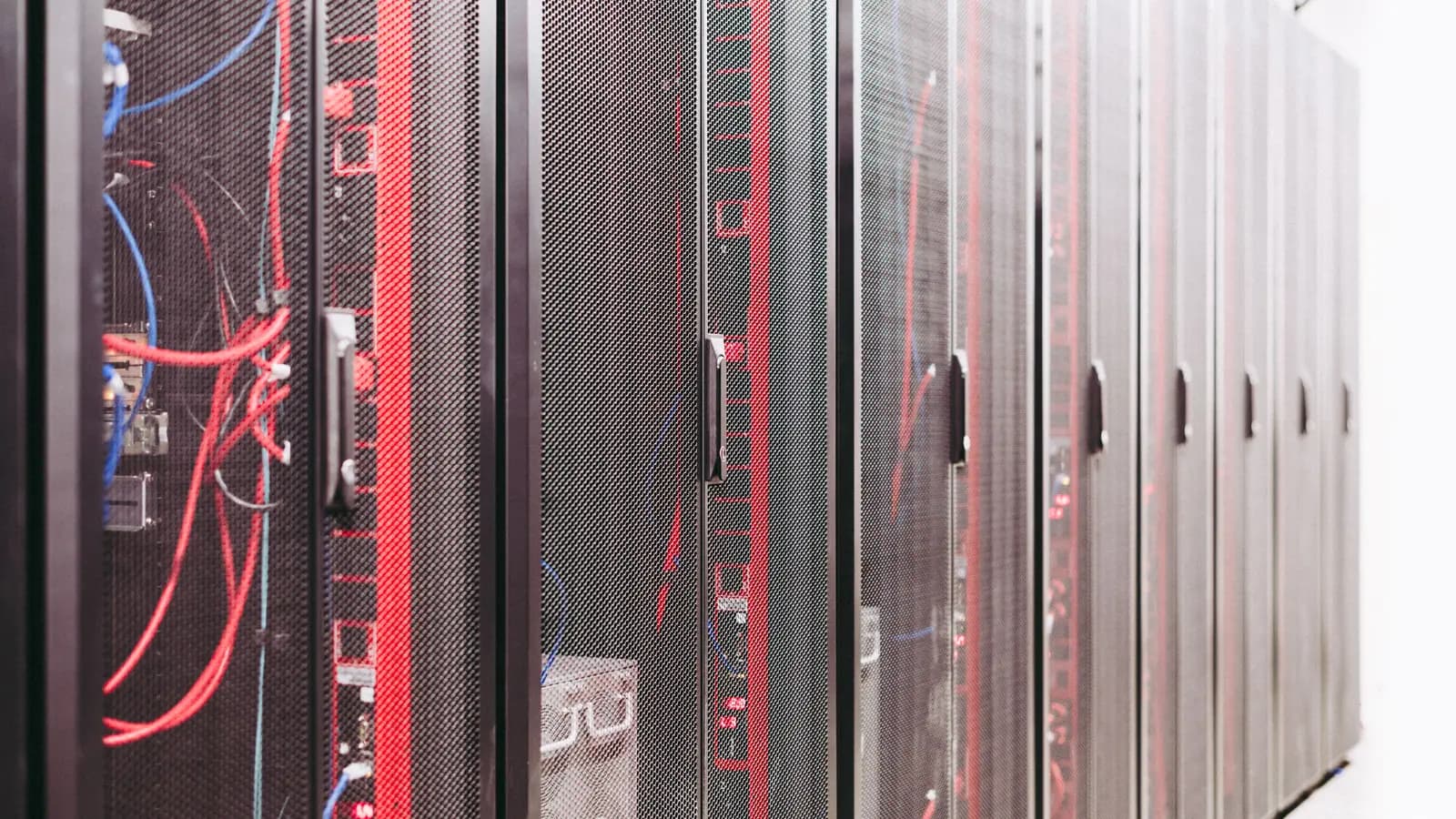
Visual methodology: The hero is a real data-center photograph by Brett Sayles used under the Pexels license. It does not depict a facility operated by SK Telecom, SK Hynix, Samsung Electronics or Naver. (Brett Sayles / Pexels)
Editorial Credit
This intelligence brief was prepared by the SIAIntel Editorial Desk.
Some contributors work in sensitive public-sector, regulatory, market, or editorial roles. Their identities may be withheld when professional duties, source protection, or safety require confidentiality.
Editorial and publishing accountability: Sefa Karahan, Founder & Publisher
Related Intelligence
Related intelligence in this category · 6 briefs
Meta’s $12.3B Bond Exposes Wall Street’s AI Debt Machine
Meta’s $12.3B data-center bond shows how Wall Street is turning Big Tech lease promises into investment-grade AI debt—and pricing a new risk premium.

3 GW Vanished: Data Centers Shock America’s Largest Grid
More than 3 GW of data-center load vanished from PJM. See the hidden AI grid risk, investor impact, Virginia tax cost and next regulatory catalysts.
AI’s Closed Capital Circuit Just Hit the Power Grid
AMD’s Anthropic investment, Amazon’s milestone-linked financing and OpenAI’s 25-year Georgia power deal expose the closed capital circuit behind AI infrastructure.
Wall Street May Be Underpricing the New AI Grid Rule
A five-stock event study and SEC-filed contracts show no durable equity discount after FERC—while power terms already reach project finance.
The AI War Enters the Age of Power and Collateral
China is institutionalising AI access while the United States turns large-scale electricity access into a test of grid readiness, operating flexibility and financial collateral.
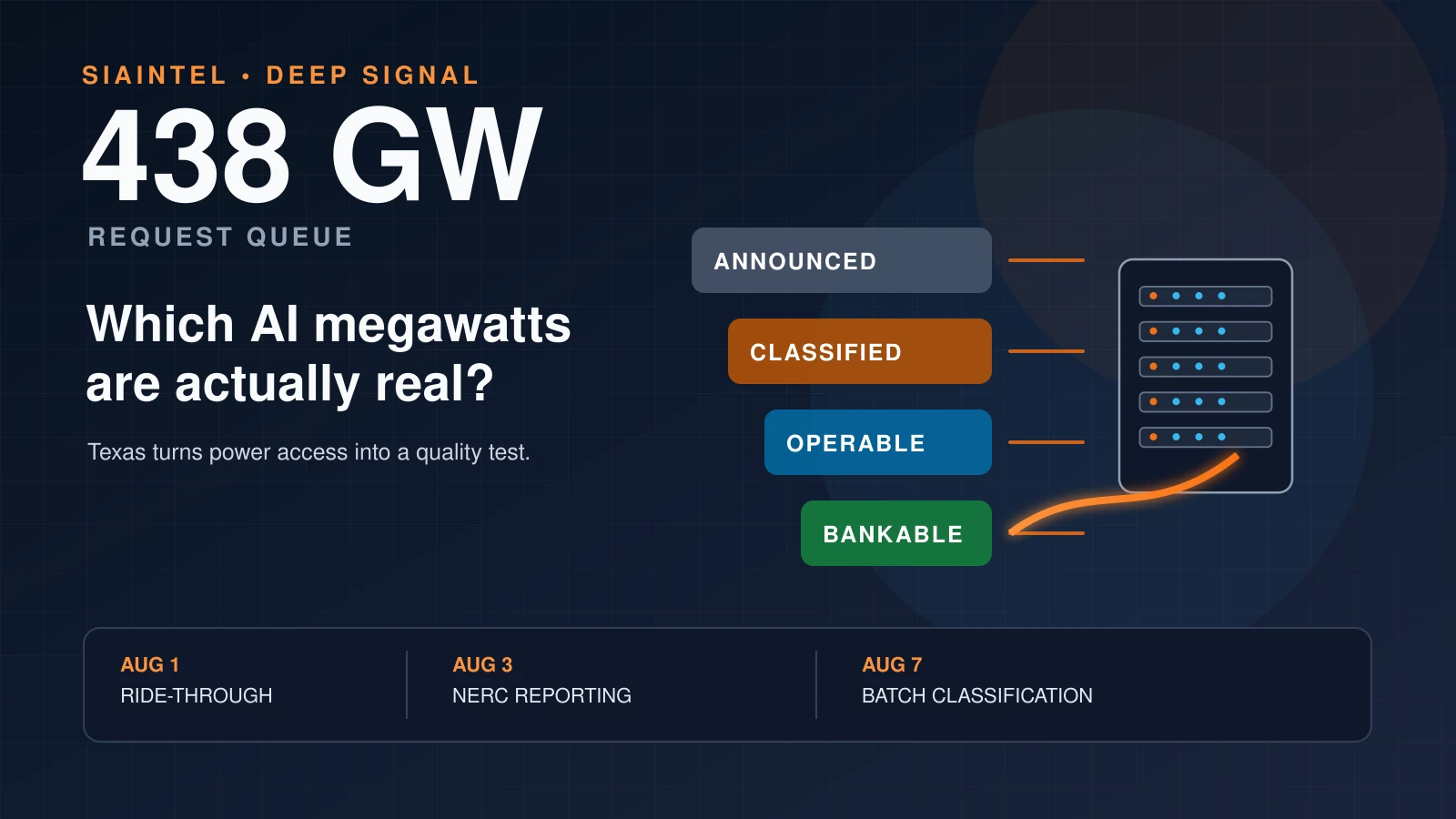
Texas Has 438 GW of Data-Center Requests. How Much Is Real?
Nearly 90% of ERCOT’s 438 GW queue comes from data centers. On August 7, Batch Zero will show which AI projects advance—and which remain speculative.