High Bandwidth Memory (HBM) has transitioned from a commodity component to a strategic sovereign asset. The concentration of production in South Korea creates a 'Silicon Shield' that underwrites global AI liquidity.
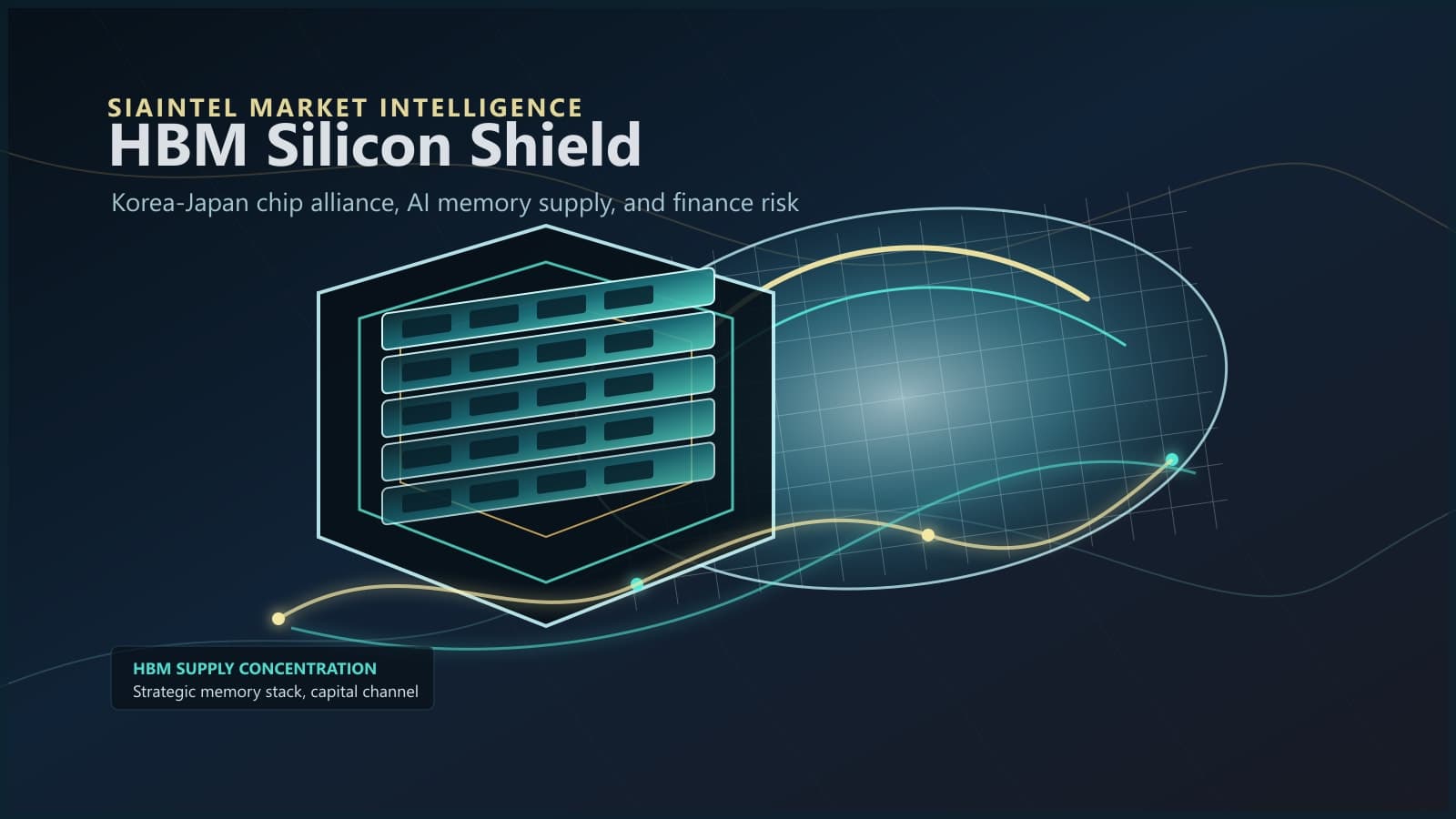
Executive Signal: High Bandwidth Memory (HBM) has transitioned from a commodity component to a strategic sovereign asset. The concentration of production in South Korea, now reinforced by a historic 2026 supply-chain alliance with Japan, creates a "Silicon Shield" that underwrites global AI liquidity while concentrating systemic risk in East Asian credit and currency markets. This report explores the convergence of memory physics, sovereign industrial policy, and capital market distortions.
The Original Thesis
The AI compute cycle is no longer governed by chip design alone, but by the physical availability of advanced memory. South Korean suppliers control roughly four-fifths of the global HBM market, a level of concentration that mirrors the OPEC era of energy dominance. By formalizing a "five-day emergency meeting mechanism" with Japan in March 2026, Seoul has effectively created a geopolitical backstop for the AI super-cycle. This "HBM Silicon Shield" protects the supply chain for leading accelerators like Nvidia’s Rubin platform, but it also ties global AI sentiment directly to the structural volatility of the Korean Won (KRW) and the stability of the Yongin semiconductor cluster.
Capital Channel: The $576B Yongin Cluster and Sovereign Allocations
The primary conduit for AI infrastructure capital has shifted toward physical manufacturing hubs. South Korea’s investment drive, exceeding $576 billion for the world's largest semiconductor cluster in Yongin, has become a vacuum for global institutional capital. We are observing a shift where Sovereign Wealth Funds (SWFs) from the Gulf and Southeast Asia are bypassing traditional tech equity markets to invest directly in the special purpose vehicles (SPVs) funding fab construction and power infrastructure.
This capital channel is no longer purely corporate; it is a national industrial policy aimed at ensuring that global AI compute remains anchored to Korean hardware. The Yongin cluster acts as a "Capital Sink," absorbing trillions in liquidity that would otherwise circulate in global liquid markets, thereby creating a localized credit boom within a broader national tightening.
Risk Trigger: The $102B Export Divergence and the "AI Dutch Disease"
In June 2026, South Korea recorded a historic $102.25 billion in monthly exports, fueled by a record $44.82 billion in semiconductor shipments. This represents an unprecedented concentration: nearly 44% of a major G20 economy's exports are now tied to a single technology segment.
Despite this massive trade surplus, the Korean Won reached the 1,500 level against the USD in Q2 2026. This divergence—driven by foreign profit-taking in the tech sector and persistent Yen-driven volatility—signals a "Dutch Disease" for the AI era. The semiconductor boom is so dominant that it masks a downturn in domestic demand and prevents the currency from appreciating, leaving the broader economy exposed to any sudden contraction in the AI capex cycle.
Country Lens: The Korea-Japan Supply Chain Nexus
The March 2026 Korea-Japan Supply Chain Partnership Arrangement (SCPA) marks a fundamental shift in East Asian industrial policy. Beyond the re-establishment of "White List" status, the agreement includes a binding five-day emergency meeting mechanism to address supply disruptions. This mechanism is the first of its kind, designed to prevent the localized equipment or material shortages that crippled the industry in 2019.
This alliance provides the physical and regulatory security needed for the long-term deployment of AI infrastructure. By merging the Japanese upstream equipment base with the Korean midstream production engine, the SCPA creates a regional "Fortress Silicon" that is increasingly independent of Western-led reshoring efforts.
Company Lens: The HBM Duopoly and Logic-in-Memory
SK hynix remains the primary partner for the rollout of high-density AI accelerators, maintaining a dominant market position through its Advanced MR-MUF technology. Samsung is aggressively qualifying for HBM4 with a target market share exceeding 30% by late 2026, leveraging its "Turnkey" advantage—the ability to offer DRAM, Foundry, and Packaging in a single vertical stack.
Both firms are transitioning to "Logic-in-Memory" architectures for HBM4. In this new standard, the HBM interface width doubles to 2048-bit, and the base die is manufactured on advanced logic processes (4nm/2nm). This shift turns memory from a passive storage component into an active processing node, effectively making memory the primary bottleneck and the highest-value component of the entire AI stack.
Bank and Credit Lens: Flight to Quality vs. Structural Defaults
The Bank of Korea’s June 2026 Financial Stability Report highlights a widening gap in corporate credit. While semiconductor leaders enjoy "flight to quality" status with tight spreads, non-tech sectors like construction, petrochemicals, and traditional manufacturing face rising borrowing costs and limited liquidity access.
In H1 2026, 78.6% of corporate bond funding was used for defensive debt refinancing rather than new capital expenditure. This highlights the capital concentration risk inherent in the HBM boom: the "Silicon Shield" is effectively starving the rest of the Korean economy of capital, creating a systemic vulnerability where a shock to the tech sector could trigger a cascade of defaults in the real economy.
Strategic Impact Matrix
| Impact Layer | Degree | Primary Driver | Financial Implication | | :--- | :--- | :--- | :--- | | AI Accelerator Supply | Critical | HBM4 production yields in Korea. | Direct correlation to Hyperscaler CapEx ROI. | | Global Forex Markets | High | KRW/USD volatility and "carry-trade" rebalancing. | Increased hedging costs for global tech portfolios. | | Regional Security | High | SCPA five-day emergency mechanism implementation. | De-risking of East Asian technology supply chains. | | Corporate Credit | Medium | Widening spreads between tech and non-tech sectors. | Systemic risk for Korean domestic banks. |
Analyst Intelligence Box: The Technical Plumbing of the Shield
- The Rubin Nexus: Nvidia’s Rubin platform (R100) uses HBM4, with up to 288GB per GPU and up to 22 TB/s of aggregate memory bandwidth. This requires 8 stacks of 12-Hi or 16-Hi memory. Any yield disruption in the Yongin cluster directly impacts Nvidia's ability to fulfill trillion-dollar backlogs.
- The 5-Day Mechanism: The SCPA emergency clause acts as a volatility dampener for AI equity markets. It ensures that a fire at a single equipment supplier in Japan or a water shortage in Korea triggers an immediate ministerial-level response, preventing localized technical failures from cascading into global AI liquidity freezes.
- TSV Density: HBM4 introduces a 2x increase in Through-Silicon Via (TSV) density. This manufacturing complexity is the primary barrier to entry for competitors, further cementing the Korean duopoly.
30/60/90 Watchlist
- 30 Days: Samsung HBM4 qualification results for Rubin-class hardware; check for yield consistency in 12-layer stacks.
- 60 Days: MOTIE Q3 export guidance; monitor if semiconductor exports can sustain the >$40B/month run rate.
- 90 Days: Initial hardware deliveries of HBM4-equipped R100 GPUs to hyperscalers; verify if the "Silicon Shield" can meet the first wave of agentic-AI deployment demand.
Counter-Thesis: The Yield Trap and CAPEX Exhaustion
If HBM4 manufacturing yields fail to meet the aggressive 2026 ramp schedule, the massive $576B capex commitment could become a "Yield Trap." The high capital intensity of the Yongin cluster requires immediate high-margin revenue; any delay in qualification or a sudden pivot in AI model architecture toward lower-memory-intensive designs could lead to a credit squeeze for the very firms currently seen as the "Silicon Shield." Furthermore, if the KRW remains at 1,500, the cost of importing Japanese equipment will continue to erode the margins of the Korean suppliers.
Break-This-Thesis
The primary risk to this thesis is a unilateral escalation in export controls. If Japan decides to expand its restricted list to include Electronic Design Automation (EDA) software or advanced testing equipment despite the SCPA, the Korean "Silicon Shield" could be compromised at the design level. While the SCPA provides safeguards, it is a diplomatic arrangement that may not survive a major shift in Japanese or U.S. "Small Yard, High Fence" policies.
Evidence Stack and Sources
- MOTIE (Korea): "June 2026 Export-Import Trends" (July 1, 2026) - Record $102.25B exports.
- METI (Japan) / MOTIE (Korea): Joint Statement on the Supply Chain Partnership Arrangement (March 14, 2026) - 5-day mechanism confirmed.
- Bank of Korea: "Financial Stability Report" (June 2026) - 1,500 KRW level and credit spread data.
- TrendForce / Gartner: "HBM Market Analysis Q1 2026" - 80%+ combined Korea share confirmed.
- Nvidia: "2026 GTC Architecture Roadmap" - Rubin/HBM4 Specifications (288GB/22 TB/s).
- Internal Link: Follow-up to AI Credit Grid Squeeze v5.3.4 regarding infrastructure constraints.
Key Takeaways
- The HBM Silicon Shield: Why the Korea-Japan Chip Alliance is the AI Era's New Finance Nexus Executive Signal: High Bandwidth Memory (HBM) has transitioned from a commodity component to a…
- This report explores the convergence of memory physics, sovereign industrial policy, and capital market distortions.
- The Original Thesis The AI compute cycle is no longer governed by chip design alone, but by the physical availability of advanced memory.
Data Snapshot
Coverage Area
MARKET
Editorial category
Read Time
~7 min
Approximate duration
Source Base
8 visible source citations
Source Map highlights 6 unique sources
Published
Jul 03, 2026
Updated: Jul 04, 2026
Source Map
6 highlighted sources
Evidence Stack & Decision Relevance
This panel shows which decision areas the story prioritizes for citizens, companies, investors and policy makers; the full capital and risk lens should be read in the article below.
Citizens and households
Relevant for budget resilience, debt management, income security and cost-of-living exposure.
Companies, SMEs, B2B and B2C
Relevant for cash flow, pricing power, supply-chain resilience, customer risk and efficiency investment.
Investors and portfolio managers
Not an investment recommendation; a monitoring frame for risk regime, liquidity, valuation discipline and balance-sheet quality.
Regulators and policy makers
Provides signals for financial stability, capital flows, debt sustainability, investment climate and policy credibility.
The full Strategic Impact Matrix and Capital, Risk & Strategic Priority Lens appear below.
Evidence Frame
This layer summarizes visible sources, article context and editorial framing. It is analytical context, not transactional guidance.
Editorial Credit
This intelligence brief was prepared by the SIAIntel Editorial Desk.
Some contributors work in sensitive public-sector, regulatory, market, or editorial roles. Their identities may be withheld when professional duties, source protection, or safety require confidentiality.
Editorial and publishing accountability: Sefa Karahan, Founder & Publisher
Related Intelligence
Related intelligence in this category · 3 briefs
AI’s $500B Shadow Credit Market Is Taking Shape
Nvidia’s $500B compute-financing push could turn AI hardware into a new collateral class, linking GPU values, power access and private credit.

Fed May Pause. AI’s $1.5T Buildout Could Keep Rates High
US PPI went flat, but AI infrastructure commitments, bond supply and grid bottlenecks may keep long-term financing costs elevated even if the Fed pauses.
Korea’s $950B AI Framework Reveals the Power Wall
Korea’s reported $950B AI framework links Nvidia, SK Hynix, Samsung, HBM4, sovereign AI factories and infrastructure finance to the power bottleneck.