The surge in AI data center investments by major technology companies is creating significant shifts in global semiconductor demand and power market dynamics.
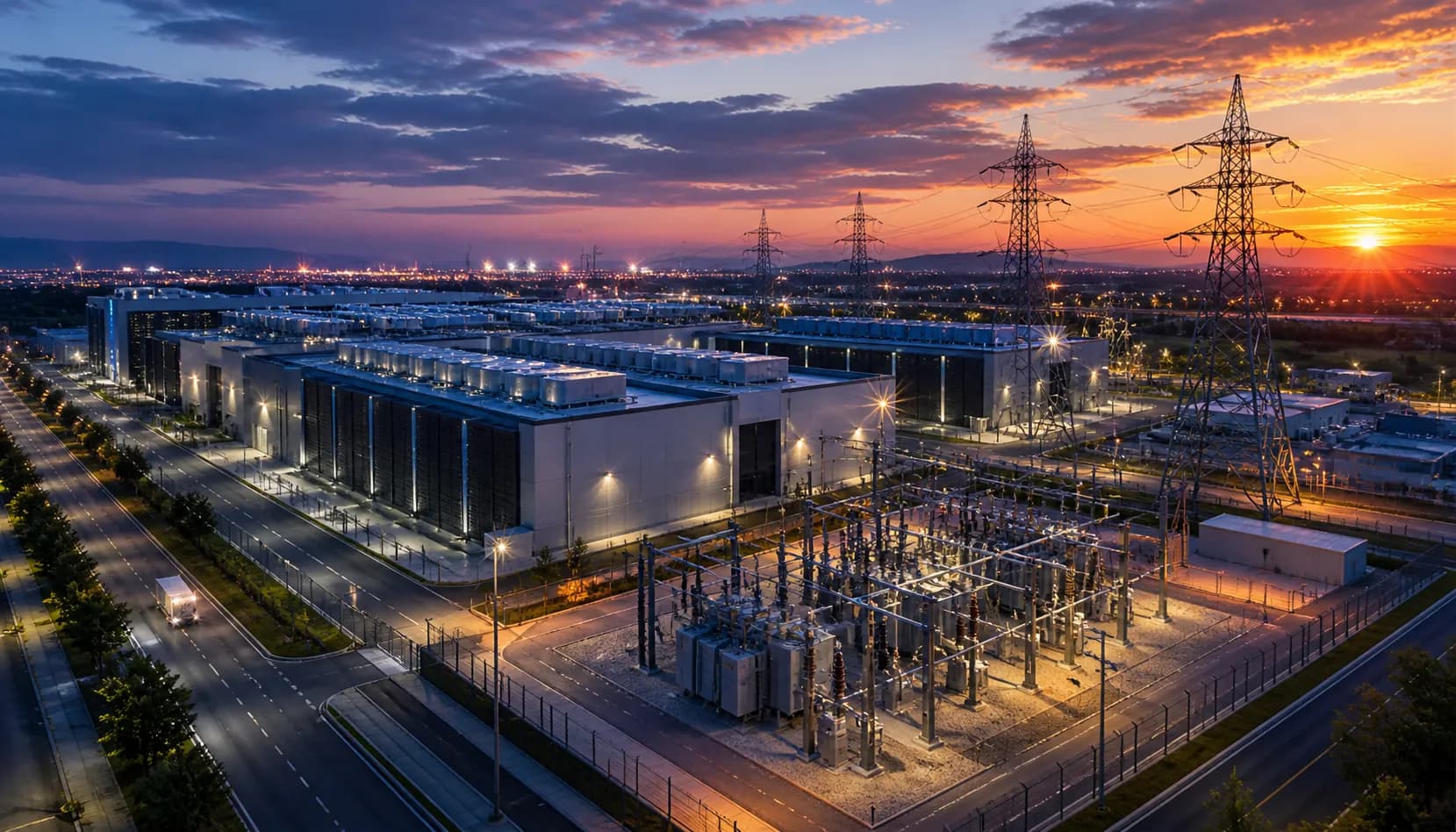
Major technology companies are expanding AI data center infrastructure, creating ripple effects across semiconductor supply chains and regional power markets. The investment wave, driven by growing demand for AI computing capacity, is reshaping procurement strategies for specialized chips and prompting utilities to reassess grid capacity planning. The scale and pace of this infrastructure buildout may influence multiple sectors, though the full economic impact remains uncertain as projects move through early deployment phases.
AI Infrastructure Spending
Major technology companies have outlined large AI infrastructure and data center investment plans, with Microsoft, Alphabet and Meta updating 2026 capital expenditure guidance and Amazon reporting continued AWS growth. Microsoft expects roughly $190B in calendar year 2026 capital expenditures, Alphabet updated 2026 capex guidance to $180–190B and cited AI compute demand, and Meta raised 2026 capex guidance to $125–145B, partly connected to future capacity and data center costs. Amazon reported AWS revenue of $37.6B in Q1 2026 with strong growth continuing. These facilities require specialized infrastructure, including advanced cooling systems capable of managing high-density computing loads, redundant power supplies to ensure continuous operation, and networking equipment designed for AI workload patterns.
The capital commitments represent a shift in technology infrastructure priorities, with companies allocating substantial resources to AI-specific computing capacity rather than general-purpose data center expansion. This strategic reorientation reflects expectations about AI service demand, though actual utilization rates and revenue generation from these investments remain to be demonstrated.
Data center power consumption has emerged as a critical planning factor. IEA analysis indicates that hyperscale AI-focused data centers can reach 100 MW or more and consume electricity on a scale comparable to around 100,000 households annually. Some AI-optimized facilities may require power capacity large enough to affect regional grid planning, creating infrastructure challenges that extend beyond the technology sector into regional energy planning and grid management.
Chip Demand Implications
The data center expansion is driving demand across multiple semiconductor categories. NVIDIA reported record Data Center revenue of $62.3B in Q4 FY2026, while TSMC described AI-related demand as extremely robust and said its 2026 capital budget is expected to be near the high end of its $52B–$56B range. Graphics processing units optimized for AI training and inference workloads represent a significant portion of procurement, with manufacturers facing capacity pressures. High-bandwidth memory chips, essential for AI accelerator performance, face similar supply pressures as data center operators compete for limited production capacity.
Networking components designed to handle the data transfer requirements of distributed AI training also see increased demand. The concentration of orders in specific chip categories may influence semiconductor manufacturers' capital allocation decisions, potentially affecting production priorities and capacity expansion plans across different product lines.
Supply chain dynamics suggest that chip availability could become a limiting factor for data center deployment timelines. Some technology companies have established direct relationships with semiconductor manufacturers to secure supply, while others face longer procurement cycles that may delay infrastructure rollouts. Industry observers note that the current demand surge differs from previous data center expansion cycles in its focus on specialized AI accelerators rather than general-purpose server processors.
Energy Grid Pressure
Data centers consume substantial electricity, and the planned expansion is prompting discussions between technology companies and regional utilities about grid capacity, power sourcing, and infrastructure upgrades. DOE/LBNL analysis states that U.S. data center load growth has tripled over the past decade and could double or triple by 2028. DOE also reports that data centers consumed about 4.4% of U.S. electricity in 2023 and may reach roughly 6.7%–12% by 2028. Some projects require new transmission infrastructure or dedicated power generation capacity to meet demand without compromising grid reliability for other users.
Utilities in several regions are evaluating how to accommodate increased load while maintaining service quality and meeting renewable energy commitments. The timing of data center power demand—which operates continuously at high utilization—differs from traditional industrial loads, creating planning challenges for grid operators accustomed to more variable demand patterns.
In some jurisdictions, data center projects face regulatory scrutiny regarding energy consumption and environmental impact. Approval processes may extend project timelines, particularly in regions where power supply is constrained or where renewable energy mandates require specific sourcing arrangements. The intersection of AI infrastructure growth and energy transition goals presents complex policy questions that regulators are still working to address.
Supply Chain Constraints
The concentration of data center investments in specific geographic regions is creating localized supply chain pressures. Equipment manufacturers, construction firms, and specialized contractors are experiencing increased demand for their services, with some reporting capacity constraints that may affect project timelines.
Specialized cooling equipment, high-voltage electrical systems, and custom networking infrastructure require lead times that can extend construction schedules. The availability of skilled labor for data center construction and commissioning also varies by region, with some markets experiencing shortages that drive up costs and extend timelines.
Component availability for critical systems—including backup power generation, fire suppression, and environmental monitoring—may influence project sequencing decisions. Technology companies are adjusting procurement strategies to account for these constraints, in some cases pre-ordering equipment before site selection is finalized.
Uncertainty and Risk Factors
Several factors could affect the pace and scale of data center deployment. Regulatory requirements for energy consumption and environmental impact vary by jurisdiction and may influence project approvals. Supply chain constraints for critical components could extend construction timelines beyond current projections.
The economic returns on AI infrastructure investments remain uncertain. Monetization strategies for AI services are still evolving, and demand for commercial AI applications has not yet been fully established. Technology companies are making infrastructure commitments based on projected demand that may or may not materialize at anticipated levels.
Market dynamics in the semiconductor industry could also shift. If chip production capacity expands faster than expected, supply constraints may ease, potentially affecting pricing and availability. Conversely, if demand from other sectors increases, competition for semiconductor manufacturing capacity could intensify.
Energy market conditions represent another variable. Power costs vary by region and time, and long-term contracts for electricity supply may expose data center operators to price risk if market conditions change. Renewable energy sourcing requirements may also affect operational costs and project feasibility in some jurisdictions.
Conclusion
The AI data center investment wave represents a significant shift in technology infrastructure spending, with potential implications for semiconductor markets, power grid planning, and regional economic development. However, the ultimate market impact will depend on factors including deployment execution, actual demand for AI services, and the evolution of AI technology itself.
Stakeholders across multiple industries are monitoring these developments as projects move from planning to implementation phases. The infrastructure buildout may create opportunities in construction, equipment manufacturing, and power generation, though the scale and timing of these effects remain uncertain. As data centers begin operations and AI services reach commercial markets, clearer patterns may emerge regarding the sustainability and economic impact of current investment levels.
---
Source Note: Data based on official 2026 financial reports and institutional energy analysis from the IEA and U.S. Department of Energy. AI Assistance Disclosure: This article was drafted with AI assistance for research and structural organization. Editorial Note: Forward-looking statements regarding market demand and infrastructure growth are based on current corporate guidance and remain subject to change as projects move through deployment phases.
Key Takeaways
- Major technology companies are expanding AI data center infrastructure, creating ripple effects across semiconductor supply chains and regional power markets.
- The investment wave, driven by growing demand for AI computing capacity, is reshaping procurement strategies for specialized chips and prompting utilities to reassess grid capacity planning.
- The scale and pace of this infrastructure buildout may influence multiple sectors, though the full economic impact remains uncertain as projects move through early deployment phases.
Data Snapshot
Coverage Area
MARKET
Editorial category
Read Time
~6 min
Approximate duration
Source Base
Article context
Visible evidence profile
Published
May 18, 2026
Updated: May 18, 2026
Evidence Stack & Decision Relevance
This panel shows which decision areas the story prioritizes for citizens, companies, investors and policy makers; the full capital and risk lens should be read in the article below.
Citizens and households
Relevant for budget resilience, debt management, income security and cost-of-living exposure.
Companies, SMEs, B2B and B2C
Relevant for cash flow, pricing power, supply-chain resilience, customer risk and efficiency investment.
Investors and portfolio managers
Not an investment recommendation; a monitoring frame for risk regime, liquidity, valuation discipline and balance-sheet quality.
Regulators and policy makers
Provides signals for financial stability, capital flows, debt sustainability, investment climate and policy credibility.
The full Strategic Impact Matrix and Capital, Risk & Strategic Priority Lens appear below.
Evidence Frame
This layer summarizes visible sources, article context and editorial framing. It is analytical context, not transactional guidance.
Editorial Credit
This intelligence brief was prepared by the SIAIntel Editorial Desk.
Some contributors work in sensitive public-sector, regulatory, market, or editorial roles. Their identities may be withheld when professional duties, source protection, or safety require confidentiality.
Editorial and publishing accountability: Sefa Karahan, Founder & Publisher
Related Intelligence
Related intelligence in this category · 3 briefs
Meta’s $12.3B Bond Exposes Wall Street’s AI Debt Machine
Meta’s $12.3B data-center bond shows how Wall Street is turning Big Tech lease promises into investment-grade AI debt—and pricing a new risk premium.
Bitcoin Miners Are Selling Their Power to AI—Google and NVIDIA Are Financing the Shift
More than $70 billion in AI/HPC contracts is turning bitcoin miners into energy-backed data-centre companies financed by Big Tech.
AI’s Closed Capital Circuit Just Hit the Power Grid
AMD’s Anthropic investment, Amazon’s milestone-linked financing and OpenAI’s 25-year Georgia power deal expose the closed capital circuit behind AI infrastructure.