"Japan’s weak yen, rising JGB yields and fiscal expansion are forcing the BOJ into a rate trap that could reshape global bond markets."

SIAINTEL INTELLIGENCE DOSSIER
Analysis Brief
SIAIntel Verification Panel
Analysis, data context, source mapping and editorial boundaries are presented as one evidence chain.
Key Takeaways
- Japan needs higher interest rates to support the yen, stable bond yields to protect its debt system, and fiscal room to shield households.
- The August 4 government-bond auction suggests those objectives are beginning to collide.
- Japan’s policy problem is no longer simply a weak currency or a difficult central-bank meeting.
Data Snapshot
Coverage Area
Editorial category
MACRO ECONOMY
Read Time
Approximate duration
~12 min
Source Base
Source Map highlights 6 unique sources
19 visible source citations
Published
Updated: Aug 05, 2026
Aug 05, 2026
Evidence Frame
This layer summarizes visible sources, article context and editorial framing. It is analytical context, not transactional guidance.
Japan needs higher interest rates to support the yen, stable bond yields to protect its debt system, and fiscal room to shield households. The August 4 government-bond auction suggests those objectives are beginning to collide.
Japan’s policy problem is no longer simply a weak currency or a difficult central-bank meeting. It is becoming a three-market constraint.
The Bank of Japan needs sufficiently high short-term rates to limit yen depreciation and imported inflation. The Ministry of Finance needs reliable demand for Japanese government bonds to refinance a central-government debt stock of approximately ¥1,343.8 trillion. The government, meanwhile, wants fiscal room to soften the cost-of-living shock and support investment.
Each objective is defensible on its own. The difficulty is that Japan may no longer be able to maximise all three at the same time.
SIAIntel Signal: Supporting the yen, containing long-term JGB yields and expanding fiscal support are becoming parts of one policy decision rather than three separate choices.
The measurable warning came from the primary bond market
The clearest signal arrived on August 4, when Japan auctioned a new tranche of 10-year government bonds.
According to Japan’s Ministry of Finance, competitive bids totalled ¥5.0624 trillion, while ¥1.9791 trillion was accepted. The weighted-average yield was 2.840%, and the yield at the lowest accepted price was 2.900%. SIAIntel calculates a bid-to-cover ratio of approximately 2.56 times and an auction tail of 6.0 basis points.
The result matters less as a single weak auction than as the latest point in a deteriorating sequence.
| 10-year JGB auction | Competitive bids | Accepted bids | Average yield | Bid-to-cover | Auction tail |
|---|---|---|---|---|---|
| May 12 | ¥7.6166tn | ¥1.9510tn | 2.540% | 3.90x | 0.4 bp |
| June 2 | ¥7.0031tn | ¥1.9839tn | 2.649% | 3.53x | 0.7 bp |
| July 2 | ¥6.1448tn | ¥1.9631tn | 2.729% | 3.13x | 2.6 bp |
| August 4 | ¥5.0624tn | ¥1.9791tn | 2.840% | 2.56x | 6.0 bp |
Sources: Japan Ministry of Finance — May auction, June auction, July auction and August 4 auction result. Bid-to-cover ratios and tails are SIAIntel calculations.
The May tail is 0.4 basis points, not 3 basis points. That correction creates a clean progression:
0.4 → 0.7 → 2.6 → 6.0 basis points
At the same time, the bid-to-cover ratio fell:
3.90x → 3.53x → 3.13x → 2.56x
Japan still sold the bonds. This was not a failed auction. The signal is that investors demanded increasingly attractive pricing even as benchmark yields climbed.
Why the 3% JGB line matters
A 10-year JGB yield near 3% is not an automatic crisis threshold. Japan borrows primarily in its own currency, retains a large domestic investor base and still has uninterrupted market access.
But the 3% area is economically important because it challenges the low-cost refinancing assumptions embedded in Japan’s fiscal system.
Higher yields do not immediately reprice the entire debt stock. Existing bonds mature over time, and the average interest cost adjusts gradually. Yet every refinancing cycle transfers more of the market move into the budget. That can narrow the room available for tax relief, industrial policy, defence, energy support and social spending.
The political importance of 3% is therefore not that a mechanical break occurs at exactly 3.00%. It is that the policy response becomes harder to execute without creating a new problem elsewhere.
The ¥13.4 trillion sensitivity
The Ministry of Finance reported ¥1,343.8426 trillion in outstanding government bonds, borrowings and financing bills as of March 31, 2026. The figure is an official stock measure, not a forecast of annual funding needs. (MOF central-government debt data)
A mechanical 100-basis-point increase applied to that entire stock equals approximately:
¥1,343.8 trillion × 1% = ¥13.4 trillion
This is a SIAIntel sensitivity calculation, not a forecast of next year’s interest bill. Japan does not refinance all debt at once; maturities, coupons, BOJ holdings and issuance structure determine the realised path.
The calculation nevertheless explains why the difference between a 1%, 2% and 3% long-term yield environment is becoming a political variable. Over time, the amount at risk is comparable with major national policy programmes.
The BOJ’s rate decision exposes the other side of the trap
On July 31, the BOJ kept the uncollateralised overnight call rate at around 1.0% by an 8–1 majority. Board member Hajime Takata dissented and proposed 1.25%, arguing that the Bank needed a more agile response to upside price risks from foreign demand shocks and changes in global financial conditions. (BOJ statement, July 31, 2026)
That dissent matters because a weak yen can raise the domestic cost of imported fuel, food and industrial inputs. The currency channel can then feed electricity bills, transport costs, corporate margins and wage negotiations.
The logic points toward higher rates:
Weak yen + imported inflation
↓
Pressure for tighter policy
The bond market points in the opposite direction:
Higher policy rates + fiscal uncertainty
↓
Higher long-term yields
↓
More refinancing and valuation pressure
The BOJ can raise the short-term rate while using bond purchases to limit disorderly moves at the long end. Operationally, that is possible. Strategically, it creates a communication risk: investors may conclude that the short end is controlled for inflation while the long end is protected for fiscal purposes.
Bond purchases can buy time, not remove the trade-off
The BOJ’s existing reduction plan still leaves it purchasing substantial quantities of JGBs. The published schedule called for monthly purchases of about ¥2.5 trillion in July–September 2026, ¥2.3 trillion in October–December, and ¥2.1 trillion in January–March 2027. (BOJ purchase-reduction schedule)
If yields rise rapidly, additional operations can calm market functioning. But repeated intervention would raise a deeper question: is the BOJ supplying liquidity to stabilise a disorderly market, or suppressing the price of government borrowing?
The distinction is central to policy credibility. A temporary liquidity operation does not imply monetary financing. A pattern of purchases designed to shield fiscal policy from market pricing would be interpreted differently.
Currency intervention cannot solve a bond-market signal
Foreign-exchange intervention can disrupt one-way positioning and punish speculative trades. It cannot permanently offset a wide interest-rate differential, imported energy pressure or uncertainty about future borrowing.
Reporting around the end of July indicated yen-buying intervention after the currency weakened sharply. At publication stage, SIAIntel will describe the event as reported intervention until the Ministry of Finance’s complete official monthly disclosure provides the final amount and dates.
This source discipline matters. The thesis does not depend on the exact intervention amount. The stronger evidence is the interaction between the BOJ vote, the auction deterioration and the government’s demand for fiscal room.
The global channel runs through portfolio incentives
Japanese banks, insurers, pension funds and institutional investors hold large foreign-asset portfolios. As domestic government-bond yields rise, the relative attraction of foreign fixed income can decline, especially after currency-hedging costs.
That does not guarantee a disorderly repatriation of Japanese capital. Portfolio decisions depend on liabilities, regulation, duration targets, liquidity and expected currency returns.
The more credible transmission chain is gradual:
Higher JGB yields
↓
Better relative return at home
↓
Less incentive to add foreign duration
↓
Weaker marginal demand for global sovereign bonds
↓
Upward pressure on international term premiums
The risk is not simply “Japan sells U.S. Treasuries.” It is that one of the world’s largest pools of savings requires less foreign duration at the margin.
The anti-thesis: Japan is not facing an immediate debt crisis
The evidence does not support claims of imminent default or a sudden funding stop.
The BOJ’s April 2026 Financial System Report concluded that Japan’s financial system remained stable overall. It found that banks had sufficient capital and stable funding to withstand severe combined stress involving oil-price shocks, weaker expectations for AI-related assets and a substantial rise in interest rates. It also reported that yen interest-rate risk in banking books remained low relative to capital. (BOJ Financial System Report, April 2026)
Japan retains several powerful defences:
- government debt is issued mainly in yen;
- domestic institutions remain major buyers;
- the country has substantial household and corporate financial assets;
- the BOJ can provide market liquidity;
- and primary auctions continue to clear.
The bearish case is not immediate insolvency. It is a shrinking policy margin.
Audience Impact
| Audience | What changes |
|---|---|
| Global investors | The 3% JGB area becomes a cross-asset signal for the yen, Japanese equities and global sovereign yields. |
| Banks and insurers | Higher yields improve reinvestment income but increase duration, valuation and asset-liability risks. |
| Exporters | Yen strength can reduce translated overseas earnings; yen weakness raises imported costs. |
| Households | Fiscal relief can soften inflation, but higher rates can lift mortgage and financing costs. |
| Policymakers | Currency operations buy time; they do not remove the conflict between tighter money and fiscal expansion. |
| Credit markets | Rising JGB yields can gradually reprice corporate debt and international capital allocation. |
What to watch next
Four signals will determine whether Japan’s policy triangle stabilises or tightens:
- whether the 10-year JGB trades sustainably above 3%;
- whether the next auctions improve or further weaken in bid quality;
- whether the BOJ moves the policy rate to 1.25%;
- whether fiscal measures are matched with a credible permanent funding source.
A stronger auction would show that higher yields are attracting durable buyers. A weaker auction combined with additional fiscal commitments would increase pressure on the BOJ to choose between currency stability and bond-market stability.
The SIAIntel stress ladder: ¥3.36–¥13.44 trillion
The headline ¥13.44 trillion figure is only the top of a mechanical sensitivity ladder. Applying persistent increases in the average refinancing cost to the official ¥1,343.8426 trillion central-government debt stock produces the following scale:
| Persistent average cost increase | Mechanical annual sensitivity |
|---|---|
| 25 basis points | ¥3.36 trillion |
| 50 basis points | ¥6.72 trillion |
| 75 basis points | ¥10.08 trillion |
| 100 basis points | ¥13.44 trillion |
These are not budget forecasts. They show the eventual annualised scale if the higher average cost were transmitted across the full stock through refinancing. The realised path would be gradual and would depend on maturities, coupons, issuance composition and BOJ holdings.
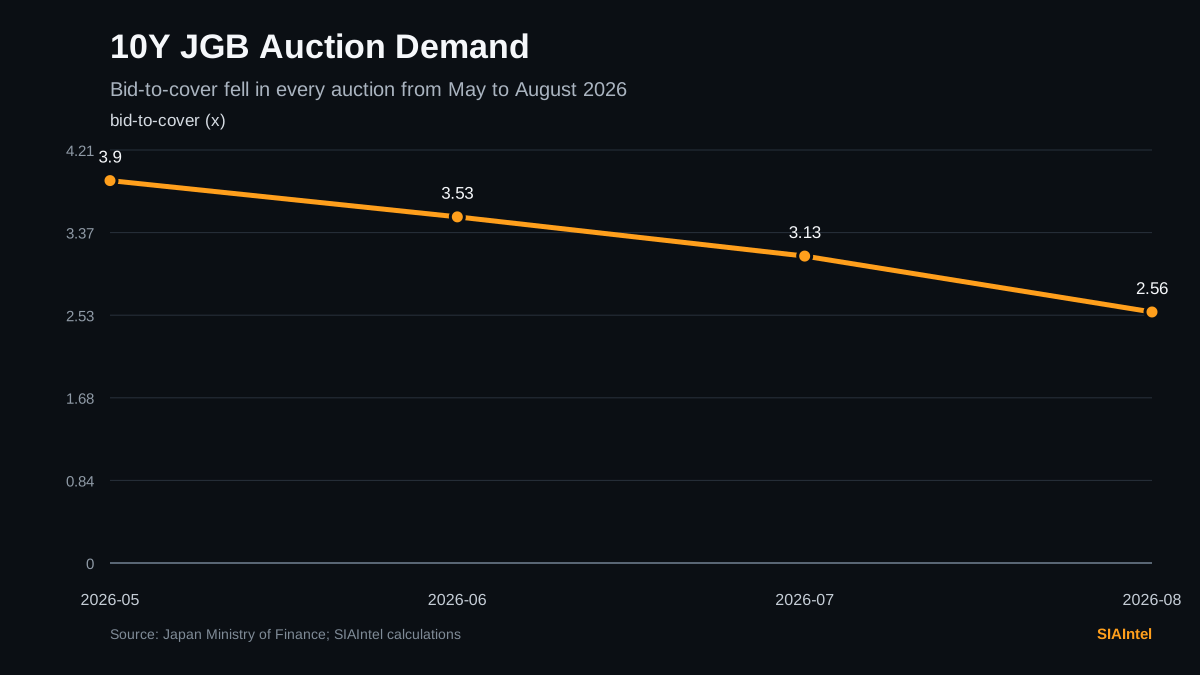
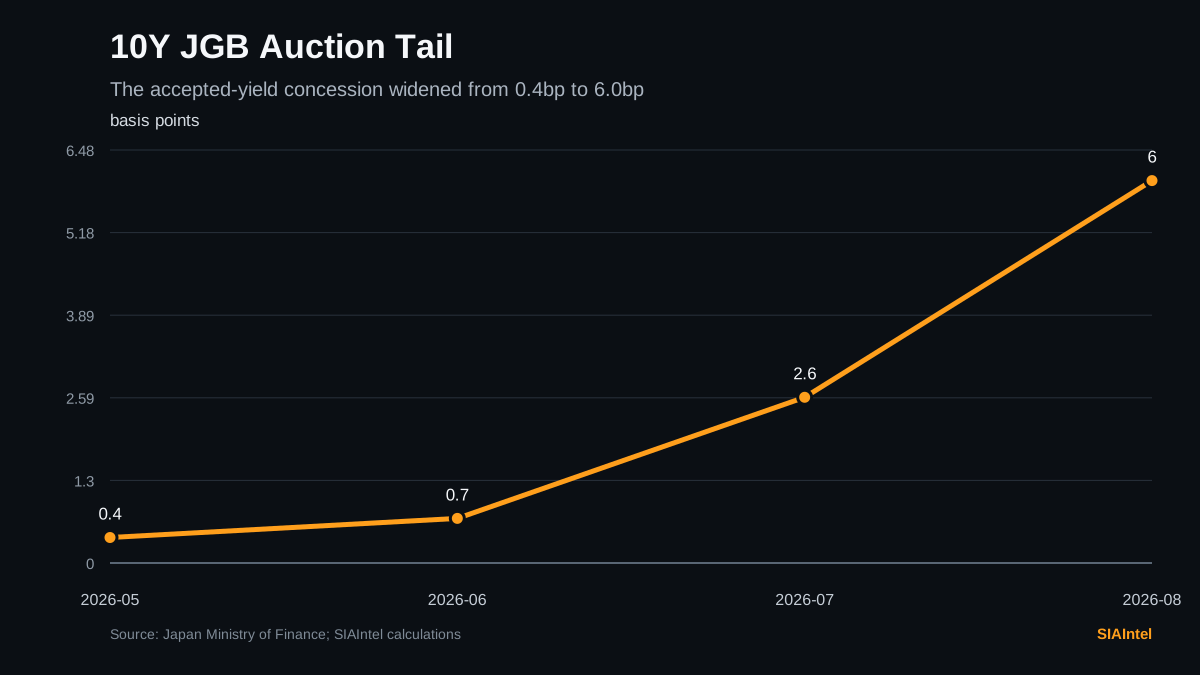
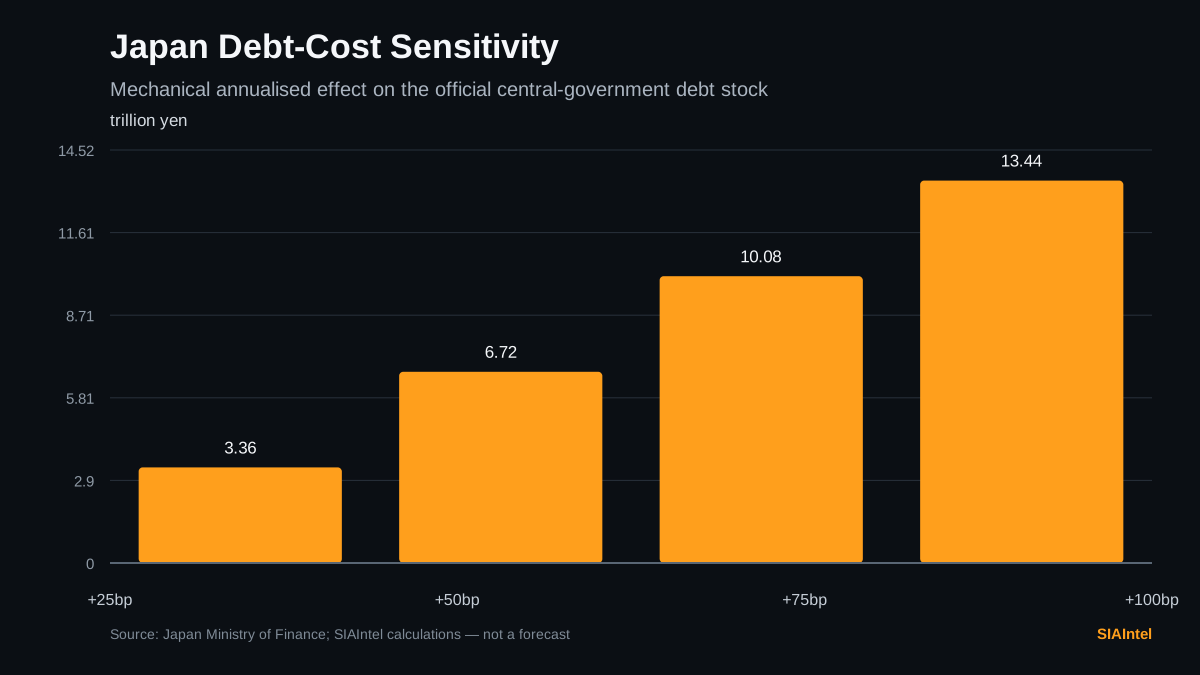
Together, the charts distinguish three different signals: less demand relative to accepted supply, a wider concession required to clear the auction, and the long-run fiscal sensitivity of a higher refinancing regime.
What would disprove the thesis?
This analysis should weaken—not merely be reworded—if the evidence changes. The policy-triangle thesis would lose force if:
- the next two 10-year JGB auctions lift bid-to-cover materially above the July level while the auction tail returns below 1 basis point;
- the yen stabilises for a sustained period without additional rate increases or repeated intervention;
- the government identifies permanent, credible funding for its tax and investment commitments without increasing net market issuance pressure;
- or domestic institutions absorb higher JGB supply without a persistent rise in term premium, volatility or required auction concession.
A single strong session is not enough. The falsification test is a durable improvement in auction quality, currency stability and fiscal credibility at the same time.
SIAIntel watch dashboard
| Indicator | Current reference | Escalation signal | Stabilisation signal |
|---|---|---|---|
| 10-year auction bid-to-cover | 2.56x | Falls further | Recovers above 3.1x |
| 10-year auction tail | 6.0 bp | Remains above 3 bp | Returns below 1 bp |
| 10-year JGB yield | Near the 3% policy line | Sustained break above 3% | Falls with stronger auction demand |
| BOJ policy rate | 1.0% | Rise to 1.25% with long-end stress | Yen stabilises without bond disorder |
| Fiscal funding | Incomplete permanent funding detail | Higher net issuance or temporary funding | Credible permanent revenue source |
The dashboard is a monitoring framework, not an automatic trading signal. Each indicator must be read with liquidity conditions, issuance composition and the policy response.
Methodology and evidence classification
SIAIntel calculated bid-to-cover as competitive bids divided by accepted competitive bids. Auction tail is the difference between the weakest accepted yield and the weighted-average accepted yield, converted into basis points. Debt-cost sensitivities apply 0.25%, 0.50%, 0.75% and 1.00% mechanically to the official debt stock.
Every material statement is classified as one of four types:
- Primary source: directly supported by the Ministry of Finance or Bank of Japan;
- Secondary confirmed: supported by reputable reporting but not yet fully disclosed in an official release;
- SIAIntel calculation: reproducible arithmetic from cited inputs;
- SIAIntel inference: an analytical transmission mechanism rather than an observed fact.
The secondary-confirmed layer includes Reuters reporting on Takaichi’s request for additional BOJ bond purchases if long-term yields rise too quickly; the official-policy implications remain separately anchored to BOJ and Ministry of Finance documents.
Python independently recalculates the arithmetic, verifies the seven-language fact representations, checks source-domain coverage, measures structural parity and renders the three charts from approved numeric inputs. A Python PASS confirms reproducibility only; it does not authorise publication.
The Bottom Line
Japan’s constraint is often described as a choice between inflation and growth. That framing is now incomplete.
The real choice is increasingly between the currency, the bond market and the budget.
The August 4 auction did not show that Japan had lost access to capital. It showed that the price of maintaining investor confidence is rising while the government seeks more fiscal room and the central bank faces pressure to protect the yen.
Japan has not reached a sovereign-debt crisis. It is approaching a policy-credibility test—and the 3% JGB line is where that test becomes visible.
Related SIAIntel Intelligence
- AI’s Dollar-Watt Squeeze: Fed Meets PJM’s 6.8 GW Gap — How interest rates and infrastructure scarcity reprice capital
- AI’s Closed Capital Circuit Just Hit the Power Grid — How capital structure and physical infrastructure become one constraint
Sources
- Ministry of Finance Japan — Auction Result of 10-Year JGBs on May 12, 2026
- Ministry of Finance Japan — Auction Result of 10-Year JGBs on June 2, 2026
- Ministry of Finance Japan — Auction Result of 10-Year JGBs on July 2, 2026
- Ministry of Finance Japan — Auction Result of 10-Year JGBs on August 4, 2026
- Bank of Japan — Statement on Monetary Policy — July 31, 2026
- Ministry of Finance Japan — Central Government Debt as of March 31, 2026
- Bank of Japan — Plan for the Reduction of JGB Purchases
- Bank of Japan — Financial System Report — April 2026
- Reuters — Takaichi asked BOJ to buy more bonds when needed
Editorial Credit
This intelligence brief was prepared by the SIAIntel Editorial Desk.
Some contributors work in sensitive public-sector, regulatory, market, or editorial roles. Their identities may be withheld when professional duties, source protection, or safety require confidentiality.
Editorial and publishing accountability: Sefa Karahan, Founder & Publisher
Related Intelligence
Related intelligence in this category · 6 briefs

Amazon Sold 2027. The AI Oracle Sold the Present
Amazon’s AI demand boom and a fund’s 67% July loss reveal why patient balance sheets may be the next scarce AI resource.

MediaTek’s $5B AI Chip Bet: Who Gets the Capacity?
MediaTek’s $5B plan turns custom AI chips into a contest for financed, deliverable semiconductor capacity.

Big Oil’s $26.6B Signal: Hormuz and Inflation Risk
Exxon and Chevron earned $26.6B as refining scarcity, Hormuz transit and war-risk insurance reshaped the inflation and Fed outlook.
AI’s Dollar-Watt Squeeze: Fed Meets PJM’s 6.8 GW Gap
A 9–3 Fed split and PJM’s 6.8 GW reliability gap show why AI infrastructure is being repriced through both capital and firm power.

AI’s Megawatt Margin Call Has Begun: Ofgem Turns Grid Access Into a Credit Test
Ofgem’s £71.3m collateral proposal, Oracle’s BBB- rating and a 73 GW queue turn AI data-centre grid access into a live credit test.
Nvidia–OpenAI $250B Talks Expose AI’s Hidden Credit Circuit
Nvidia’s reported $250B OpenAI guarantee talks, project bonds and BIS warnings confirm SIAIntel’s early map of AI’s hidden credit circuit.