Wistron is tapping global equity markets to fund raw materials as Nvidia locks $279 billion of future supply and capacity. The macro leg remains a test, not a conclusion.
30-Second Signal
The fresh signal on September 7 is not Nvidia's August filing; it is a financing transaction one layer deeper in the AI hardware chain. Reuters reports that Wistron launched 25 million global depositary shares worth up to about $1.48 billion, with proceeds intended to fund purchases of raw materials denominated in foreign currencies. Wistron is an Nvidia supplier, and the transaction arrives while the company says AI-server demand remains stronger than available supply.
The upstream scale is visible in Nvidia's Form 10-Q: supply and capacity commitments rose from $119 billion to $279 billion in one quarter, an increase of $160 billion or about 134.5%. Nvidia says these commitments are primarily related to memory and manufacturing facilities. Its listed future commitments across supply and capacity, cloud services, not-yet-commenced data-center leases, equity investments and capital expenditure total about $366 billion. That does not mean $366 billion is an immediate cash liability; some supplier arrangements can be cancelled, rescheduled or adjusted before firm orders.
A second supply-chain financing point appeared days earlier. WT Microelectronics' official September 1 announcement priced $435 million of GDSs and $500 million of zero-coupon convertible bonds, about $935 million combined. The company said proceeds would support purchases of raw materials in foreign currencies, while part of the GDS proceeds would repay foreign-currency bank borrowing.
This is not a brand-new financing channel. Wistron's August 4 board disclosure had already approved filing for up to 250 million new common shares in GDR form. Earlier, Wistron completed a $914.25 million GDS offering in June 2025, and a $1.2 billion zero-coupon convertible-bond offering in October 2025. The defensible signal is therefore not a regime break. It is a recurring external-financing channel being used at larger scale while AI hardware demand expands.
SIAIntel status: CONFIRMED — EARLY TRANSMISSION. Confirmed today: AI hardware demand is producing measurable external-financing requirements inside the supply chain. Not confirmed: that supplier financing is large enough to move sovereign yields. That macro leg remains a testable hypothesis.
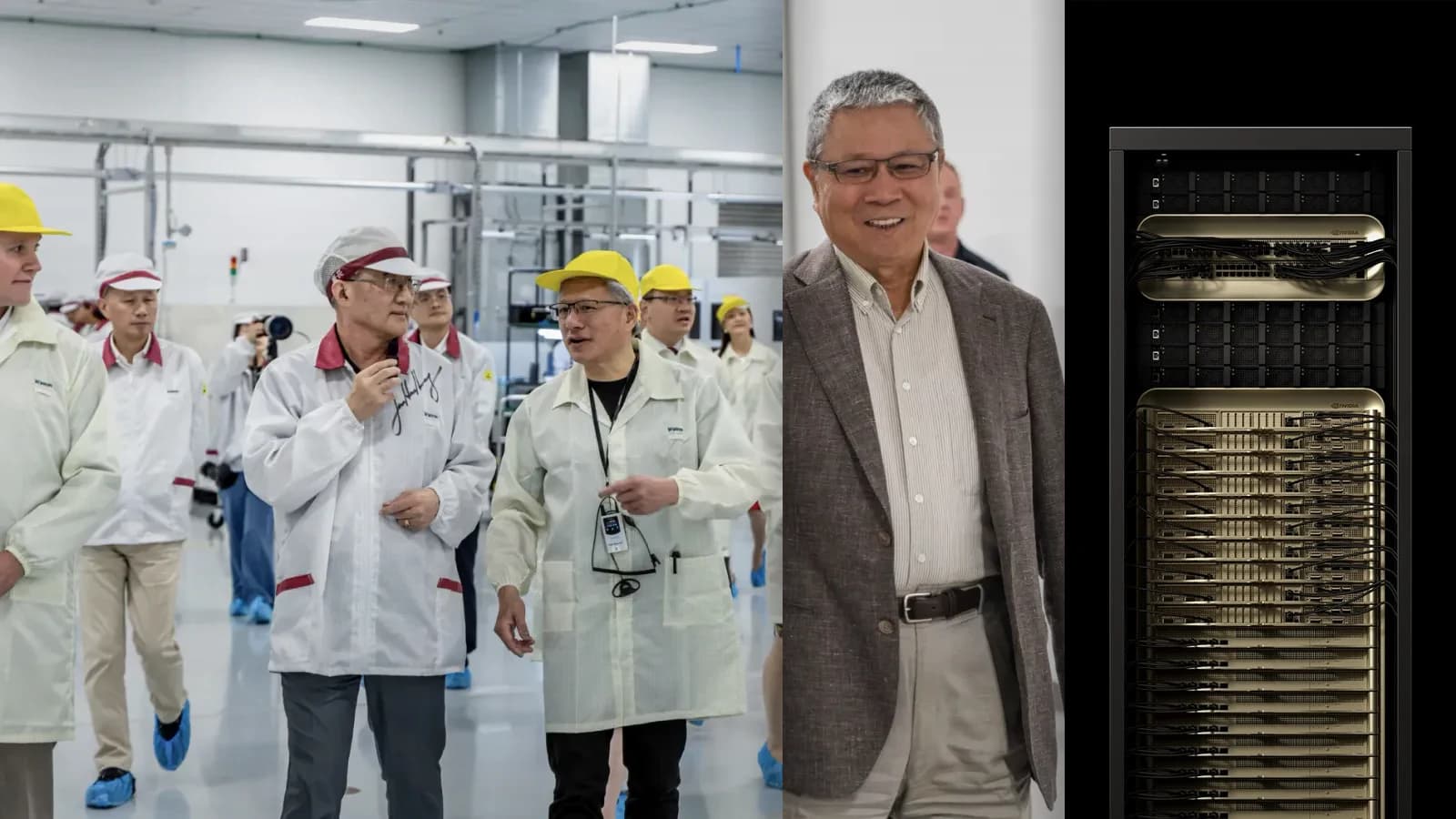
*Visual disclosure: the feature image is a no-text editorial composite assembled from official Wistron event photography and an official NVIDIA Newsroom product image. It is contextual and is not evidence of the September 7 financing transaction.*
The Channel Is Not New. The Scale Is Growing.
Wistron's financing history is important because it prevents a misleading headline. A company that issued GDSs in 2025 and later sold a large convertible has not suddenly discovered external capital in September 2026. Today's signal is better understood as repetition with a larger current equity transaction and a more visible connection to the working-capital needs of the AI supply chain.
The scale comparison is still notable. The current Wistron GDS could reach about $1.48 billion versus $914.25 million in the June 2025 GDS deal, roughly 62% larger. But even that comparison should not be read as proof of financial stress. Equity is a legitimate way to finance rapid growth, particularly when management wants to avoid loading all expansion onto debt.
Physical capacity is also expanding. Wistron's official account of its Fort Worth D1 AI smart factory describes a $700 million investment producing Nvidia GB300 systems. The factory matters analytically because it makes the chain tangible: orders for AI systems become purchases of memory, boards, networking components, power equipment, racks, logistics and labor before the final system is delivered and paid for.
That timing gap is where working capital enters the story. The faster unit volumes and component values rise, the more cash can be tied up between procurement and customer settlement even when final demand is exceptionally strong. External financing can therefore rise during a boom rather than only during distress.
Nvidia Shows Why Working Capital Can Grow
Nvidia's $279 billion commitment number should be used carefully. It is not $279 billion of debt, it is not an invoice due tomorrow, and the $160 billion quarterly increase should not be described as $160 billion of memory purchases. Nvidia's own wording says supply and capacity commitments are primarily related to memory and manufacturing facilities across current and future products.
The number nevertheless reveals the industrial scale being reserved ahead of expected demand. When a platform company attempts to secure memory and manufacturing capacity several years forward, suppliers have incentives to expand plant, reserve components and hold more high-value inventory. The cash requirement does not sit on one balance sheet. It can propagate through contract manufacturers, distributors, memory vendors, networking suppliers, utilities and data-center developers.
Nvidia's broader $366 billion table reinforces that point because it includes several different forms of future resource access rather than one homogeneous liability. The correct interpretation is a large forward commitment stack against expected AI demand. The investment question is whether cash generation across the ecosystem keeps pace with the capital that must be committed before final revenue is realized.
The Hidden AI Working-Capital Chain
The conventional AI-capex map is hyperscaler spending → Nvidia revenue → servers → data centers. A physical supply chain adds another layer: AI orders → component procurement → inventory → assembly → delivery → customer payment. Financing sits between several of those steps.
Wistron's stated use of proceeds is therefore analytically useful. Raw-material purchases denominated in foreign currencies are not an abstract future capex ambition; they are a direct operating input. WT Micro's similar use-of-proceeds language provides a second observable example in the same week. Together the two announced financings are about $2.4 billion, but the value of the observation is compositional, not macro in size.
The composition matters because AI discussion often treats the largest cash-rich hyperscalers as if they represent the financing capacity of the entire ecosystem. They do not. Smaller manufacturers, distributors and infrastructure providers face different cash-conversion cycles, credit ratings and funding choices. As AI demand spreads, financing quality can become a competitive advantage even when end demand remains strong.
This Is Not Yet a Treasury-Crowding Story
About $2.4 billion of Wistron and WT Micro financing is tiny relative to global sovereign debt markets. It cannot credibly explain why the U.S. 10-year Treasury yield has traded near 4.8%. Treating those transactions as the cause of the move would turn a useful signal into false precision.
The macro connection should instead be stated as a transmission hypothesis. Reuters' September 4 global-markets analysis described elevated long-term yields as the product of multiple pressures, including fiscal supply, inflation risk and heavy corporate or AI-linked borrowing. AI can enter the same marginal pool of long-duration capital without being responsible for every basis point.
The hypothesis strengthens only if the financing pattern broadens: more server and memory suppliers raise equity or debt for inventory and capacity; more data-center projects require guarantees or structured finance; corporate issuance stays heavy alongside sovereign supply; and long yields remain elevated even after cyclical inflation pressure eases. Until then, supplier financing is an early indicator, not proof of macro crowding out.
Who Feels the Capital Chain First
AI suppliers: High-growth manufacturers and distributors must balance market share against cash conversion. A supplier can report strong revenue and profits while still needing more external capital because inventories, receivables and component commitments grow faster than cash settlement.
Hyperscalers and model companies: Cash-rich leaders can internalize more of the build-out, but their suppliers cannot all finance at hyperscaler spreads. Contract structure, prepayments and guarantees may increasingly determine which projects can scale fastest.
Investors and lenders: The useful split is not simply AI versus non-AI. It is cash-generative platforms versus capital-hungry infrastructure and supply-chain firms. Equity issuance can dilute holders; convertibles transfer future upside; bank and bond financing raises fixed claims. The mix tells investors where the financing burden is landing.
Households and the broader economy: There is no direct line from one Taiwanese GDS to mortgage rates. The transmission becomes relevant only if a much larger AI investment complex competes persistently with sovereigns and conventional companies for term capital. That is why the next phase must be measured rather than asserted.
Waller Is a Macro Bridge, Not Proof
The structural bridge comes from the Federal Reserve, but it needs a narrow reading. Reuters reported Christopher Waller's argument that competition for capital from AI infrastructure is one factor affecting long-term yields and his estimate of the neutral rate. He also argued that the historical safety premium attached to liquid U.S. government debt had largely disappeared.
That does not mean Waller declared an AI crowding-out crisis. His comments on near-term policy were read dovishly at first, and his structural r-star discussion should not be converted into a claim that the Fed is alarmed by AI financing. It is useful here for one reason: an independent central-bank policymaker has explicitly placed AI infrastructure inside the broader competition-for-capital framework.
The near-term price of capital is also not moving in an obviously easier direction. Reuters reported on September 7 that UBS shifted its 2026 Fed forecast to two 25-basis-point hikes, in September and December, after stronger employment data. A forecast is not a policy decision, but it illustrates the environment in which capital-intensive AI expansion is being financed.
Counter-Case: Healthy Growth Financing
The strongest counter-case is that these transactions are exactly what healthy companies should do when demand is growing faster than current production capacity. Reuters reported Wistron's second-quarter net profit rose 128% year over year and revenue increased 64%. Those are not obvious symptoms of distress. The company can use equity to enlarge its capital base while preserving debt capacity for other needs.
Nvidia also generates extraordinary operating cash flow, and its commitments are designed to secure supply against expected demand. If AI revenue and productivity gains rise fast enough, a larger capital stack can be absorbed without destabilizing credit markets. In that scenario, more issuance reflects a productive investment supercycle rather than a bubble.
The historical Wistron transactions strengthen this anti-thesis. Because GDS and convertible financing existed before today's raise, the September deal cannot by itself mark a sudden regime change. What would change the regime is synchronized acceleration across many suppliers combined with weaker cash conversion, wider credit spreads or increasing reliance on guarantees. We do not have that evidence yet.
Confirmation Test
The next evidence should be observable. First, track additional GDS, equity, bond and convertible issuance by server, memory, networking and component suppliers, especially where the stated use of proceeds is inventory, raw materials or capacity. Second, track whether customer prepayments and supplier financing grow alongside Nvidia and hyperscaler commitments. Third, compare financing growth with operating cash generation rather than revenue alone.
Fourth, watch whether lower-tier AI infrastructure borrowers pay materially wider concessions even while top-tier technology credit remains strong. Fifth, test the sovereign link separately: persistent long yields, weaker auction demand or higher term premia must be evaluated against fiscal supply, inflation and foreign demand before attributing any residual to AI capital competition.
The thesis is weakened if supplier fundraising normalizes, working-capital intensity falls, AI cash generation covers a larger share of expansion internally, or long-term yields decline despite continued AI investment. It is strengthened if financing repeatedly appears deeper in the supply chain while the all-in cost of capital remains high. These are monitoring thresholds, not trading instructions.
SIAIntel Bottom Line
Wistron's September 7 GDS is valuable because its use of proceeds exposes a normally hidden layer of the AI boom: the cash needed to buy inputs before finished AI systems generate final payment. WT Micro shows a similar mechanism, Nvidia's commitment stack shows why the physical pipeline can become enormous, and Wistron's own 2025 transactions prove that the financing channel is recurring rather than new.
The honest boundary is equally important. Two transactions totaling about $2.4 billion do not move the global Treasury market by themselves, and SIAIntel is not claiming that they do. What changed is the evidence set: financing demand is now observable beyond hyperscaler capex budgets, inside the firms that procure and assemble the hardware.
SIAIntel final signal: AI has already become a compute and energy constraint. The new confirmed layer is supply-chain financing; whether that grows into a system-wide capital constraint is the next test.
Source Map
6 highlighted sources
Reuters reports that Wistron launched 25 million global depositary shares worth up to about $1.48 billion
NewswireEditorial Credit
This intelligence brief was prepared by the SIAIntel Editorial Desk.
Some contributors work in sensitive public-sector, regulatory, market, or editorial roles. Their identities may be withheld when professional duties, source protection, or safety require confidentiality.
Editorial and publishing accountability: Sefa Karahan, Founder & Publisher
Related Intelligence
Related intelligence in this category · 3 briefs

Fed May Pause. AI’s $1.5T Buildout Could Keep Rates High
US PPI went flat, but AI infrastructure commitments, bond supply and grid bottlenecks may keep long-term financing costs elevated even if the Fed pauses.

Nvidia Pulls Back as AI Credit Loop Tightens
AI demand is still surging, but Nvidia's financing pullback shows capital quality is becoming the next constraint on the boom.

AI Revenue Is Booming. Credit Is Getting Nervous
Nvidia's Q2 revenue beat expectations and its Q3 revenue guidance came in above consensus, but rising debt, guarantees and infrastructure finance leave demand quality unresolved.