"US PPI went flat, but AI infrastructure commitments, bond supply and grid bottlenecks may keep long-term financing costs elevated even if the Fed pauses."
SIAINTEL INTELLIGENCE DOSSIER
Analysis Brief
SIAIntel Verification Panel
Analysis, data context, source mapping and editorial boundaries are presented as one evidence chain.
Key Takeaways
- AI’s $1.5T Buildout Could Keep Rates High US producer prices were unchanged in July, cutting the immediate case for another Federal Reserve hike.
- But a separate capital shock is building underneath the policy rate: hyperscalers are locking in roughly $1.5 trillion of purchase commitments while AI-linked debt issuance and grid…
- SIAIntel’s signal is that a Fed pause may no longer guarantee a rapid return of cheap long-term money.
Data Snapshot
Coverage Area
ECONOMY
Editorial category
Read Time
~14 min
Approximate duration
Source Base
17 visible source citations
Source Map highlights 6 unique sources
Published
Aug 13, 2026
Updated: Aug 13, 2026
Source Map
6 highlighted sources
July Producer Price Index was unchanged month over month
NewswireMarket reporting / newswire context
Financial Times calculated roughly $1.5 trillion of hyperscaler purchase commitments
SourceReferenced source context
Heron Power announced a $100 million factory near San Jose
NewswireMarket reporting / newswire context
SIAINTEL DATA INTELLIGENCE
AI Capital Pressure Console
Disinflation meets long-duration AI capital, power and grid commitments.
July PPI m/m
0.0%
Final demand
Hyperscaler purchase commitments
$1.5T
Approximate aggregate
Alphabet commitments
$811B
June 30 disclosure
Heron grid factory
$100M
Announced Aug. 13
Alphabet commitment acceleration
Material purchase commitments and other contractual obligations rose sharply between Q1 and Q2 2026.
Alphabet long-duration capital markers
Fixed or guaranteed commitments, uncommenced leases and first-half capex show the duration of the buildout.
AI buildout to financing-cost transmission
Multiple linked channels separate the Fed policy rate from long-duration financing costs.
| Layer | Observed signal | Capital channel | Watch |
|---|---|---|---|
| Inflation | PPI 0.0% m/m | Lower immediate Fed-hike pressure | CPI/PCE |
| Hyperscalers | ~$1.5T commitments | Long-duration private capital demand | Bond issuance |
| Grid | New transformer/power capacity | Physical bottleneck extends project duration | Interconnection |
| Borrowers | Long yields can diverge | Benchmarks can stay restrictive | 10Y/30Y + spreads |
Rate-pressure scenarios
Four paths separate the policy-rate signal from the long-duration capital channel.
Scenario 1
Pause, long yields sticky
Fed pauses but term premium stays firm
Borrowing relief arrives slowly
Scenario 2
Pause, curve rallies
Disinflation overwhelms new issuance
Long-term financing eases
Scenario 3
Inflation returns
Fed-hike risk revives with heavy issuance
Short and long rates tighten together
Scenario 4
Buildout self-funds
AI revenue outruns obligations and bottlenecks ease
External funding need falls
Source lock
Only sourced commitments and disclosed obligations are plotted. Long-rate impact is a SIAIntel inference, not a single-factor causality claim.
Evidence Stack & Decision Relevance
This panel shows which decision areas the story prioritizes for citizens, companies, investors and policy makers; the full capital and risk lens should be read in the article below.
Citizens and households
Relevant for budget resilience, debt management, income security and cost-of-living exposure.
Companies, SMEs, B2B and B2C
Relevant for cash flow, pricing power, supply-chain resilience, customer risk and efficiency investment.
Investors and portfolio managers
Not an investment recommendation; a monitoring frame for risk regime, liquidity, valuation discipline and balance-sheet quality.
Regulators and policy makers
Provides signals for financial stability, capital flows, debt sustainability, investment climate and policy credibility.
The full Strategic Impact Matrix and Capital, Risk & Strategic Priority Lens appear below.
Evidence Frame
This layer summarizes visible sources, article context and editorial framing. It is analytical context, not transactional guidance.
US producer prices were unchanged in July, cutting the immediate case for another Federal Reserve hike. But a separate capital shock is building underneath the policy rate: hyperscalers are locking in roughly $1.5 trillion of purchase commitments while AI-linked debt issuance and grid investment accelerate. SIAIntel’s signal is that a Fed pause may no longer guarantee a rapid return of cheap long-term money.
The 30-second decision
The market received a conventional dovish signal on August 13. The July Producer Price Index was unchanged month over month, against expectations for a rise, while goods prices fell 0.7%. The annual PPI rate slowed to 4.7%. Futures pricing subsequently put the probability of a September hike near one-third, leaving a hold as the dominant outcome.
That is the surface story. The deeper story sits farther out on the yield curve. Big technology companies and the financing ecosystem around them are securing chips, data-center capacity, electricity and grid equipment years in advance. The Financial Times calculated roughly $1.5 trillion of hyperscaler purchase commitments, separate from a similarly large pool of future lease obligations discussed in the same analysis. These are not the same thing as debt, and not every dollar is purely AI-related. But they are a measurable claim on future capital, equipment and energy.
SIAIntel decision: the Fed can stop tightening at the short end while AI infrastructure continues to put upward pressure on the long end through bond supply, project finance, lease commitments and competition for scarce power equipment. A pause can therefore coexist with expensive mortgages, corporate refinancing and infrastructure finance.
What changed today: inflation pressure cooled, but not to zero
The August 13 PPI release showed final-demand prices unchanged in July. Goods prices declined 0.7%, while services increased 0.2%. The year-over-year rate eased to 4.7% from 5.5% in June. That weakens the argument for an immediate September hike because it follows softer consumer-price data and recent labor-market weakness.
The Fed is still not declaring victory. At its July 29 meeting, the FOMC kept the federal-funds target at 3.50%–3.75% in a 9–3 vote. Beth Hammack, Neel Kashkari and Lorie Logan preferred a 25-basis-point increase. Inflation therefore remains high enough for a hawkish minority to exist even as today’s data reduces the probability of that minority becoming a majority in September.
This distinction matters. Monetary policy controls the overnight price of money and influences the curve, but it does not mechanically set every ten-, twenty- or thirty-year borrowing cost. Long-term rates also respond to inflation expectations, Treasury supply, term premium and private bond issuance. That is where the AI buildout enters the macro story.
The $1.5 trillion commitment wall
Calling $1.5 trillion “AI debt” would be wrong. The more precise description is multi-year purchase commitments. Technology companies are contractually locking in future spending on computing capacity, chips, servers, networking, power and other infrastructure needed to guarantee supply.
The FT’s August 13 analysis aggregated commitments at Alphabet, Microsoft, Amazon, Meta, Oracle, Nvidia and other hyperscalers. Not every commitment becomes a bond. Some will be funded from operating cash flow; some are equipment or energy contracts; some include activity that is not exclusively AI. The important fact is scale: the AI race is moving from a software cycle into a physical-capital cycle measured in years.
That shift matters for interest rates because physical AI capacity requires much more than GPUs. Data centers need land, generation, grid connections, cooling, substations, transformers, fiber, construction labor and long-duration financing. When many companies reserve those inputs simultaneously, capital demand meets real supply constraints. Lower policy rates can improve project economics, but they do not erase the financing requirement.
The commitment wall is therefore not a prediction of default. It is an indicator that AI expansion is pre-committing future cash flows at a scale that can influence how much debt, lease finance and project capital the market must absorb.
Alphabet is the cleanest micro-level proof
The strongest primary-source example comes from Alphabet’s SEC filing. The company’s Q2 2026 Form 10-Q reports $811.0 billion of material purchase commitments and other contractual obligations at June 30. About $200.7 billion is short term. Alphabet says the major components include technical infrastructure and inventory, content licenses and energy take-or-pay arrangements.
The same filing describes $707.0 billion of expected future fixed or guaranteed commitments, with the significant majority tied to long-term supply agreements. Energy-service agreements run for two to 26 years, with obligations extending through 2054. That time horizon is incompatible with the idea that this is merely a two-quarter AI spending burst.
Alphabet also disclosed $85.2 billion of future lease payments for leases that had not yet commenced, primarily data-center related and expected to begin mainly between 2026 and 2031. Capital expenditures were $80.6 billion in the first half of 2026, more than double the $39.6 billion recorded a year earlier.
The quarter-on-quarter jump is especially revealing. Purchase commitments rose from $332.4 billion at the end of March to $811.0 billion at the end of June — roughly 144% in one quarter.
These numbers do not mean Alphabet will borrow $811 billion. SIAIntel’s narrower inference is stronger: one of the world’s most cash-generative companies is accumulating future infrastructure and energy claims so quickly that bonds, leases, partner capital and project finance are becoming increasingly relevant channels for the broader AI buildout.
The capital channel: from AI racks to Treasury yields
The transmission is not “AI directly sets Treasury yields.” That would overstate causality. The mechanism is that multiple borrowers are drawing on the same long-duration pool of capital at the same time.
When a hyperscaler issues investment-grade debt, investors allocate between corporate bonds and Treasuries. When corporate supply rises sharply, issuers may need to offer more attractive absolute yields or spreads to clear the market. Data-center developers, utilities, power producers and equipment suppliers can then add their own financing needs. Meanwhile, the U.S. Treasury is already issuing large amounts of government debt.
A Reuters analysis published June 3 found that Meta, Oracle and other technology companies had raised about $250 billion in global debt markets in 2026 and that AI-related investment was becoming a background driver of long-term Treasury yields. Reuters also emphasized the correct caveat: Fed policy, inflation, fiscal deficits and global demand for safe assets still matter more.
That caveat strengthens rather than weakens the SIAIntel signal. We are not replacing the traditional rate model. We are adding a new private-capital layer to it. The question is whether that layer has become large enough to slow the fall in long-term yields when the Fed stops tightening.
The physical bottleneck confirms the financial signal
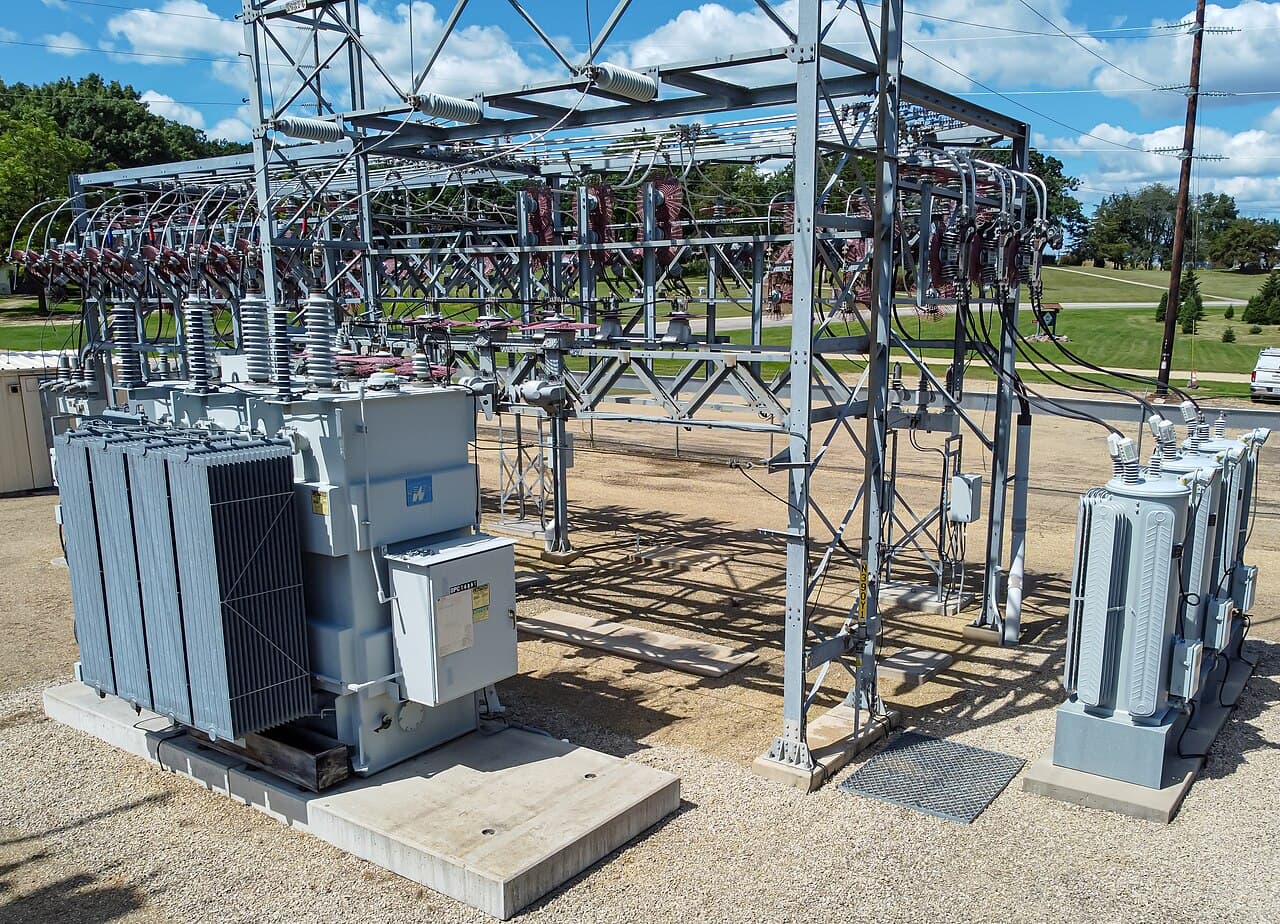
If this were only a bond-market story, conviction would be lower. On August 13, however, a matching signal appeared in physical grid investment. Heron Power announced a $100 million factory near San Jose to manufacture advanced power equipment, including a 5-megawatt medium-voltage conversion system for data-center and large-energy applications.
The factory matters because it turns an abstract “AI electricity problem” into an industrial response. U.S. transformer and grid-equipment shortages can delay interconnection and force data-center developers to reserve equipment years in advance. A GPU order creates no usable compute if power cannot reach the rack.
Heron said it is targeting a market in which conventional transformer lead times can stretch for years and where utilities and data-center developers are showing strong interest. Mass production is planned for late 2027. That means the supply response itself is capital intensive and slow.
A second confirmation arrived one day earlier. Bank of America launched a $250 billion Critical Infrastructure Finance Initiative covering digital infrastructure, data centers, computing, energy and core infrastructure. The program spans lending, investments, capital-markets services and advisory work.
The implication is not that all $250 billion is AI debt. It is that financial institutions are building dedicated balance-sheet and capital-markets capacity around the same physical infrastructure wave. AI capex is creating second- and third-order financing demand in the grid, construction and equipment chain.
Why a Fed pause does not automatically mean cheap money
A Fed pause still matters enormously. If the market expects cuts, short rates should fall and long yields can fall too. SIAIntel is not arguing that private AI capital demand can override monetary policy in every scenario.
The point is narrower: a lower policy-rate path can coexist with a high term premium, heavy Treasury issuance and heavy private bond issuance. If AI-related companies continue signing long-term obligations and financing data-center ecosystems, investors may be asked to absorb more duration just as government borrowing remains large.
That can produce an unusual curve. The two-year yield may respond strongly to a dovish Fed while ten- and thirty-year borrowing costs decline more slowly. Mortgage rates and infrastructure project finance would then receive less relief than the policy-rate headline suggests.
There is also a feedback loop. Lower Fed rates can make more marginal AI projects financially viable. Instead of simply reducing the cost of existing investment, easing could unlock additional projects, which then create more financing demand. That is one reason the sign of the effect is not mechanically dovish.
Household, company and investor impact
Households: U.S. mortgage rates are closely linked to long-term Treasury and mortgage-backed-security yields, not only to the overnight policy rate. If ten-year yields stay elevated, a Fed pause may take longer to reach homebuyers. Auto and other long-duration borrowing can feel the same lag.
Companies: Investment-grade hyperscalers have broad market access, but smaller businesses and lower-rated borrowers are more sensitive to benchmark yields. If large AI issuers absorb a bigger share of investor demand, refinancing conditions elsewhere can remain tighter than a simple Fed-pause narrative implies.
Investors: Rising AI equity prices do not guarantee cheap AI infrastructure finance. Each project must earn a return above its weighted average cost of capital. Higher long rates increase the discount rate applied to distant cash flows and raise the hurdle rate for data centers, generation, transmission and equipment plants.
The core consumer consequence is therefore indirect but real. A capital boom concentrated in AI can help growth and productivity while simultaneously keeping the market price of long-duration money higher than households expected from a dovish Fed.
Company lens: the risk is not distributed evenly
The largest hyperscalers can absorb elevated financing costs longer because their core businesses generate extraordinary cash flow. The more fragile part of the chain may sit outside Big Tech: data-center developers, power developers, cooling specialists, transformer manufacturers, real-estate partners and smaller cloud providers.
Banks can benefit from underwriting, project loans and advisory revenue, but they also inherit construction, interconnection, customer-concentration and technology-obsolescence risks. Bank of America’s $250 billion initiative illustrates how rapidly this financing ecosystem is institutionalizing.
Equipment makers face a different trade-off. Demand can be exceptionally strong, but adding production capacity requires their own capex before revenue arrives. Heron Power’s factory is a clear example of AI capex generating another layer of industrial capex.
The credit question is therefore not “Will Google default?” That is the wrong stress test. The better question is where leverage, project delay and fixed commitments accumulate across the broader infrastructure chain.
Country lens: dollar funding exports the signal
If long-term U.S. yields remain higher than expected, the effect does not stop at the U.S. border. Global investors can earn more on dollar assets, raising the hurdle rate for emerging-market debt and for companies refinancing in dollars.
For Türkiye, the relevant channel is not a direct exchange-rate forecast. It is the combination of U.S. ten- and thirty-year yields, dollar funding costs and global credit spreads. A Fed pause can improve the external backdrop, but that relief can be diluted if long-term U.S. yields remain sticky.
The same logic applies across energy-importing and externally financed economies. Long-duration dollar funding is a global benchmark. If an AI capital boom becomes one additional reason for U.S. real yields to stay high, its effects can travel well beyond Silicon Valley.
Again, the attribution must remain disciplined. Fiscal policy, inflation, Treasury supply and global savings flows can dominate the move. AI is an added capital-demand layer, not the only cause.
Signal matrix: what would confirm or invalidate the thesis?
Signal Confirmed would require several of these conditions to align:
- The probability of a Fed hold rises while long-term Treasury yields fail to fall materially.
- Hyperscaler bond issuance continues increasing and new deals require higher absolute yields or wider spreads.
- Purchase commitments, leases and power agreements rise sharply at companies beyond Alphabet.
- More factories, grid projects or dedicated finance programs emerge to address transformer, conversion and interconnection bottlenecks.
- Project-finance margins or required equity returns rise for AI data-center and power assets.
Thesis Weakens if:
- The Fed begins cutting and long-term yields fall rapidly with it.
- Hyperscalers materially reduce AI capex or comfortably fund the buildout from internal cash generation.
- Transformer and grid supply expands faster than expected, reducing delays and equipment premiums.
- Investor demand for new corporate bonds grows faster than issuance, compressing spreads despite the capex boom.
This framework gives the story a falsifiable structure. It is not enough for AI spending to remain large; the capital-market transmission must also remain visible.
Counter-thesis: why the AI buildout may not keep rates high
The strongest counterargument is scale. The Treasury market and global fixed-income universe are enormous. Even rapidly growing AI-related corporate borrowing may remain too small to dominate long-term rates. A decisive fall in inflation and an actual Fed easing cycle could overwhelm the private-supply effect.
The second counterargument is cash generation. Alphabet, Microsoft, Meta and Amazon do not need to debt-finance every dollar of capex. Purchase commitments cannot be converted one-for-one into future bonds. Treating the $1.5 trillion figure as $1.5 trillion of debt would be analytically wrong.
The third is productivity. If AI investment produces the productivity gains its backers expect, it can raise real growth and future cash flows. Stronger productive capacity could make today’s financing burden more sustainable and could ultimately ease inflationary constraints.
Those counterarguments are why SIAIntel classifies this as a building signal rather than a completed causal verdict.
Analyst Intelligence Box
Signal class: AI infrastructure capital demand / long-rate persistence Verified today: July PPI 0.0% m/m and 4.7% y/y; July FOMC hold at 9–3; hyperscaler purchase commitments near $1.5T; Alphabet $811B commitments; $85.2B of mostly data-center uncommenced leases; Heron Power $100M grid-equipment factory SIAIntel inference: A Fed pause can coexist with sticky long-term borrowing costs if AI-related private capital demand keeps expanding through bonds, leases, project finance and grid capex Not established: AI is the dominant driver of current long-term Treasury yields Confidence: Medium-high on the mechanism; lower on the exact share of yields attributable to AI Next confirmation: September FOMC, hyperscaler debt issuance, Q3 capex/commitment disclosures, grid-equipment and project-finance pricing
SIAIntel Bottom Line
The easy headline today is that producer inflation cooled and the probability of another Fed hike fell. That is true, but incomplete.
The deeper signal is that AI is shifting from a software-spending cycle into a multi-year capital, power, debt and lease cycle. Roughly $1.5 trillion of purchase commitments, Alphabet’s $811 billion contractual burden, uncommenced data-center leases, large bond issuance and new grid-equipment factories all point in the same direction: expanding compute requires companies to reserve capital and electricity first.
That changes the question for the second half of 2026. It is no longer only:
Will the Fed hike again?
The more important question is:
Has AI capital demand become large enough to slow the decline in long-term rates even when the Fed stops?
SIAIntel moves this from Watch → Building Signal today. If long yields, fresh corporate issuance and infrastructure-finance pricing confirm the same direction again, the thesis can move to Signal Confirmed.
Sources & Methodology
This analysis prioritizes same-day macro data and primary corporate filings, then cross-checks the market and infrastructure transmission with Reuters and the Financial Times.
- Reuters — US producer prices unchanged in July, August 13, 2026
- Federal Reserve — July 29, 2026 FOMC statement
- Financial Times — hyperscalers’ purchase commitments approach $1.5tn
- Alphabet — Q2 2026 Form 10-Q
- Reuters — AI building boom and the Treasury market
- Reuters — Heron Power’s $100m grid-equipment factory
- Reuters — Bank of America’s $250bn infrastructure-finance initiative
- Federal Reserve — 2026 FOMC calendar
Editorial safety note: This analysis is for editorial intelligence purposes only. It is not investment advice, legal advice, or a recommendation to buy, sell or hold any asset.
Editorial Credit
This intelligence brief was prepared by the SIAIntel Editorial Desk.
Some contributors work in sensitive public-sector, regulatory, market, or editorial roles. Their identities may be withheld when professional duties, source protection, or safety require confidentiality.
Editorial and publishing accountability: Sefa Karahan, Founder & Publisher