Japan's 30-year high bond yield and America's $1.9 trillion deficit projection are sending a global warning signal, from mortgages and pensions to emerging-market debt.
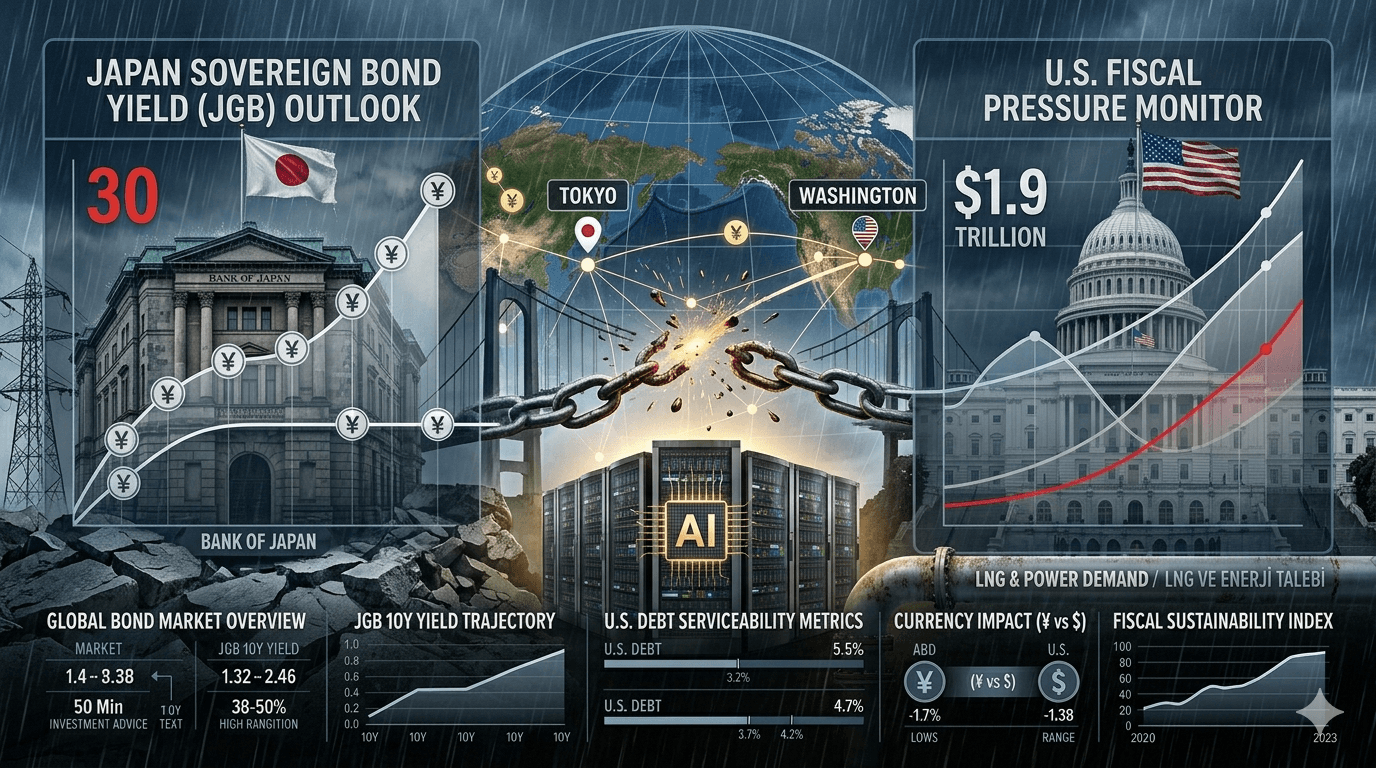
Japan's 30-year high bond yield and America's $1.9 trillion deficit projection are sending a global warning signal, from mortgages and pensions to emerging-market debt.
Context
Japan's 10-year government bond yield has reached around 2.8%, the highest level since 1996. Reuters reports that the Bank of Japan (BOJ) may consider slowing or pausing its bond-purchase taper in fiscal 2027. Separate Reuters market coverage indicates the BOJ could temper its taper as bond wobbles rattle markets.
These developments are not merely a local monetary-policy issue for Japan. They are part of a broader global debt-market signal: developed economies are facing higher borrowing costs, large fiscal deficits, fragile bond liquidity, and more complex investor risk pricing.
Why Japan's Bond Market Matters Globally
Japan's bond-market signal also matters because it connects to global liquidity and yen-funded carry trade dynamics. For years, Japan's low interest-rate environment helped make yen funding attractive for market participants seeking exposure to higher-yielding assets abroad. If Japanese yields keep rising, assumptions around low-cost yen funding may become less stable, with possible effects across currency markets, bond yields and cross-border liquidity conditions.
Rising Japanese bond yields may also signal a wider repricing in global bond markets. Reuters reports that changes in the BOJ's bond-purchase program could create volatility in global bond markets. The move suggests that other developed-country bonds may face similar pressure. The IMF's April 2026 Global Financial Stability Report underscores that developed economies are facing high debt levels and rising borrowing costs. According to the IMF, bond-market volatility can affect liquidity, duration risk, and risk-asset valuations.
Where the U.S. $1.9 Trillion Deficit Fits
CBO data from the Budget and Economic Outlook: 2026 to 2036 puts the U.S. federal deficit at about $1.9 trillion in 2026, around 5.8% of GDP. This is a significant fiscal deficit, and repricing in global bond markets could affect U.S. borrowing costs.
The Federal Reserve's May 2026 Financial Stability Report observes that higher Treasury yields can increase government debt-service pressure, which could affect public budgets. The Fed further notes that bond-market volatility can affect mortgage rates, corporate borrowing costs, and risk-asset valuations.
The ECB's May 2026 Financial Stability Review states that pressures in global debt markets can spread across developed economies and create financial stability risks.
The key point is not that Japan "triggered" or "caused" the U.S. deficit, but that both countries are part of the same global debt-pressure environment. High bond yields, large fiscal deficits, and fragile bond liquidity create a common risk profile for developed economies.
What This Means for People in the United States
How might bond stress in Japan and America's $1.9 trillion deficit affect daily financial decisions for Americans?
- Mortgage rates: Higher Treasury yields can increase mortgage rates. The Federal Reserve's May 2026 Financial Stability Report notes that bond-market volatility can affect mortgage rates. This could mean higher borrowing costs for people looking to buy homes.
- Public budgets: Higher bond yields can increase government interest payment costs. The CBO's Budget and Economic Outlook: 2026 to 2036 projects the U.S. federal deficit at about $1.9 trillion in 2026. This could create pressure in public spending and tax debates.
- Corporate borrowing costs: Higher bond yields can increase companies' refinancing costs. The Fed report notes that corporate borrowing costs may rise. This could affect corporate profits and employment.
- Retirement portfolios: Many pension funds and 401(k) plans hold bonds. Bond volatility can affect the value of retirement portfolios.
- Taxpayers: Higher debt-service costs may make future budget debates more difficult. Governments may face harder choices when financing public spending.
What This Means for People in Japan
What does Japanese bond yields hitting a 30-year high mean for Japanese households and the economy?
- Banks and insurers: Higher JGB yields can affect banks' and insurance companies' bond portfolios. The IMF's April 2026 Global Financial Stability Report highlights that developed economies are facing high debt levels.
- Pension funds: Japanese pension funds hold large amounts of JGBs. Changes in interest rates can affect the value of these funds.
- BOJ taper decisions: According to Reuters, the BOJ may consider slowing or pausing its taper in fiscal 2027. These decisions can affect yen stability.
- Household effects: Higher interest rates may increase savings returns while also increasing the cost of imported goods. Japan's aging population may make debt-service pressure more sensitive.
- Government borrowing costs: Higher JGB yields can increase the Japanese government's borrowing costs. This could create pressure on public spending.
What This Means for Developed Countries
What signal do developments in Japan and the U.S. send to other developed economies?
- Debt management: Large public debts become harder to manage when interest rates rise. The IMF report notes that developed economies are facing high debt levels.
- Central bank balance: Central banks must balance inflation control with bond-market stability. The ECB's May 2026 Financial Stability Review states that pressures in global debt markets can spread across developed economies.
- Fiscal policy space: Higher interest rates may narrow fiscal policy space. Governments may have less flexibility to finance public spending.
- Refinancing costs: Higher yields can create pressure on public investment, defense, health, and social spending.
What This Means for Emerging Markets
How might interest rate increases in the U.S. and Japan affect emerging markets?
- Capital flows: Higher U.S. and Japanese yields can pull capital toward developed-market bonds. The IMF report notes that currency volatility can affect global financial stability.
- Currency pressure: A stronger dollar or yen volatility can create pressure on local currencies. This can increase import costs.
- External debt refinancing: External debt refinancing can become more expensive. Countries with high dollar debt may be more vulnerable.
- Energy and import costs: Currency weakness can increase energy and import costs. This can worsen inflation and current-account pressure.
- Crisis risk: Countries with high dollar debt may be more sensitive to global interest rate increases.
What This Means for Companies
What does stress in global bond markets mean for companies?
- Refinancing costs: Higher interest rates can increase companies' refinancing costs. Highly indebted firms may face margin pressure.
- Investment projects: Investment projects may become more selective. Companies may delay some projects due to higher return requirements.
- Currency volatility: Exporters and importers may face currency volatility. The IMF report notes that currency volatility can affect global financial stability.
- Capital-intensive sectors: Capital-intensive sectors may be more sensitive to interest rates. Construction, infrastructure, and energy sectors may be affected.
- Profit margins: Higher borrowing costs can squeeze profit margins. Companies may be forced to pass costs to prices.
What Market participants may track
This article is not a buy/sell recommendation. It is a macro risk map. Investors may monitor the following indicators:
**Japanese 10-year JGB yield**: [According to Reuters](https://www.reuters.com/world/asia-pacific/boj-may-heed-calls-pause-bond-taper-next-year-2026-05-29/), the 2.8% level is the highest since 1996. Movements above this level may signal repricing pressure in global bond markets.
**BOJ taper guidance**: [As reported by Reuters](https://www.reuters.com/world/asia-pacific/boj-could-temper-its-taper-bond-wobbles-rattle-markets-2026-05-19/), changes in the BOJ's taper program could create volatility in global bond markets. Investors may closely monitor the BOJ's next steps.
**U.S. 10-year and 30-year Treasury yields**: [The Fed's Financial Stability Report](https://www.federalreserve.gov/publications/files/financial-stability-report-20260508.pdf) notes that higher Treasury yields can increase debt-service pressure. Movements in these yields may be an indicator of U.S. fiscal pressure.
**USD/JPY and yen carry trade pressure**: Rising Japanese bond yields could create pressure on the yen carry trade. [The IMF report](https://www.imf.org/en/publications/gfsr/issues/2026/04/14/global-financial-stability-report-april-2026) notes that currency volatility can affect global financial stability.
**Treasury market liquidity**: [The Fed report](https://www.federalreserve.gov/publications/files/financial-stability-report-20260508.pdf) notes that bond-market volatility can affect liquidity. Investors may monitor liquidity conditions.
**Energy prices and inflation expectations**: [The ECB's Financial Stability Review](https://www.ecb.europa.eu/press/financial-stability-publications/fsr/html/ecb.fsr202605~50566915a7.en.html) notes that inflation shocks can affect bond markets. Investors may monitor these factors.
**Central-bank communication**: Central bank communication can shape market expectations. Investors may monitor statements from the BOJ, Fed, and ECB.
SIAIntel Assessment
The real signal is the rising cost of money. Japan is an early warning point because its bond market was long anchored by ultra-low rates. The U.S. matters because fiscal deficits increase sensitivity to bond repricing. Emerging markets matter because global yield shifts often transmit through currencies, capital flows, and refinancing costs. Ordinary people matter because bond yields eventually affect mortgages, pensions, taxes, jobs, and public services.
Japan's bond stress and the BOJ taper debate expose the global debt-pressure environment facing developed economies. This does not mean that Japan "caused" the U.S. deficit, but that both countries are part of the same global risk profile.
This article is not a buy/sell recommendation. It is a macro risk map.
Sources
- Reuters — BOJ may heed calls to pause bond taper next year
- Reuters — BOJ could temper its taper as bond wobbles rattle markets
- CBO — The Budget and Economic Outlook: 2026 to 2036
- IMF — Global Financial Stability Report, April 2026
- Federal Reserve — Financial Stability Report, May 2026
- ECB — Financial Stability Review, May 2026
Source Map
6 highlighted sources
Editorial Credit
This intelligence brief was prepared by the SIAIntel Editorial Desk.
Some contributors work in sensitive public-sector, regulatory, market, or editorial roles. Their identities may be withheld when professional duties, source protection, or safety require confidentiality.
Editorial and publishing accountability: Sefa Karahan, Founder & Publisher
Related Intelligence
Related intelligence in this category · 3 briefs

AI Has Entered the Fed’s Reaction Function
AI’s investment boom may lift the neutral rate and bond yields before productivity lowers inflation. The Fed now faces a timing problem.

Fed May Pause. AI’s $1.5T Buildout Could Keep Rates High
US PPI went flat, but AI infrastructure commitments, bond supply and grid bottlenecks may keep long-term financing costs elevated even if the Fed pauses.

Can Falling US Unemployment Trigger a Fed Hike?
US payrolls fell by 23,000 while the labor force shrank by 264,000 and unemployment dropped to 4.1%. July CPI is now the Fed’s next critical policy trigger.