A near-20-year low in EU maize output is arriving as Brazil loses access for key animal products. The hidden risk sits between feed, protein supply and food prices.
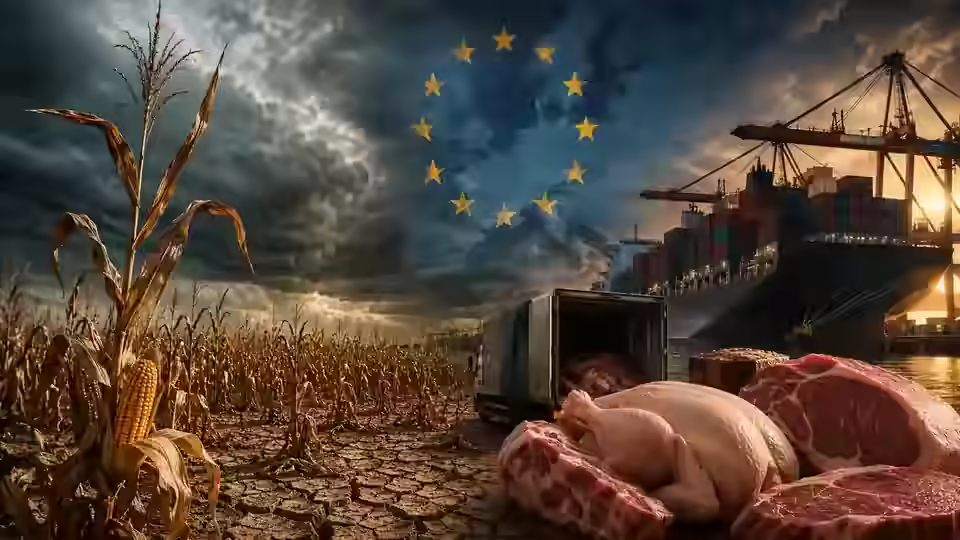
Europe is about to run an unusual stress test across two parts of its food system at once. The EU’s 2026 maize crop is heading toward 50.1 million tonnes, close to a two-decade low, after drought and extreme heat damaged key producing regions. At the same time, a regulatory decision taken months ago removes Brazil from the EU’s authorised list for several animal products from 3 September. Reuters European Commission
*Visual disclosure: the hero is an AI-generated editorial composite. It is an explanatory visualization, not a photograph of a specific farm, port or shipment.*
> SIAIntel signal: Europe is becoming more dependent on imported feed at the same moment it is temporarily less able to rely on its largest external source of animal protein. That combination can turn two manageable shocks into one food-cost transmission test.
This is not evidence of a food shortage today. It is a testable risk about the durability of Europe’s two buffers: imported feed and imported protein.
30-Second Signal
Reuters reports that the European Commission’s late-August estimate puts the 2026 EU maize harvest at 50.1 million tonnes, roughly a fifth below the recent three-year average and near a 20-year low. Hungary, normally an exporter, may need to import maize; Romania’s exportable surplus has also shrunk. Expana expects EU maize imports in 2026/27 to rise about 8–9%. Reuters
The weather shock is broader than a single country. The Commission’s Joint Research Centre said on 24 August that persistent heat and water deficits across parts of France, Hungary, Romania and neighbouring areas were cutting summer-crop yields, with some forecasts as much as 14% below the five-year average, and raising feed-supply concerns. JRC
Separately, the Commission confirmed that Brazil is not on the list of third countries accepted under the EU’s antimicrobial-use rules for several animal products from 3 September. The decision was not a surprise headline on 1 September; the regulatory path had been known for months. The significance comes from the timing: an old deadline now lands beside a newly confirmed crop shock. European Commission
The Model: Europe’s Protein Squeeze
Markets can read these as two unrelated stories — drought and regulation. Structurally, both hit the same food chain.
Buffer one is feed. Europe can compensate for a weak maize harvest by importing more grain. The EU’s livestock sector uses an enormous feed base: the Commission says roughly 5 million EU farmers raise animals and annual feed needs are around 450 million tonnes. European Commission
Buffer two is imported protein. When domestic livestock costs rise, imported poultry and beef can limit how much of that pressure reaches consumers.
That is where Brazil matters. Official Commission market data show that in the first quarter of 2026 Brazil supplied 42.5% of EU poultry imports from outside the bloc, with volume up 27.5% year on year. Brazil, Ukraine, Thailand and the United Kingdom together supplied about 92%. Brazil also represented 34.6% of extra-EU beef imports, with volume up 65.3% year on year. European Commission market data
The working transmission chain is therefore:
Drought → lower maize output → more feed imports → higher livestock input-cost risk
running alongside:
Brazil delisting → fewer low-cost import units → substitution toward EU producers and remaining third-country suppliers
The SIAIntel hypothesis is narrow: if feed costs rise while Brazilian protein access stays closed long enough, Europe loses cushioning on both sides at once.
The Mercosur Irony
The political timing makes the signal sharper. The EU-Mercosur Interim Trade Agreement began provisional application on 1 May 2026. The Brazilian animal-product restriction was then set on a separate regulatory track and takes effect four months later. One policy channel is opening trade while another is demanding stricter sanitary and antimicrobial guarantees. European Commission trade policy
That does not make the restriction protectionist by definition. It shows that tariff liberalisation and regulatory market access are different gates. For companies, this distinction matters more than the headline agreement.
Who Feels It
Consumers: no shortage exists today. EU poultry production was still growing through the spring and broiler prices were not signalling crisis conditions. The risk is a one-to-two-quarter transmission through meat, dairy and processed-food input costs if both channels activate.
EU livestock producers: the Brazil restriction can temporarily reduce import competition, but a weaker maize crop can simultaneously raise feed bills. Producers may gain pricing power and lose margin support at the same time.
Grain and feed traders: the most immediate volume signal is import substitution. If the 8–9% maize-import forecast is met or exceeded, Black Sea, U.S. and South American grain exporters gain a larger role in balancing the EU market.
Brazilian exporters: Europe is not their only outlet. The United States has opened an additional 300,000-tonne tariff-rate window for eligible lean beef trimmings from multiple countries between September and November. Brazil can compete for that demand, but the quota is not Brazil-exclusive. White House
Reuters also reported, citing the Wall Street Journal, that JBS co-owner Joesley Batista had lobbied President Donald Trump for lower beef import tariffs. Reuters said it could not independently verify the meeting details, so this is a reported lobbying episode, not proof of causality behind U.S. policy. Reuters
Winners and Losers
Hungary and Romania are exposed on the harvest side. Hungary’s move from normal exporter to possible importer is especially important because it changes regional trade flows, not just national farm income.
Ukraine, Thailand and the UK could gain share in poultry if Brazil remains absent.
Brazil loses EU access in the short run but has alternative markets and may not face the same urgency across poultry and beef, because compliance paths can differ.
EU consumers are the final transmission point, but only if higher feed costs and tighter imported protein supply show up together in wholesale and retail data.
A further asymmetry sits inside the existing winners-and-losers map. The European Commission says the EU remains highly dependent on imports for high-protein feed. Grain trade can cushion a maize shortfall, but the livestock system still carries a structural external-protein dependency. That does not prove scarcity; it changes where substitution costs can accumulate.
The Counter-Case
The strongest version of this thesis should be rejected for now.
First, Europe can import more maize. Expana’s forecast already assumes an 8–9% increase, meaning trade can absorb part of the production loss. Reuters
Second, alternative meat suppliers can fill some of Brazil’s gap.
Third, Brazil’s exclusion is reversible. The issue is missing regulatory guarantees, not evidence that Europe has permanently closed the market.
Fourth, EU domestic production can respond. A restriction that lifts farmgate prices may induce supply before retail inflation becomes material.
So the headline is not “Europe faces a food crisis.” The right framing is two buffers under simultaneous strain.
Confirmation Dashboard
| Signal | What it would mean |
|---|---|
| EU maize imports accelerate beyond the 8–9% forecast | Feed gap is larger than expected |
| Compound-feed and livestock input prices rise | First transmission stage is active |
| Wholesale poultry or beef prices turn materially higher | Protein channel is activating |
| Brazil remains off the authorised list for several weeks | Regulatory shock is becoming persistent |
| Ukraine/Thailand rapidly replace Brazilian poultry | Substitution is working; squeeze thesis weakens |
| Retail meat/dairy inflation rises after feed costs | Consumer transmission is confirmed |
These are editorial monitoring markers, not trading recommendations.
SIAIntel Bottom Line
The drought and the Brazil restriction are not the same event. They do not share a cause, and neither proves a European food crisis.
But they land on the same system.
Europe normally manages a poor feed crop by importing more grain and manages expensive domestic protein by drawing on competitive external suppliers. In September 2026 those two buffers are being tested at the same time.
> The signal is not empty shelves. It is the moment Europe discovers how much food-price stability depended on having two backup channels available at once.
Source Map
6 highlighted sources
SIAINTEL FOOD SYSTEM
Europe Food Buffer Stress Console
A weak maize crop and a Brazil access shock are testing Europe’s feed and protein buffers at the same time.
EU maize crop
50.1 Mt
Commission estimate; near a 20-year low
Maize import forecast
+8–9%
Expana 2026/27 increase cited by Reuters
Brazil share of extra-EU poultry
42.5%
Q1 2026 Commission market data
Brazil share of extra-EU beef
34.6%
Q1 2026 Commission market data
The feed buffer is being asked to work harder
Recent three-year maize output is normalized to 100; the 2026 estimate is roughly one-fifth lower.
Brazil is a material protein supplier
Brazil’s share of EU imports from outside the bloc in the first quarter of 2026.
Confirmation dashboard
The squeeze thesis strengthens only if feed and protein channels tighten together.
| Channel | Current reading | Confirm | Disconfirm |
|---|---|---|---|
| Feed | 50.1 Mt maize crop; imports seen +8–9% | Imports exceed forecast and feed costs rise | Trade absorbs the crop loss cleanly |
| Poultry | Brazil = 42.5% of extra-EU imports | Replacement supply is slow or costly | Ukraine/Thailand rapidly fill the gap |
| Beef | Brazil = 34.6% of extra-EU imports | Wholesale prices rise with tighter access | Alternative origins cap prices |
| Brazil access | Restriction effective from 3 September | Delisting persists for several weeks | Authorisation is restored quickly |
SIAIntel scenario map
Editorial weights, not statistical probabilities.
Scenario 1
Substitution works — 50%
More grain imports and alternative protein suppliers absorb the shock.
Food inflation stays contained.
Scenario 2
Double-buffer squeeze — 30%
Feed costs rise while Brazilian protein access stays constrained.
Wholesale meat and dairy pressure builds over one to two quarters.
Scenario 3
Fast relief — 20%
Weather, trade flows or regulatory access improve quickly.
The two-channel signal fades before consumer transmission.
Evidence boundary
Observed crop, trade and import-share figures are source locked. The transmission path and scenario weights are editorial monitoring constructs, not shortage forecasts.
Editorial Credit
This intelligence brief was prepared by the SIAIntel Editorial Desk.
Some contributors work in sensitive public-sector, regulatory, market, or editorial roles. Their identities may be withheld when professional duties, source protection, or safety require confidentiality.
Editorial and publishing accountability: Sefa Karahan, Founder & Publisher
Related Intelligence
Related intelligence in this category · 3 briefs

AI’s Capital Squeeze Reaches U.S. Treasuries
Waller says AI infrastructure is competing for capital as Norway’s fund proposes a sharp Treasury-weight cut. The signal is rotation, not dollar flight.

AI Has Entered the Fed’s Reaction Function
AI’s investment boom may lift the neutral rate and bond yields before productivity lowers inflation. The Fed now faces a timing problem.

AI’s $29.6B Loan Pulls Banks Into the Boom
ByteDance’s $29.6B unsecured loan shows AI funding moving onto global bank balance sheets as bonds, revolvers and private credit expand.