"Türkiye's defense boom now faces a harder test: turning steel, KAAN, finance and the Mecca Pact into bankable exports without hiding target and engine risks."
SIAINTEL INTELLIGENCE DOSSIER
Analysis Brief
SIAIntel Verification Panel
Analysis, data context, source mapping and editorial boundaries are presented as one evidence chain.
Key Takeaways
- second signal SSB recorded $10.054 billion of exports in 2025, while January-July 2026 reached $5.787 billion at 26.2% growth.
- The industrial baseline is real; the difficult question is the delivery path from here.
- Reuters reported a two-year doubling ambition, but the Presidency had set an $11 billion 2028 objective.
A pact is not an order, a contract is not a delivery, and gross contract value is not present investor value.
Data Snapshot
Coverage Area
GEOPOLITICS
Editorial category
Read Time
~11 min
Approximate duration
Source Base
22 visible source citations
Source Map highlights 6 unique sources
Published
Aug 15, 2026
Updated: Aug 15, 2026
Source Map
6 highlighted sources
January-July 2026 reached $5.787 billion at 26.2% growth
OfficialOfficial source context
Reuters reported a two-year doubling ambition
NewswireMarket reporting / newswire context
The Mecca agreement creates a formal three-country defense framework
OfficialOfficial source context
Sovereign production chain
Türkiye defense export execution map
Official results, mechanical scenarios and the bottlenecks between steel, propulsion, finance and delivery.
2025 official exports
$10.054bn
SSB full-year result
Jan–Jul 2026 exports
$5.787bn
SSB seven-month result
Current year-on-year pace
26.2%
Observed seven-month growth
Required 2027 catch-up
57.6–58.5%
If 2026 holds 26.2% and 2027 must reach $20.000–$20.108bn
Mechanical export path
The 2026 bar extends the observed 26.2% pace; the 2027 bars separate the headline target from exact doubling.
Growth burden by framing
A smooth two-year average masks the higher single-year burden left after a 26.2% 2026.
Eight-link investability chain
Capital becomes bankable only when every link has an owner, milestone and auditable acceptance test.
| Link | Capital gate | Verification |
|---|---|---|
| Requirement | Common specification | Signed configuration |
| Finance | Credit and guarantees | Funded milestones |
| Design | Architecture and software rights | Configuration authority |
| Subsystems | Engines, radar and electronics | Export clearance |
| Materials | Armor steel and qualified inputs | Certification yield |
| Co-production | Saudi and Pakistani workshare | Qualified suppliers |
| Testing | Airworthiness and trials | Acceptance evidence |
| Lifetime | Training, spares and MRO | Availability revenue |
Export-path scenarios
Each case changes the deadline, delivery conversion or dependency burden; none is an investment recommendation.
Scenario 1
Conservative floor
The repeated official marker remains above $11bn by 2028.
Capacity expands, but the $20bn narrative is not treated as the base case.
Scenario 2
Run-rate case
The 26.2% pace continues through 2028.
Mechanical exports reach about $20.2bn by end-2028.
Scenario 3
Execution-heavy upside
Exports must reach $20.000–$20.108bn by end-2027.
Growth must jump to 57.6–58.5% in 2027 after the mechanical 2026 path.
Scenario 4
Dependency downside
Engine, certification, finance or localization milestones slip.
Backlog converts later and working-capital needs rise.
Evidence boundary
Official results are separated from SIAIntel's mechanical scenario. The 2026 and 2027 path is not a forecast.
Evidence Stack & Decision Relevance
This panel values defense exports through Turkish retained workshare, licensing, delivery, finance and discounted service cash flow—not the headline contract amount.
Citizens and workers
Separate foreign-exchange and skilled-job gains from budget opportunity cost, public guarantees and imported-input exposure.
Industrial companies and SMEs
Verify qualification, certification, local value share, payment cycles and export-control compliance contract by contract.
Investors and financiers
Value Turkish retained workshare, joint milestone probability, working capital and discounted service cash—not gross backlog.
Regulators and policy makers
Set transparent terms for export credit, intellectual property, re-export, sanctions risk and funded local workshare.
Target mathematics, steel qualification, KAAN’s engine transition and funded Mecca-agreement workshare are tested together in the analysis below.
Evidence Frame
This layer summarizes visible sources, article context and editorial framing. It is analytical context, not transactional guidance.
30-second signal
SSB recorded $10.054 billion of exports in 2025, while January-July 2026 reached $5.787 billion at 26.2% growth. The industrial baseline is real; the difficult question is the delivery path from here.
Reuters reported a two-year doubling ambition, but the Presidency had set an $11 billion 2028 objective. Investors therefore need scenario bands, not one unqualified target.
The Mecca agreement creates a formal three-country defense framework, while Türkiye ranked seventh in 2025 crude-steel output. The opportunity runs from qualified material to financed co-production, not from diplomacy alone.
Indonesia's definitive 48-aircraft KAAN contract proves demand, while the F110 notification to Congress shows why propulsion and export permissions remain cash-flow gates.
Türkiye's defense industry has moved beyond the stage where success can be measured by a single drone, ship or fighter prototype. The investable story is now a production system: qualified steel, propulsion, electronics, software, final assembly, export finance, co-production, training and lifetime maintenance. The Mecca Joint Defense Agreement with Saudi Arabia and Pakistan could connect those layers to larger procurement pools. But the same chain also exposes three hard tests that promotional headlines tend to compress: the export target's mathematics, conflicting official time horizons and KAAN's foreign-engine dependency.
This is not a recommendation to buy any security or fund any project. It is an evidence-based map of where capital could enter, what milestones can convert political ambition into revenue and which dependencies can postpone cash flow.
The mathematics: a 41% average hides a 58.5% second-year burden
If the headline objective is to rise from $10.054 billion in 2025 to $20 billion by the end of 2027, the required two-year compound annual growth rate is about 41.0%. Using an exact doubling to $20.108 billion produces 41.4%. Both calculations are arithmetically correct, but neither shows the path implied by the latest data.
The January-July 2025 comparison base can be derived as $5.787 billion divided by 1.262, or approximately $4.586 billion. That leaves about $5.468 billion for the second half of 2025. If the same 26.2% growth rate continues through the second half of 2026, that period would generate roughly $6.901 billion, taking the mechanical full-year 2026 result to approximately $12.688 billion.
| Mechanical path | Export value | Required growth | |---|---:|---:| | 2025 official baseline | $10.054bn | — | | 2026 at the current 26.2% pace | $12.688bn | 26.2% | | End-2027 exact-doubling target | $20.108bn | 58.5% in 2027 alone | | End-2028 at 26.2% in 2027 and 2028 | $20.208bn | Current pace sustained |
This is a scenario, not a forecast. Its purpose is to locate the burden. Under the current pace, an end-2027 target is not a smooth 41% climb; it requires a single-year acceleration to about 58.5% in 2027. An end-2028 interpretation is materially less fragile: maintaining 26.2% would mechanically reach roughly $20.2 billion.
The official target has two clocks
The harder source problem is not the square root; it is the deadline. President Recep Tayyip Erdoğan said in December 2025 that the 2028 objective was to reach $11 billion in defense and aerospace exports and enter the global top ten. The same 2028 figure appeared again in February 2026, while a May speech described exceeding $11 billion as a short-term goal. Presidency — 16 December 2025 Presidency — 24 February 2026 Presidency — 8 May 2026
Reuters then reported on 5 June that Türkiye aimed to double defense exports over two years, attributing the target to SSB. Reuters — two-year doubling statement
These statements cannot be treated as one clean target without clarification. They may reflect a revised ambition, different starting dates or different definitions. Until SSB publishes a dated annual path with the same metric, investors should model $11 billion as the conservative official floor, the current 26.2% run-rate as a middle scenario, and $20 billion by end-2027 as an execution-heavy upside case — not as a guaranteed state forecast.
The Mecca Pact is a demand-and-capital bridge, not an order book
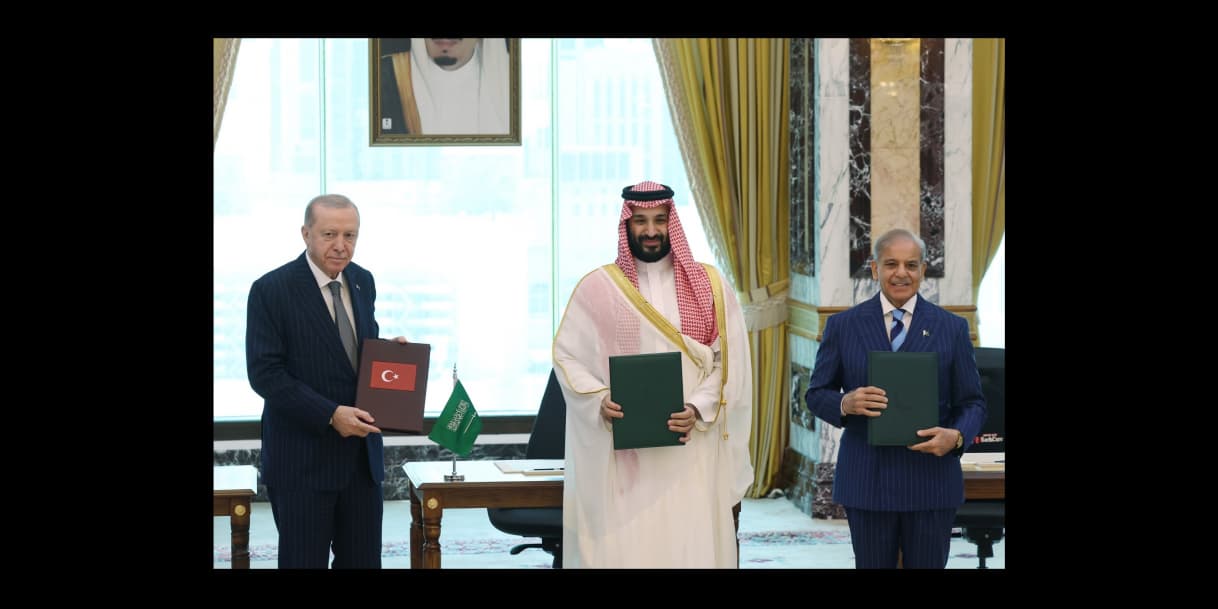
Türkiye, Saudi Arabia and Pakistan signed the Mecca Joint Defense Agreement on 7 August 2026. The official text establishes collective deterrence and calls for deeper defense cooperation, including defense-industry opportunities. Türkiye Presidency — official Mecca agreement
The pact does not itself create export revenue. Its financial importance is that it can shorten the distance between three assets: Türkiye's design and production depth, Saudi Arabia's procurement capital and localization drive, and Pakistan's operating experience, engineering base and access to additional markets. Saudi Arabia's GAMI reports that military-spending localization reached 24.89% in 2024 and continues to target 50% by 2030. That means any investable project must be designed for local workshare, not just finished-product sales. GAMI — localization update
The eight-link industrial chain
The opportunity becomes visible when the pact is translated into an industrial sequence:
1. Joint requirement: common mission needs and interoperable specifications. 2. Sovereign finance: buyer credit, export credit, milestone guarantees and currency protection. 3. Design authority: platform architecture, software ownership and configuration control. 4. Critical subsystems: engines, radars, seekers, chips, electronic warfare and secure communications. 5. Qualified materials: armor steel, naval plate, forgings, superalloys, composites and energetic materials. 6. Co-production: Saudi and Pakistani workshare, final assembly and supplier qualification. 7. Testing and certification: airworthiness, firing trials, cybersecurity and export approvals. 8. Lifetime revenue: training, spares, upgrades, ammunition, MRO and fleet availability contracts.
The chain is only as strong as its slowest licensed component. A memorandum may raise strategic probability, but revenue appears only after configuration, financing, export approval, production slots and acceptance tests are locked.
Steel is not a footnote; it is the first sovereignty test
Calling any country's output “the world's best steel” is not an auditable global ranking. Steel quality is certified product by product: chemistry, hardness, toughness, ballistic performance, weldability, fatigue life and repeatability. The defensible statement is more valuable: Türkiye combines large-scale steelmaking with an increasingly sovereign armor-steel capability.
Worldsteel reported that Türkiye produced 38.1 million tonnes of crude steel in 2025, ranking seventh globally. Worldsteel — 2025 production ranking
At the high-value end, OYAK describes Miilux OY as Türkiye's only armor-steel producer and its facility as the country's first and only flat-steel heat-treatment plant. Its 560T and 650T grades are positioned for ballistic protection; OYAK also says the material is used in ships and submarines and is expected to be used for the Altay tank. OYAK — Miilux armor-steel portfolio OYAK — defense applications and Altay
For investors, the important shift is from commodity tonnage to qualified defense material. Certification, repeatable heat treatment and integration into approved vehicle or naval designs can create stickier margins than raw steel, but only if capacity, yield, energy cost and customer qualification are verified.
KAAN proves demand — and reveals the engine bottleneck
Turkish Aerospace and Indonesia signed a definitive contract for 48 KAAN fighters. That is a genuine export milestone, not a memorandum. Turkish Aerospace — official Indonesia contract
Yet the aircraft's early production path still depends on General Electric F110 engines. In June 2026, the Trump administration notified Congress of a proposed F110 transaction. The statutory review period expired without Congress blocking it; that is different from an affirmative congressional vote approving the sale. Reuters — F110 congressional notification Turkish Aerospace's chief executive later said the U.S. had cleared 80 engines, enough for roughly 40 Turkish Air Force aircraft. Breaking Defense — TAI chief on 80 F110 engines
The sensitivity is structural. The United States imposed CAATSA sanctions on Türkiye's Presidency of Defence Industries after the S-400 acquisition. U.S. State Department — CAATSA action A license can unlock a batch; it does not erase the political filter applied to future engines, re-exports or configurations.
Indonesia changes what counts as delivery evidence
The Indonesia contract is strategically important precisely because the customer wants the long-term aircraft to be free of that dependency. Turkish Aerospace management has said Indonesia's configuration is tied to the indigenous TF35000 engine and has identified 2033 as the latest management target for domestic-engine KAAN deliveries. DefenceTurk — indigenous-engine KAAN schedule
That makes the order a multi-stage asset. The contract validates demand today, but the highest-value cash-flow test is whether engine development, flight integration, certification, export configuration and Indonesian industrial participation converge on schedule. A six- or seven-year technology bridge is financeable only with credible milestones and payment protections.
The investor error would be to count all 48 aircraft as near-term delivered revenue. The analytical error would be the opposite — dismissing the contract because the engine is unfinished. The correct treatment is a risk-adjusted backlog whose probability rises at each verified engine and certification milestone.
Where international capital can enter
The broadest opportunities may sit around the platforms rather than inside a single prime contractor:
- Specialty materials: armor steel, naval plate, titanium, superalloys, composites and thermal coatings.
- Propulsion localization: test cells, casting, precision machining, digital engine control and maintenance tooling.
- Mission electronics: AESA radar, electronic warfare, secure data links, sensors and embedded computing.
- Industrial capacity: automated machining, additive manufacturing, quality systems and supplier finance.
- Sovereign financing: export-credit structures, milestone insurance, local-currency hedges and receivables finance.
- Recurring services: training, simulators, spares, fleet-health software and depot maintenance.
- Mekke Pact co-production: Saudi localization and Pakistani engineering workshare linked to third-market exports.
Foreign investors and partner states should separate strategic access from investability. A politically endorsed project can still lack transferable technology rights, bankable offtake, a qualified supplier base or permission to re-export U.S.-origin components.
The investor due-diligence waterfall
A premium valuation should be earned in stages. First verify that a public announcement is a binding contract. Then identify deposit and milestone payments, export licenses, local-content obligations, delivery slots, price-escalation clauses and acceptance conditions. Finally test whether MRO and upgrade rights remain with the Turkish supplier or migrate to the buyer.
The most useful equation is not “backlog equals revenue.” It is:
Risk-adjusted defense value = contracted value × license probability × technical-readiness probability × financing probability × on-time delivery probability + lifetime service value.
This framework penalizes engine and certification uncertainty without ignoring the option value created by a large customer, shared production and long-duration fleet support.
What would confirm the $20 billion path?
The upside case strengthens if five independent signals arrive together: SSB publishes an annual target bridge; large 2026 contracts convert into recorded deliveries; KAAN's engine milestones remain on schedule; Mekke Pact committees announce funded co-production projects; and qualified-material capacity expands without quality slippage.
It also requires composition. Export growth led by ammunition and one-off deliveries is not economically identical to growth led by platforms, electronics, propulsion and recurring support. SIAIntel will therefore watch export value, new-contract value, delivery concentration, customer concentration and service revenue separately.
What would break the thesis?
The thesis weakens if the $20 billion language is not translated into a dated official plan, if 2027 requires the full 58.5% catch-up without large scheduled deliveries, if F110 or other third-country permissions delay configurations, if TF35000 integration slips materially beyond management's 2033 marker, or if Saudi localization rules turn Turkish exports into low-margin assembly without protected intellectual property.
Steel is also a falsifiable signal. If defense-grade heat-treatment capacity, qualification yields or downstream vehicle and naval integration do not expand, crude-steel rank alone will not produce defense export leverage.
Final assessment
Türkiye has already demonstrated that it can turn engineering autonomy into exportable systems. The next stage is harder: converting a broad industrial base into predictable, financed and licensed delivery at a scale that can support $20 billion.
The Mecca Pact can become the bridge between Turkish design authority, Saudi capital and localization, and Pakistani engineering and operating depth. But a pact is not a purchase order, an order is not a delivery and a prototype is not yet sovereign propulsion.
The premium signal is therefore neither euphoria nor dismissal. It is a measurable chain from steel certification to engine clearance, from sovereign finance to co-production, and from contract signature to fleet availability.
SIAIntel Signal
TÜRKİYE DEFENSE INDUSTRIAL CHAIN — ACTIVE, with the end-2027 $20 billion case classified as execution-heavy. Watch the official target calendar, 2026 delivery conversion, TF35000 milestones, Mekke Pact funded workshare and qualified armor-steel capacity.
Editorial Credit
This intelligence brief was prepared by the SIAIntel Editorial Desk.
Some contributors work in sensitive public-sector, regulatory, market, or editorial roles. Their identities may be withheld when professional duties, source protection, or safety require confidentiality.
Editorial and publishing accountability: Sefa Karahan, Founder & Publisher