"Egypt, gas corridors and maritime security could make Israel’s cost of staying outside the Mecca Pact rise faster than the headline alliance suggests."
SIAINTEL INTELLIGENCE DOSSIER
Analysis Brief
SIAIntel Verification Panel
Analysis, data context, source mapping and editorial boundaries are presented as one evidence chain.
Key Takeaways
- The Mecca Joint Defence Agreement signed by Türkiye, Saudi Arabia and Pakistan on August 7 creates an uncomfortable question for Israel.
- The immediate question is not whether Israel could join the pact today.
- SIAIntel’s central thesis is conditional: Israel can remain outside the Mecca Pact without suffering a near-term strategic shock.
Data Snapshot
Coverage Area
GEOPOLITICS
Editorial category
Read Time
~13 min
Approximate duration
Source Base
17 visible source citations
Source Map highlights 6 unique sources
Published
Aug 10, 2026
Updated: Aug 11, 2026
Source Map
6 highlighted sources
Evidence Frame
This layer summarizes visible sources, article context and editorial framing. It is analytical context, not transactional guidance.
The Mecca Joint Defence Agreement signed by Türkiye, Saudi Arabia and Pakistan on August 7 creates an uncomfortable question for Israel. The immediate question is not whether Israel could join the pact today. Politically, that remains remote. The more useful question is whether Israel can afford to stay completely disengaged if the pact evolves from a mutual-defence promise into a wider system for maritime security, critical infrastructure and regional connectivity.
SIAIntel’s central thesis is conditional: Israel can remain outside the Mecca Pact without suffering a near-term strategic shock. But if Egypt joins, energy and shipping security become part of the architecture, and Türkiye’s northbound infrastructure options deepen, the cost of staying outside could rise non-linearly. The risk would not be classic military encirclement. It would be something quieter: Israel could become economically embedded in a network whose rules it does not help write.
| Evidence status | What it means |
|---|---|
| Verified | The pact, R4 links, gas commitments and pipeline capacities are sourced facts. |
| SIAIntel inference | The rising exclusion cost is a conditional network inference, not an observed loss. |
| Counter-thesis | If Egypt stays out and alternative routes remain credible, the exclusion cost stays much lower. |
The 30-second map: what changes if Egypt joins?
Türkiye, Saudi Arabia and Pakistan have already created a collective-defence core. Foreign Minister Hakan Fidan has compared the mutual-defence clause technically with NATO’s Article 5 and said Egypt is a potential future member. The pact is to be managed through a ministerial committee and a permanent secretariat in Saudi Arabia. Separately, Türkiye, Egypt, Pakistan and Saudi Arabia already meet as the R4; their fourth foreign-ministers’ consultation took place in Cairo on June 21 and explicitly linked regional instability to risks for energy markets, maritime routes, supply chains and trade. Türkiye MFA: R4 statement Reuters: Mecca pact
Egypt is the hinge because it belongs to two systems at once. It is part of the R4 political mechanism, while also sitting with Israel, Cyprus, Greece, Italy, France, Jordan and Palestine in the East Mediterranean Gas Forum. It owns the Suez chokepoint and LNG infrastructure that can connect Eastern Mediterranean gas to external markets. If Cairo enters the Mecca security architecture, an Israeli energy relationship and a Türkiye-Saudi-Pakistan security relationship would overlap at the same node.
That does not make Israel a member. It creates what SIAIntel calls asymmetric embeddedness: Israel can be economically inside parts of the network while politically outside the institution that increasingly protects, coordinates or standardises that network.
Short term, 2026–2028: the first loss is not money
In the next two years, staying outside does not imply an Israeli economic crisis. Israel still has its U.S. alliance, direct energy relations with Egypt and Jordan, membership in the East Mediterranean Gas Forum and its own military and technology base. The Mecca Pact itself is also new and operational commitments beyond collective defence remain incomplete. A narrow pact that never becomes an infrastructure or interoperability regime would impose only modest exclusion costs.
The short-term loss is therefore an option on rule-making. Founding members are deciding how committees, consultations and operational coordination work. If maritime protection, intelligence exchange, cyber defence or infrastructure security become recurring functions, procedures established now can become the default later. Paul Pierson’s work on path dependence is useful here: timing and sequence matter because institutions can generate increasing returns, making an established path progressively harder to reverse. Pierson, APSR
For Israel, the distinction is between being a rule-maker and becoming a rule-taker. Today, selective engagement could allow Israel to influence practical arrangements without seeking membership: deconfliction channels, maritime-threat information, energy-infrastructure protection or observer-level technical talks. If it refuses all engagement and returns later, it may encounter standards designed around other countries’ priorities.
SIAIntel assigns this short-term exclusion risk a 20–30/100 scenario range. That is not a probability of conflict or economic loss. It is a heuristic for how much strategic optionality could be impaired if Israel chooses total disengagement.
Medium term, 2029–2033: gas turns geography into bargaining power
The energy mathematics becomes more important near the end of the decade. Israel currently consumes about 14 billion cubic metres of gas a year and exports another 14 bcm. Leviathan holds roughly 600–635 bcm of gas. Its partners took a final investment decision in January to expand annual production capacity to about 21 bcm, with expanded output expected around 2029. Reuters: Israel gas tender NewMed: Leviathan expansion
The largest export commitment is to Egypt: about 130 bcm through 2040, with an estimated value of roughly $35 billion. NewMed says the first stage adds about 2 bcm a year above existing sales, while a second stage of roughly 110 bcm begins after the Leviathan expansion and supporting transmission infrastructure are completed. NewMed: Egypt export agreement
Two calculations show why route diversity matters. First, the $35 billion contract divided by 130 bcm is about $269 million of nominal contract value per bcm. That is not a unit gas price; it ignores timing, the Brent-linked pricing formula and the delivery profile. It is only a scale measure. Second, Israel’s current 14 bcm annual export volume shows that a 130 bcm multi-year commitment is not marginal. It ties future monetisation to a relationship that will matter for years.
This is where real-option value enters. Dixit and Pindyck’s investment-under-uncertainty framework shows why keeping an irreversible investment option open can itself be valuable. A Türkiye route does not need to be built tomorrow to matter today. The credible possibility of Egypt, EastMed, LNG and Türkiye routes gives a seller more flexibility than a system with only one or two practical exits. Dixit & Pindyck, Investment under Uncertainty
SIAIntel’s sensitivity test is deliberately simple. If route optionality affected the long-horizon negotiating or netback value of a $35 billion export book by only 3%, the scale would be about $1.05 billion; at 5%, $1.75 billion; at 10%, $3.5 billion. These are not forecasts of Israeli losses. They show why a few percentage points of bargaining flexibility can be worth billions when the underlying contracts are large.
Türkiye is an option, not a guaranteed route
A serious analysis must avoid the claim that Israeli gas “has to” pass through Türkiye. It does not. Egypt already provides a real route. EastMed-Poseidon is designed as a roughly 2,100-km connection from the Levantine basin through Cyprus and Greece to Italy, with capacity of about 12 bcm a year expandable to 20 bcm. IGI Poseidon
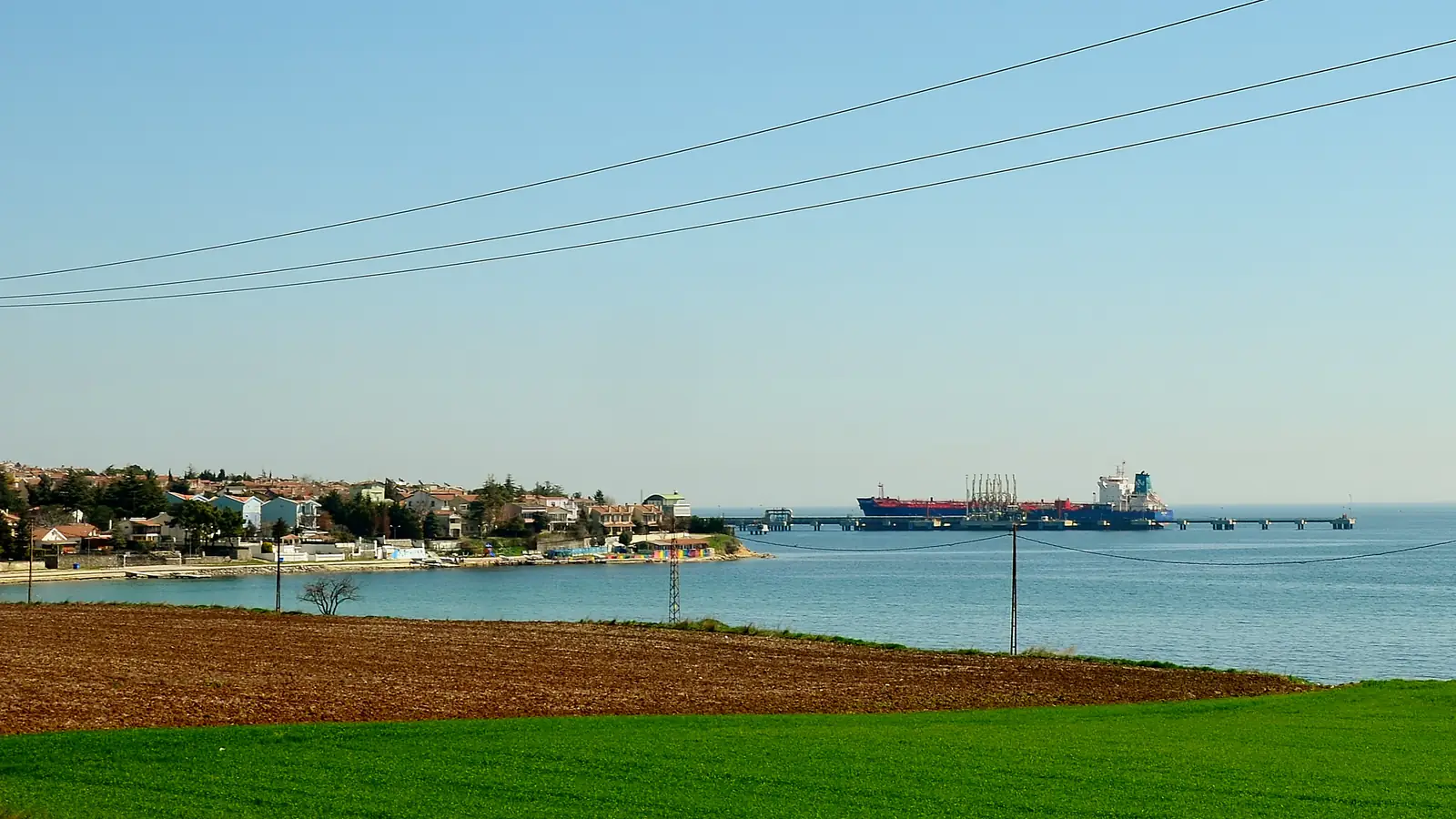
Türkiye matters because it adds another possible geometry. On July 10, Türkiye and the Turkish Cypriot administration announced a planned Anamur–Teknecik gas system of about 101 km: 97 km offshore and 4 km onshore, with two planned 22-inch pipelines. Energy Minister Alparslan Bayraktar said it would be designed for two-way flows—from Türkiye to the island, but also from the island back to Türkiye and onward to Europe. There is no approved Leviathan-to-Türkiye project in that announcement. The significance is that the infrastructure is being designed with a northbound option. Türkiye Energy Ministry
North of Türkiye, the Southern Gas Corridor already reaches Europe. TAP connects with TANAP at the Türkiye-Greece border; TAP’s current operational capacity is 10 bcm a year and it is designed to expand toward at least 20 bcm, while an additional 1.2 bcm a year of long-term capacity became operational in 2026. None of this proves spare capacity for Israeli gas. Entry points, gas quality, bookings, regulation, upstream connections—the links from oil and gas production operations into the system—and political agreements would all have to be solved. It does prove that Türkiye is not an isolated pipe ending at its western border. TAP operations TAP 2026 expansion
The option value disappears if politics makes the route impossible before economics can even be tested. That is the medium-term cost of total disengagement: not necessarily lost molecules, but fewer credible alternatives.
The overlooked oil paradox: Israel also wants Gulf flows
Gas is only half of the corridor story. Israel’s own energy minister, Eli Cohen, proposed in July a roughly 700-km Saudi-to-Eilat oil pipeline that would connect Gulf crude to Israel’s existing Eilat–Ashkelon system and then the Mediterranean. The concept is explicitly about bypassing Hormuz and Red Sea disruption. Reuters: Saudi–Eilat concept
The existing Eilat–Ashkelon crude line is 42 inches in diameter and 254 km long. Its operator lists maximum south-to-north capacity at 60 million tonnes a year. EAPC
That creates a strategic contradiction. Israel cannot simultaneously maximise the probability of becoming a Gulf-to-Europe energy bridge and treat the Saudi-centred security architecture as irrelevant. Full membership is not required, but some degree of political and security accommodation becomes more valuable when the commercial vision itself depends on Saudi territory and regional route protection.
Long term, 2034–2040: the danger is network lock-in
The largest risk is not that the pact becomes an anti-Israel military coalition. The more consequential scenario is that it becomes a network operating system for ports, shipping lanes, pipelines, radar feeds, cyber protocols and critical infrastructure.
Saudi Arabia has already proposed a multinational maritime defence coalition for the Red Sea, Bab el-Mandeb and Gulf of Aden. Representatives of 43 countries and the European Union attended the July 30 meeting, and 14 countries—including Türkiye, Pakistan and Egypt—backed the proposal. The stated mission includes protecting international trade and energy supply lines. Days later, a Houthi drone attack caused a fire at Saudi Aramco’s Jazan refinery, underscoring that infrastructure protection is not an abstract concern. Reuters: maritime coalition Reuters: Jazan attack
Henry Farrell and Abraham Newman’s “weaponized interdependence” framework explains why network position matters. Their work shows that asymmetric networks can create hubs and chokepoints that give actors controlling central nodes informational or coercive advantages. SIAIntel is not claiming the Mecca Pact will deliberately weaponize pipelines against Israel. The narrower inference is that centrality itself creates leverage. A country outside the standards, information-sharing and protection architecture can become dependent on nodes controlled or coordinated by others. Farrell & Newman, International Security
This is the long-term version of asymmetric embeddedness: Israeli gas may flow through Egypt; Gulf energy may seek Mediterranean outlets; maritime security may be coordinated by countries inside an expanding regional framework; yet Israel may have limited influence over the protocols surrounding those flows.
In a high-integration scenario, SIAIntel places the 2034–2040 strategic-exclusion range at 65–80/100. If the Mecca Pact stays a narrow mutual-defence arrangement with little economic or technical integration, the same long-term risk falls to roughly 20–35/100.
SIAIntel’s network multiplier: why Egypt changes the curve
A linear score understates Egypt’s role because Cairo is not simply one more member. It combines Suez, LNG infrastructure, the Israeli gas relationship, EMGF membership and R4 participation. SIAIntel therefore adds an Egypt Network Multiplier to the scenario model.
The base Strategic Exclusion Risk score weights six variables: energy-optionality loss (25%), network-centrality loss (20%), security-interoperability gap (20%), rule-making loss (15%), market-access friction (10%) and late-entry cost (10%). This is a transparent editorial heuristic, not an econometric model.
If the base score were 55 and Egypt joined the pact but energy-security integration remained shallow, a 10–15% multiplier would push the adjusted score to roughly 61–63. If Egypt joined and the pact also developed joint maritime and critical-infrastructure protection, a 25% multiplier would lift the same base score to 68.75.
The point is not the decimal. It is the shape of the risk. Egypt can make the cost of exclusion multiplicative rather than additive because it links networks that are currently separate.
Audience Impact
For households, the transmission channel is indirect: route security, insurance and gas optionality can eventually influence power, transport and imported-energy costs rather than producing an immediate bill shock.
For investors, the decisive signals are Egypt’s membership decision, Leviathan expansion milestones, maritime-security institutionalisation and whether a northbound corridor becomes commercially testable.
For companies, the relevant risk is fewer credible logistics and energy alternatives. That can weaken bargaining power before any physical supply interruption occurs.
For policymakers, the key choice is not membership versus isolation. It is whether technical engagement can preserve rule-making access without requiring political alignment that is currently unrealistic.
What would prove this thesis wrong?
The strongest counter-thesis is straightforward. The Mecca Pact may remain a limited mutual-defence promise. Egypt may not join. The Saudi-led maritime coalition may develop separately. Türkiye’s Cyprus pipeline may serve only local demand. EastMed or Egyptian LNG capacity may give Israel sufficient export diversity. European gas demand may fall faster than expected. Israel’s U.S.-centred security and technology relationships may continue to outweigh any benefit from a new regional structure.
The EU consumed 339 bcm of gas in 2025 at an average wholesale price of about €36/MWh. A hypothetical 12 bcm corridor would equal only about 3.5% of that consumption. Europe is also decarbonising, so a route that looks strategically attractive today still needs long-term commercial demand. European Commission
SIAIntel would materially downgrade the thesis if three things occur together: Egypt stays outside the pact through 2030; the alliance does not create shared maritime, cyber or infrastructure-security standards; and Israel secures credible alternative export routes that preserve bargaining optionality.
It would upgrade the thesis if Egypt joins, the Mecca structure formally assumes critical-infrastructure or maritime-security functions, and a northbound Eastern Mediterranean energy corridor becomes commercially testable.
The bottom line: the real risk is being bypassed, not surrounded
Israel does not need the Mecca Pact to survive, and there is no evidence that it is preparing to join. In the short term, refusing membership may even avoid substantial political costs. The strategic issue is whether refusing all engagement becomes more expensive as the network develops.
If Egypt closes the fourth side of the security geometry, Israel could find itself in an unusual position: its gas economy connected to a member of the system, its proposed Gulf oil corridor dependent on Saudi geography, and parts of the surrounding maritime-security architecture shaped by Türkiye, Saudi Arabia, Pakistan and Egypt.
The most important risk is therefore not military encirclement. It is that neighbouring powers build a useful regional network without needing Israel as the indispensable bridge.
That changes the bargaining equation. In 2026, Israel can approach the architecture with assets the system may value: technology, intelligence, gas, logistics and U.S. connectivity. If the network matures without it, a future approach could carry a late-entry premium—more political conditions, less influence over standards and fewer route options.
The question for 2035 may not be whether Israel needs the Mecca system. It may be whether the Mecca system still needs Israel.
Editorial Credit
This intelligence brief was prepared by the SIAIntel Editorial Desk.
Some contributors work in sensitive public-sector, regulatory, market, or editorial roles. Their identities may be withheld when professional duties, source protection, or safety require confidentiality.
Editorial and publishing accountability: Sefa Karahan, Founder & Publisher