Coinbase and Kalshi are bringing regulated crypto perpetual futures to U.S. traders, signaling a shift in how offshore crypto derivatives activity may enter supervised market infrastructure.
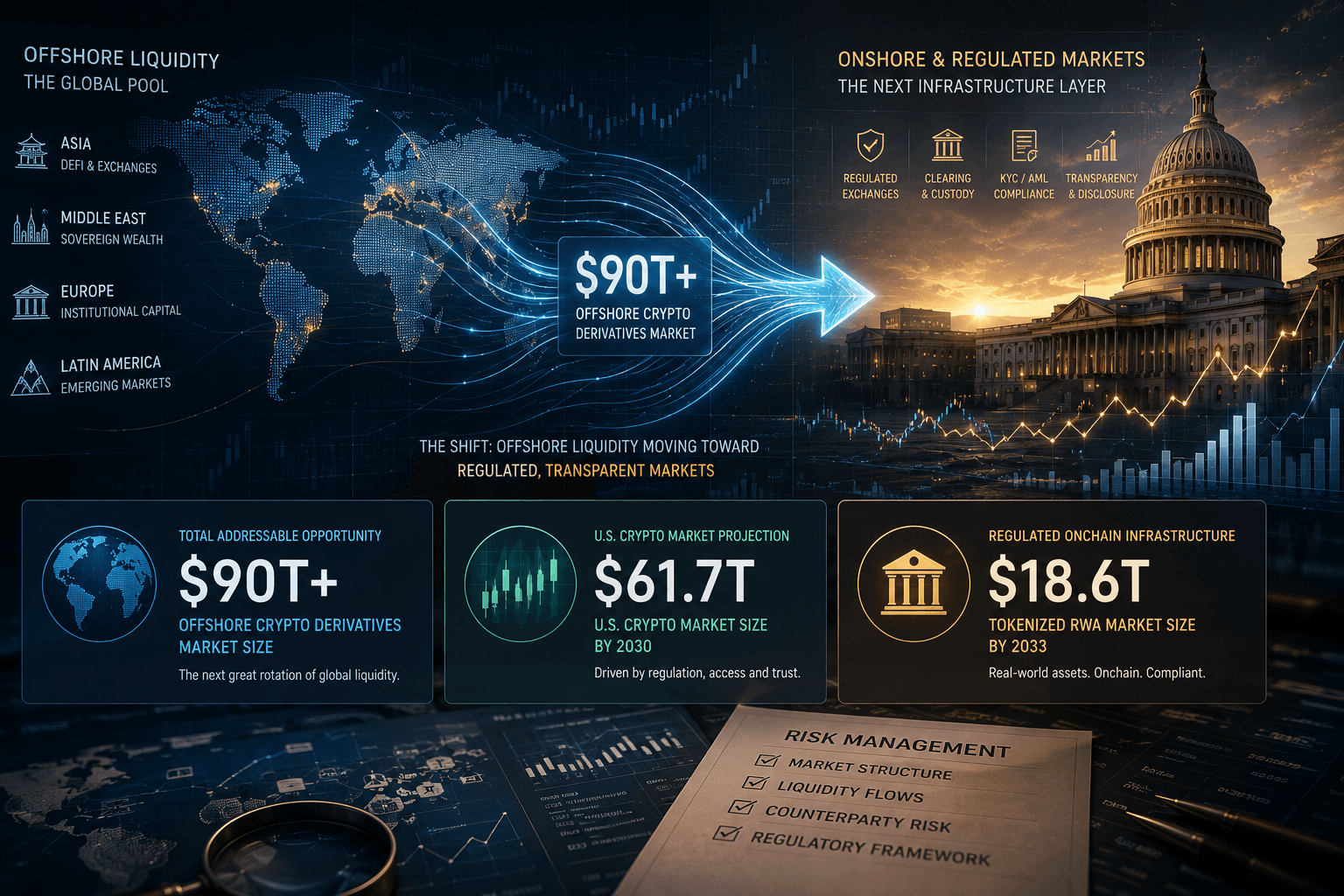
Coinbase and Kalshi are bringing regulated crypto perpetual futures to U.S. traders, signaling a shift in how offshore crypto derivatives activity may intersect with supervised market infrastructure. This development is not simply a product launch. It is a market-structure signal: a derivatives category that grew largely offshore is beginning to intersect with the American regulatory perimeter.
The intelligence signal is regulatory migration, not a claim that all offshore liquidity will move onshore. The deeper question is whether regulated U.S. venues can attract meaningful institutional flow while reducing opacity, without reproducing the most dangerous features of high-leverage offshore markets.
Volume Data: Context and Methodology
Kalshi's announcement cites offshore perpetuals annual volume growing from $28T in 2023 to $90T+ in 2025. Reuters, drawing on CryptoQuant data, reports that 2025 perpetual futures volume reached approximately $61.7T, while spot crypto volume stood at approximately $18.6T. Perpetual futures volume increased around 29% from 2024.
These figures should not be added together. They represent different measurement scopes and different source methodologies. Kalshi's $90T+ figure refers to offshore perpetuals volume, while CryptoQuant's $61.7T figure measures perpetual futures volume through a different methodology. The market-structure signal is that a product category that developed offshore is now entering regulated U.S. venues, not that all offshore activity will immediately migrate.
What Are Perpetual Futures?
Perpetual futures are derivative contracts that allow traders to gain leveraged price exposure to cryptocurrency markets without a fixed expiration date. Unlike traditional futures contracts, perpetuals do not settle on a specific date. Instead, they use a funding-rate mechanism to keep the contract price anchored to the underlying asset's spot price.
The funding rate is a periodic payment between long and short positions. When the perpetual contract price trades above the spot price, long position holders may pay short position holders. When it trades below spot price, short position holders may pay long position holders. This mechanism creates an incentive for the contract price to converge toward the spot market.
Perpetuals are among the most actively traded crypto derivatives products. They offer leverage, allowing traders to control larger positions with less capital. That leverage can amplify both potential gains and potential losses.
Why the Onshore Shift Matters in the U.S.
The U.S. regulatory perimeter for crypto derivatives has been defined primarily by the Commodity Futures Trading Commission. On May 29, 2026, the CFTC issued a policy statement on American crypto asset perpetuals, providing clarity on how these products fit within the regulatory framework.
CFTC Chairman Michael Selig's statement emphasized that perpetual contracts can fall under CFTC oversight when offered through regulated venues. The policy framework addresses the funding-rate mechanism, the absence of fixed expiration and the requirements for platforms offering these products.
Coinbase and Kalshi's entry into this space represents a major step toward regulated crypto perpetual access for U.S. traders. This could shift part of the offshore derivatives activity toward supervised venues, potentially changing liquidity distribution, spreads and venue competition.
Capital Efficiency Is the Real Test
The critical question is not whether regulated perpetuals will launch, but whether they can compete on capital efficiency. Offshore venues have built structural advantages that regulated U.S. platforms may struggle to replicate:
Cross-margining and collateral efficiency: Offshore platforms often allow traders to use a single collateral pool across multiple positions and products. Regulated U.S. venues typically operate under stricter margin segregation rules, which can increase capital requirements for the same exposure.
Margin rules and capital costs: U.S. regulatory margin requirements may be more conservative than offshore practices. For institutional traders managing large portfolios, the difference in margin efficiency can materially affect returns and capital allocation decisions.
KYC friction and operational complexity: Regulated venues require full Know Your Customer compliance, which creates onboarding friction and ongoing compliance costs. Offshore platforms, while also subject to AML rules, may offer faster account opening and lower operational overhead for certain market participants.
Tax visibility and reporting: U.S. regulated venues generate comprehensive tax reporting, which can create compliance burdens for traders. Offshore platforms may offer different tax treatment or reporting requirements, which some participants view as advantageous despite legal risks.
Institutional cost of capital: The aggregate effect of these factors—margin requirements, collateral segregation, compliance costs, and tax visibility—creates a higher cost of capital for trading on regulated venues. For sophisticated market participants, this cost differential can outweigh the benefits of regulatory oversight.
The implication is that regulated U.S. perpetuals may attract institutional flow primarily from participants who are already constrained from using offshore venues due to compliance restrictions. Retail traders and unconstrained institutions may continue to find offshore venues more capital-efficient, despite the regulatory risks.
The 50:1 Leverage Paradox
Reuters reports that leverage in crypto perpetuals can reach up to 50:1. This figure highlights a regulatory paradox: the same leverage that makes perpetuals attractive to traders also creates systemic risk that regulators are designed to contain.
The paradox is that regulated venues, by definition, operate under stricter risk management and consumer protection standards. If U.S. regulated perpetuals offer significantly lower leverage than offshore alternatives, they may fail to attract liquidity. If they offer comparable leverage, they risk reproducing the very systemic risks that regulatory oversight is meant to prevent.
This is not a simple risk-management problem. It is a structural question about whether regulated derivatives markets can compete with unregulated venues on product features without compromising financial stability. The CFTC's policy statement attempts to navigate this paradox by providing clarity while leaving leverage limits to be determined through market practice and supervision.
The practical implication is that leverage levels on regulated U.S. perpetuals will be a key indicator of whether the product succeeds. Too low, and liquidity stays offshore. Too high, and regulators face pressure to intervene. The equilibrium point is uncertain and will evolve through market experience.
Why Regulated Perpetuals May Not Drain Offshore Liquidity
The assumption that regulated U.S. perpetuals will automatically drain offshore liquidity overlooks several structural factors:
Capital efficiency differentials: As outlined above, offshore venues may maintain significant capital efficiency advantages due to cross-margining, looser margin requirements, and lower compliance costs. Traders optimize for total cost of capital, not just regulatory compliance.
Established liquidity pools: Offshore perpetuals markets have deep, established liquidity with tight spreads and high trading volumes. Regulated U.S. venues will start with thinner liquidity, creating a chicken-and-egg problem: traders follow liquidity, but liquidity requires traders.
Product feature gaps: Offshore platforms often offer more advanced features—complex order types, structured products, and bespoke derivatives—that may not be immediately available on regulated venues. Sophisticated traders may stay offshore for product functionality.
Geographic restrictions: Regulated U.S. perpetuals are legally available only to U.S. persons. Non-U.S. traders, who constitute a significant portion of offshore perpetuals volume, cannot access these products regardless of capital efficiency.
Regulatory arbitrage persistence: Some market participants will continue to seek regulatory arbitrage opportunities, preferring offshore venues precisely because they operate outside strict U.S. oversight. This is not a rational economic calculation but a deliberate risk-taking strategy.
The net effect is likely to be a segmentation rather than a wholesale migration. Regulated U.S. perpetuals may capture institutional flow that is compliance-constrained, while offshore venues retain retail and unconstrained institutional flow. The total offshore perpetuals volume may decline modestly, but a complete drain is unlikely without significant regulatory crackdowns on offshore access.
What This Means for U.S. Traders
For U.S. traders, regulated crypto perpetuals may offer access to leveraged crypto derivatives inside a supervised framework. That could mean trading through CFTC-overseen platforms rather than relying primarily on offshore venues.
The potential benefits include clearer venue oversight, more formal margin rules, better reporting standards and stronger compliance integration. But these benefits do not make the product low-risk.
Regulated venues do not eliminate leverage risk. They may provide different risk management tools and stronger supervision, but traders still face liquidation risk, margin pressure, volatility and funding-rate exposure.
What This Means for Individual Investors
Individual investors should approach crypto perpetuals with caution. These instruments are not equivalent to holding spot crypto assets. They are derivatives with leverage, funding payments and liquidation mechanics.
The most important risks are:
- leverage risk,
- funding-rate costs,
- rapid liquidation during volatility,
- misunderstanding of margin requirements,
- overexposure to short-term market moves.
A regulated venue can improve transparency and legal clarity, but it does not remove the basic risk of using leverage in a volatile crypto market.
What This Means for Institutional Investors
For institutional investors, the onshore shift may be more significant. Many hedge funds, asset managers and trading firms face compliance restrictions that make offshore venues difficult or impossible to use.
Regulated perpetuals may create a cleaner path for hedging, basis trading, liquidity provision and risk management. They may also support more formal reporting, custody and collateral workflows.
Institutions without regulated clearing, compliance and real-time risk surveillance may be less competitive for institutional flow as regulated options expand.
What This Means for Companies
Crypto exchanges, brokerages and fintech companies may need to reassess product strategy as regulated perpetuals enter the U.S. market.
Potential areas of impact include:
- product design,
- custody and collateral management,
- margin systems,
- clearing workflows,
- compliance infrastructure,
- market-data products,
- trade surveillance tools.
Companies that integrate with regulated clearing and real-time risk monitoring may be better positioned if institutional demand grows.
What This Means for Emerging Fintech Companies
The opportunity is not limited to exchanges. Emerging fintech companies may serve the infrastructure around regulated perpetuals.
Potential opportunities include:
- funding-rate dashboards,
- margin engines,
- liquidation analytics,
- AI-driven trade surveillance,
- collateral infrastructure,
- compliance automation,
- venue-comparison data tools.
If regulated perpetual volumes grow, demand for these services could increase. The advantage may go to firms that can combine speed, transparency and regulatory alignment.
What This Means for Emerging Markets
Emerging markets may experience indirect effects from the U.S. regulatory migration. These effects are likely to vary by country and should not be treated as immediate or uniform.
Liquidity distribution, spreads and venue competition could change if major market makers allocate more activity to regulated U.S. venues. Regulators in emerging markets may also monitor whether the U.S. model becomes a reference point for local crypto derivatives policy.
For countries with high crypto adoption, FX sensitivity or heavy offshore-platform usage, the issue is not just access. It is retail protection, leverage supervision and the ability of local frameworks to keep pace with global market structure.
Countries and Financial Centers to Watch
The following jurisdictions are watchlist markets, not direct-impact claims:
- United States: Primary regulatory and liquidity shift through CFTC-supervised market infrastructure.
- European Union: Crypto-asset and derivatives oversight may evolve as U.S. regulated perpetuals develop.
- United Kingdom: Post-Brexit market-structure positioning and crypto derivatives oversight.
- Singapore: Crypto-finance hub positioning and regulatory caution.
- Hong Kong: Digital-asset market access and financial-center competition.
- UAE: A crypto-finance hub to watch.
- Japan: Retail trading culture and derivatives oversight relevance.
- South Korea: High retail participation and politically sensitive crypto regulation.
- Turkey: Crypto participation, FX sensitivity and retail-risk implications.
- Brazil: Developing crypto oversight and financial-market regulation.
- India: Restrictive but evolving crypto policy environment.
- Indonesia: Retail crypto interest and developing regulatory framework.
- Nigeria: Significant crypto adoption and regulatory uncertainty.
These jurisdictions are not all affected in the same way. They represent a watchlist for regulatory and market-structure developments.
Indicators for Investors to Monitor
Investors and market participants may track:
- regulated U.S. perpetual futures volume,
- offshore perpetual futures volume,
- open interest,
- funding rates,
- liquidation data,
- spread differences between venues,
- institutional onboarding,
- CFTC guidance and enforcement posture,
- additional exchange launches,
- custody and collateral infrastructure.
The key question is whether regulated U.S. venues can attract meaningful liquidity while reducing opacity, without reproducing the most dangerous features of high-leverage offshore markets.
SIAIntel Assessment
This development may strengthen the case for regulated crypto derivatives infrastructure while shifting part of the liquidity debate toward supervised venues. The offshore era may be entering a new competitive phase rather than ending.
Liquidity distribution, spreads and venue competition could change as regulated options expand. Firms without regulated clearing, compliance and real-time risk surveillance may be less competitive for institutional flow. Regulated volumes could increase if adoption grows, but the scope and timing remain uncertain.
The deeper signal is not a guaranteed liquidity migration. It is that a crypto-native derivatives product is moving closer to the center of regulated financial infrastructure. However, capital efficiency differentials, leverage paradoxes, and structural advantages of offshore venues mean that regulated perpetuals are more likely to segment the market than to drain it.
This article is not a buy/sell recommendation. It is a market-structure risk map.
Sources
1. Reuters: Coinbase and Kalshi bring regulated perpetual crypto futures to U.S. investors. 2. Reuters: Crypto exchanges gear up for U.S. perpetual futures ahead of rule change, citing CryptoQuant data. 3. Kalshi / Business Wire: Kalshi launches first-ever perpetual futures in America. 4. CFTC: Statement of Chairman Michael Selig on American crypto asset perpetuals. 5. CFTC Press Release: May 29, 2026 perpetual contracts policy statement and related actions.
Editorial Credit
SIAIntel Editorial Team
Editorial Credit
This intelligence brief was prepared by the SIAIntel Editorial Desk.
Some contributors work in sensitive public-sector, regulatory, market, or editorial roles. Their identities may be withheld when professional duties, source protection, or safety require confidentiality.
Editorial and publishing accountability: Sefa Karahan, Founder & Publisher
Related Intelligence
Related intelligence in this category · 3 briefs

Europe’s Food Buffer Is Starting to Crack
A near-20-year low in EU maize output is arriving as Brazil loses access for key animal products. The hidden risk sits between feed, protein supply and food prices.

AI’s Capital Squeeze Reaches U.S. Treasuries
Waller says AI infrastructure is competing for capital as Norway’s fund proposes a sharp Treasury-weight cut. The signal is rotation, not dollar flight.

AI Has Entered the Fed’s Reaction Function
AI’s investment boom may lift the neutral rate and bond yields before productivity lowers inflation. The Fed now faces a timing problem.