AI Power in Évian: Did Trump's "Greenland" Whisper Expose the New Northern Front of AI Geopolitics?
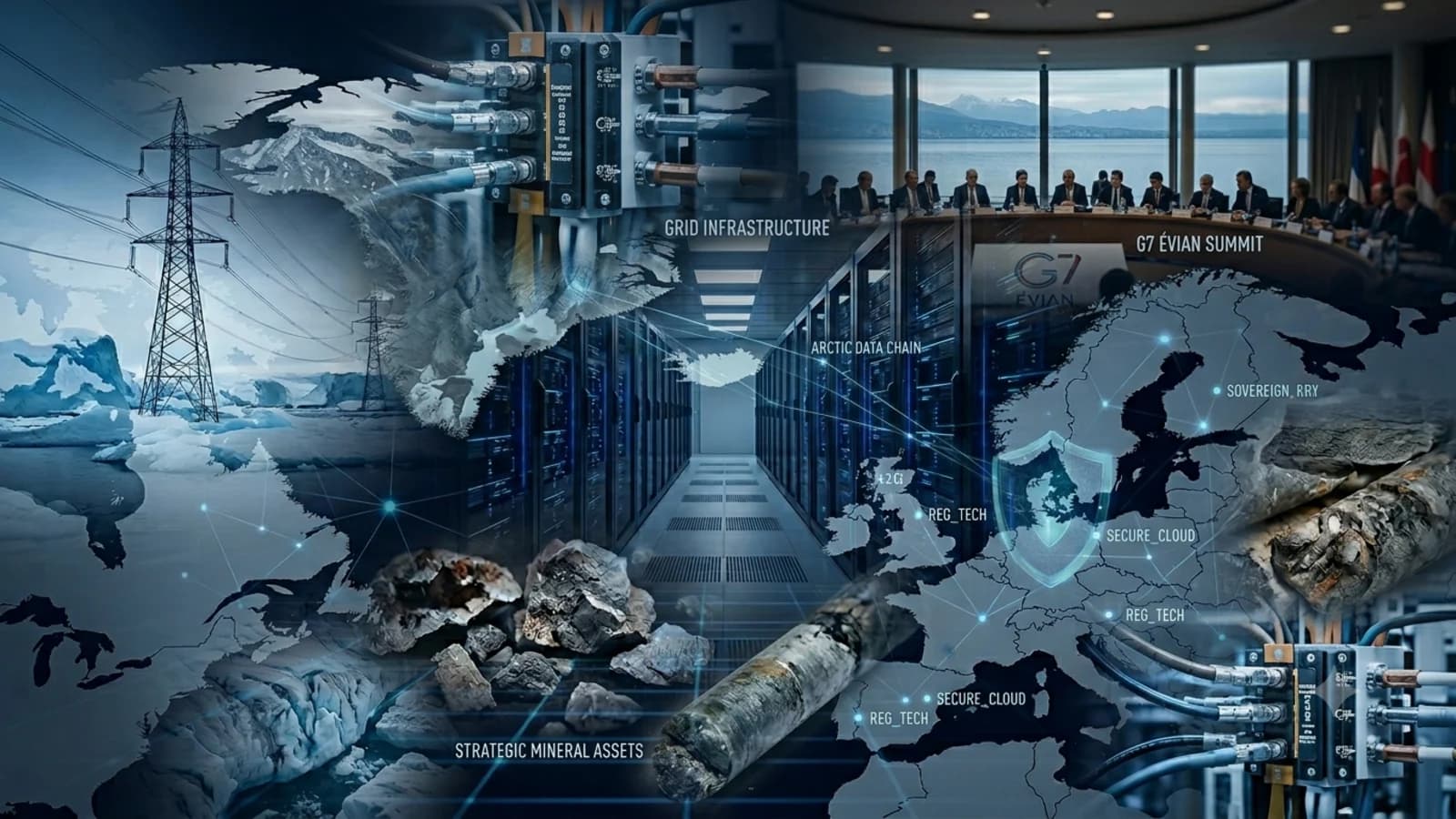
Executive Intelligence Panel
G7 Évian 2026 should be read as an inflection point in the geopolitics of AI infrastructure. The summit did not merely place artificial intelligence beside trade, security and digital policy. It exposed how AI power now depends on a linked chain of hard assets and regulatory permissions: critical minerals, mineral processing, grid capacity, trusted cloud access, platform safety obligations, and the political geography of Arctic resource optionality. The official G7 summit context anchors the setting official G7 summit page, while the G7 mineral track and trusted partner AI discussion identify the two strongest market signals Reuters critical minerals Reuters trusted AI partners.
The central SIAIntel reading is that AI dominance is moving from a compute-only race into a controlled access regime. Chips and models still matter, but they are no longer sufficient. AI scale requires secure mineral inputs, reliable electricity, cooling and water infrastructure, compliant cloud jurisdictions, and a platform-liability framework that can survive online safety scrutiny. For fund managers, this shifts the AI trade from a narrow software multiple toward a broader infrastructure risk premium. For commodity traders, it elevates rare earths, mineral processing, copper and grid equipment as AI-linked exposure. For technology analysts and policy desks, it turns "sovereign AI" into a practical test: can Europe secure trusted access to US technology while keeping control over data, regulation, power systems and public legitimacy?
The Greenland signal must be handled with discipline. AP reporting provides the basis for the hot-mic Greenland reference AP hot-mic reporting. SIAIntel does not treat that item as evidence of a secret deal, a formal Greenland agreement, a diplomatic commitment, or a resource transaction. The market-relevant interpretation is narrower: Greenland sits at the intersection of Arctic security, rare earth optionality, North Atlantic geography and the mineral dependencies of AI infrastructure. CSIS provides the strategic background for that Arctic and rare earth frame CSIS Greenland rare earths analysis. The investable question is not "what was secretly agreed?" It is "which mineral, grid and trusted-access chokepoints are moving back into strategic pricing?"
Editorial Guardrail
This brief separates verified reporting from SIAIntel inference. Verified reporting: AP reported the hot-mic Greenland element AP hot-mic reporting. Reuters reported the G7 critical minerals and AI trusted partner tracks Reuters critical minerals Reuters trusted AI partners. The G7 documents provide primary-source policy framing for critical minerals and safer digital spaces for minors G7 critical minerals declaration G7 minors digital safety call. The IEA provides the energy-demand basis for the AI grid discussion IEA Energy and AI outlook.
SIAIntel inference: the convergence of these files suggests that AI power is becoming a strategic infrastructure system. That inference does not prove a Greenland transaction, does not assert a hidden mineral agreement, and does not convert a hot-mic moment into a policy decision. Greenland is used here as a market signal linked to Arctic security and rare earth optionality, not as proof of a secret deal.
Lead
The G7 Évian 2026 AI story is not simply that leaders discussed artificial intelligence. The deeper story is that AI has entered the hard-asset phase of geopolitics. The same summit field now contains critical minerals, trusted partner access, online safety obligations for minors, European sovereign AI, Greenland's Arctic-mineral signal, and the electricity load of data centers. Together, these files describe a new operating environment for AI capital: the winning stack is not only model performance, but secure supply, trusted jurisdiction, grid capacity and regulatory legitimacy.
That matters because the AI trade has been priced heavily for speed, scale and compute, while the policy system is starting to price trust, resilience and social permission. The G7 critical minerals declaration places supply-chain security under a strategic lens G7 critical minerals declaration. The G7 call for a safer digital space for minors adds a platform-liability and product-design layer G7 minors digital safety call. The IEA's energy and AI work brings the physical grid into AI growth analysis, including a projection that data-center electricity demand could move toward around 945 TWh by 2030 IEA Energy and AI outlook. This is not a deterministic crisis claim. It is an infrastructure constraint signal: AI capacity that cannot secure electricity, cooling, water and grid connection remains a model demo, not a sovereign industrial base.
Transmission Chain table
| Chain Link | Verified Reporting / Primary Source Ground | SIAIntel Inference | Market Transmission |
|---|---|---|---|
| Hot-mic Greenland signal | AP hot-mic reporting anchors the Greenland reference. | Strategic market signal only. It is not proof of a secret deal, formal agreement or resource transaction. | Rare earth optionality, Arctic security risk, North Atlantic basing geography, defense-tech and AI infrastructure supply-chain premiums. |
| Critical minerals security | Reuters critical minerals and G7 critical minerals declaration. | AI scale depends on secure physical inputs and mineral processing, not only chips and compute budgets. | Rare earths, processing capacity, friend-shoring, offtake agreements, strategic stocks and recycling networks. |
| Copper and grid equipment | IEA Energy and AI outlook anchors the electricity-demand layer. | AI demand turns grid expansion into a technology bottleneck and a materials problem. | Copper, transformers, switchgear, high-voltage equipment, grid software and connection queues become AI-linked exposures. |
| Power generation and PPAs | IEA Energy and AI outlook. | Data-center load requires continuous, contracted and politically acceptable electricity supply. | Clean-power PPAs, gas backup, nuclear interest, storage, flexibility services and regional power-price floors. |
| Cooling and water infrastructure | IEA Energy and AI outlook supports the broader infrastructure constraint. | AI sites compete not only for electricity but for heat management, water access and local permission. | Cooling technology, water treatment, siting risk, permitting, municipal backlash and data-center operating margins. |
| Trusted partner AI access | Reuters trusted AI partners. | AI infrastructure access may become partly conditioned by jurisdictional trust, allied alignment and security posture. | Cloud location, chip access, model API controls, data governance, procurement eligibility and cross-border compliance costs. |
| Europe sovereign AI | official G7 summit page as summit context. | Europe needs allied technology access without becoming a passive customer of external AI stacks. | Sovereign cloud, secure data spaces, public AI procurement, compliance infrastructure and regulated AI deployment. |
| Online safety and minors regulation | Reuters online safety and G7 minors digital safety call. | Platform safety becomes a social-license and market-access condition for AI products. | Age assurance, child-data governance, content moderation, ad-targeting limits and Big Tech platform-liability risk. |
Critical Minerals
Critical minerals are the physical base of the AI power stack. The G7 critical minerals declaration frames supply chains as a matter of resilience, security and coordination G7 critical minerals declaration. Reuters' reporting on a G7 critical minerals alliance and crisis platform places that policy frame into a market context Reuters critical minerals. The combined signal is not just "more minerals." It is a shift toward trusted supply, processing visibility, contingency planning and strategic reserve logic.
For investors, the first segmentation is rare earths and mineral processing. Rare earth exposure is not only a mining question. It is a separation, refining, magnet, permitting and jurisdictional trust question. AI data centers, high-performance chips, grid equipment, electric vehicles, defense sensors and satellite systems all draw from overlapping industrial ecosystems. The scarcity premium may therefore migrate from ore bodies to processing capacity, compliant supply chains, offtake agreements and the ability to certify non-adversarial inputs.
Greenland belongs in this section as optionality, not as a claim of action. CSIS frames Greenland through rare earths and Arctic security CSIS Greenland rare earths analysis. SIAIntel reads the hot-mic item as a reminder that North Atlantic mineral geography can reprice quickly when AI infrastructure, defense production and allied supply-chain security converge. That does not imply a new transaction. It does imply that resource geographies once treated as remote can become strategically liquid when supply chains are politicized.
The second segmentation is copper and grid equipment. AI demand is a grid story as much as a compute story. Data centers require transformers, switchgear, transmission capacity, distribution upgrades and grid software. The IEA's AI energy analysis places data-center electricity demand on a trajectory that could approach around 945 TWh by 2030 IEA Energy and AI outlook. That should be treated as a constraint scenario, not a guaranteed crisis. The market implication is still material: copper, transformer supply, grid equipment backlogs and connection queues become AI-linked indicators.
AI Dominance / Trusted Partners
AI dominance is being redefined away from open-market access and toward trusted access architecture. Reuters' trusted partner reporting indicates that G7 leaders were working through a scheme for closer AI ties among trusted partners Reuters trusted AI partners. The immediate policy language may be cooperative, but the market logic is more restrictive: access to advanced AI capabilities can become conditional on jurisdiction, security posture, data governance and political alignment.
The strategic issue is not whether AI becomes fully closed. It is whether the most valuable layers of the stack become selectively open. Advanced chips, high-end cloud capacity, frontier model access, government AI procurement, sensitive data sets and cross-border deployment rights can all be filtered through trust rules. That creates an advantage for companies and jurisdictions that can prove security, compliance and allied reliability. It also creates cost for firms that built their models around frictionless global access.
Europe's sovereign AI dilemma sits inside this trusted partner regime. Europe needs access to US cloud, chips and model ecosystems. But if it accepts access without bargaining power, it risks becoming a regulated customer rather than a platform owner. The investment lens should therefore separate three categories: sovereign cloud and secure data spaces, compliance-heavy AI infrastructure, and Big Tech platforms exposed to regulatory and platform-liability risk.
EU Digital Safety / Platform Regulation
Digital safety for minors is not a side issue in the AI race. It is part of the social license for AI products. Reuters' online safety reporting places technology executives and G7 leaders inside the same AI and online safety debate Reuters online safety. The G7 call for a safer digital space for minors adds a primary-source policy layer G7 minors digital safety call.
The market transmission runs through Big Tech compliance and platform-liability risk. AI assistants, recommendation systems, social feeds, video platforms, advertising tools and education products face a stricter design environment when minors are involved. Age assurance, child-data controls, content safety, ad targeting, recommender transparency and default privacy settings can move from policy debate into product cost.
Europe's advantage is that it already treats platform regulation as a strategic capability. Its risk is that regulation can become a substitute for infrastructure if policymakers confuse legal control with technical capacity. Sovereign AI requires rules, but it also requires power, cloud, chips, capital and deployable services. The high-quality European outcome is a regulatory shield paired with competitive infrastructure. The weak outcome is a regulatory shield around imported technology.
Capital, Risk & Strategic Priority Lens
Capital allocation priority should shift from AI model headlines toward the infrastructure that makes model deployment durable. The relevant capital stack includes rare earths and mineral processing, copper and grid equipment, power generation and PPAs, cooling and water infrastructure, sovereign cloud and secure data spaces, and compliance systems for platform-liability risk.
Risk budget should be assigned to bottlenecks that can interrupt AI scale even when demand remains strong. The main watchlist: mineral processing outside high-risk jurisdictions, transformer lead times, grid connection queues, regional electricity price floors, PPA availability, water permits, cooling efficiency, cloud localization rules, trusted partner eligibility and online safety compliance costs.
Strategic priority should be given to firms and jurisdictions that can integrate physical resilience with trusted access. A data center with cheap land but no grid connection is not strategic capacity. A model with strong benchmarks but weak data governance may lose public-sector access. A mineral deposit without processing, permitting and allied trust is not secure supply. AI power is becoming a system property, not a single-asset story.
Audience Impact Matrix
| Audience | Decision Question | Risk Signal | Opportunity Field |
|---|---|---|---|
| Fund managers | Are AI infrastructure valuations pricing political access, grid constraints and compliance costs? | Connection delays, PPA inflation, trusted partner restrictions, platform-liability exposure. | Integrated AI infrastructure, secure cloud, grid equipment, compliant data-center operators. |
| Commodity traders | Is AI demand turning critical minerals from cyclical tech exposure into strategic supply security exposure? | Processing bottlenecks, China concentration, Arctic risk, stockpiling policy. | Rare earths, mineral processing, copper, strategic offtake, recycling networks. |
| Power and infrastructure investors | Which power markets can absorb AI load without political backlash or grid paralysis? | Grid queues, transformer shortages, local opposition, water constraints, price floor risk. | Power generation, PPAs, grid modernization, storage, cooling and water infrastructure. |
| Technology analysts | Which AI companies can preserve access under trusted partner and online safety regimes? | Cloud localization, model access controls, age assurance obligations, content safety cost. | Sovereign cloud, secure data spaces, compliance tooling, platform safety infrastructure. |
| Policy desks | Can Europe combine regulation, infrastructure and allied access into a credible sovereign AI posture? | Dependency on US stack, slow permitting, energy constraints, fragmented procurement. | Public AI procurement, EU data spaces, trusted partner agreements, grid-linked industrial policy. |
| Big Tech risk teams | How does the G7 online safety direction alter AI product design and liability exposure? | Minors safety rules, child-data controls, ad targeting scrutiny, recommender accountability. | Safety-by-design systems, age assurance, privacy-preserving personalization, audit-ready governance. |
Three Market Scenarios
Scenario 1: Trusted access acceleration
The G7 moves from declarations to operational coordination on critical minerals and trusted AI access. Mineral security platforms gain practical relevance, trusted partner rules become clearer, and Europe negotiates access to US technology while hardening sovereign data and cloud infrastructure. In this scenario, sovereign cloud, secure data spaces, mineral processing, grid equipment and platform compliance tools benefit. Big Tech remains advantaged if it can meet safety and jurisdictional trust demands without slowing product deployment.
Scenario 2: Mineral-grid bottleneck
AI demand keeps growing, but mineral processing, copper supply, transformer availability and grid connection capacity do not scale at the same pace. The IEA data-center demand outlook, including the pathway toward around 945 TWh by 2030, becomes an investment constraint rather than a background statistic IEA Energy and AI outlook. In this scenario, AI capex remains high but project execution slows. Power generation, grid equipment, storage, cooling and water infrastructure gain bargaining power. Data-center developers face margin pressure and siting risk.
Scenario 3: Regulatory divergence
Online safety and minors protection move faster in Europe than in other major markets. The G7 safety language supports stronger product obligations G7 minors digital safety call, while platform firms face higher compliance and liability cost. Europe may gain a trust premium, especially for public-sector AI and regulated data use. But if infrastructure and deployment speed lag, the region risks becoming a rule-setter without enough platform ownership. The market winners are firms that turn compliance into a product advantage rather than a drag.
The Blind Spot: Invisible Cost of AI
The least visible risk in the Évian AI file is not a model-risk issue. It is the cost of physical scale. AI demand is often discussed through chips, data and talent, but data centers require electricity, grid connection, cooling, water, backup capacity, land, permitting and local political acceptance. The IEA's energy and AI work, including data-center electricity demand moving toward around 945 TWh by 2030, turns that physical layer into a central market variable IEA Energy and AI outlook.
This should not be read as a deterministic crisis forecast. It should be read as a constraint map. Some jurisdictions will absorb AI load by expanding grids, securing clean-power PPAs, permitting generation and managing local impacts. Others will find that data-center ambitions collide with network queues, water stress, power-price politics and community resistance. In those markets, the AI bottleneck may not be GPU supply. It may be a substation, a transformer, a cooling loop or a local permit.
The invisible cost can move through several channels. Households may see grid investment in network tariffs. Industrial users may face tighter power markets. Data-center operators may pay more for PPAs and backup capacity. Cloud customers may eventually absorb higher infrastructure cost. Policymakers may face a trade-off between AI industrial strategy and electricity affordability. The market usually prices this late because grid capacity lacks the drama of a model launch. That is precisely why it belongs in the brief.
Investor Action Box
- Treat critical minerals as AI infrastructure exposure, not only as commodity beta.
- Separate ore ownership from processing, refining, permitting, offtake and allied supply-chain trust.
- Track copper, transformers, switchgear and grid software as AI-linked capacity indicators.
- Watch power generation, PPAs, regional price floors and backup capacity as data-center margin variables.
- Add cooling and water infrastructure to data-center diligence, especially in politically sensitive regions.
- In Europe, separate sovereign AI rhetoric from actual secure cloud, data-space and compute capacity.
- For Big Tech, price platform-liability risk around minors safety, age assurance, child-data governance and recommender accountability.
- Treat Greenland as Arctic-mineral optionality and strategic signal only. Do not trade it as proof of a secret deal.
- This brief is not investment advice. It is a strategic risk and market-transmission framework.
SIAIntel Conclusion
G7 Évian 2026 exposed the structure of the next AI contest. The frontier is no longer only model performance. It is trusted access to the full stack: minerals, processing, chips, cloud, electricity, cooling, data governance, platform safety and political legitimacy. This is why the summit's critical minerals, trusted partners, minors safety and energy-grid signals belong in one intelligence brief.
The Trump-Costa Greenland hot-mic item is the most visible narrative hook, but it is not the core claim. The core claim is that AI geopolitics is moving north, down into the ground, across the grid and into the regulatory perimeter. Greenland is relevant because Arctic security and rare earth optionality are relevant. That is a market signal, not evidence of a hidden agreement.
SIAIntel's final view: AI power will be measured less by who announces the most capable model and more by who can secure the inputs, electricity, jurisdictional trust and social license required to deploy AI at scale. Évian did not settle that contest. It made the contest harder to ignore.
Reader Takeaway
AI is becoming a geopolitical infrastructure system. The investable chain runs from rare earths and mineral processing to copper, grid equipment, power contracts, cooling, water, sovereign cloud, secure data spaces and platform-liability controls. The Greenland hot-mic item should be read only as a strategic market signal inside that chain.
The sentence to keep: AI valuation is incomplete until the hidden infrastructure cost and geopolitical access filter are priced.
Source Map
- AP hot-mic reporting: Reporting ground for the Greenland hot-mic reference. Used only with the guardrail that it is not proof of a secret deal, formal Greenland agreement or resource transaction.
- Reuters critical minerals: Reporting ground for the G7 critical minerals alliance and crisis platform.
- Reuters trusted AI partners: Reporting ground for trusted AI partner access and cross-border coordination.
- Reuters online safety: Reporting ground for the AI and online safety summit agenda.
- official G7 summit page: Official summit context.
- G7 critical minerals declaration: Primary-source frame for secure and resilient critical mineral supply chains.
- G7 minors digital safety call: Primary-source frame for safer digital spaces for minors and platform accountability.
- IEA Energy and AI outlook: Analytical basis for AI and data-center electricity demand, including the careful around-945-TWh-by-2030 infrastructure constraint.
- CSIS Greenland rare earths analysis: Strategic context for Greenland, rare earth optionality and Arctic security.
Key Takeaways
- Executive Intelligence Panel G7 Évian 2026 should be read as an inflection point in the geopolitics of AI infrastructure.
- The summit did not merely place artificial intelligence beside trade, security and digital policy.
- The central SIAIntel reading is that AI dominance is moving from a compute-only race into a controlled access regime.
Data Snapshot
Coverage Area
GEOPOLITICS
Editorial category
Read Time
~17 min
Approximate duration
Source Base
Article context
Visible evidence profile
Published
Jun 17, 2026
Updated: Jun 17, 2026
Evidence Frame
This layer summarizes visible sources, article context and editorial framing. It is analytical context, not transactional guidance.
Editorial Credit
This intelligence brief was prepared by the SIAIntel Editorial Desk.
Some contributors work in sensitive public-sector, regulatory, market, or editorial roles. Their identities may be withheld when professional duties, source protection, or safety require confidentiality.
Editorial and publishing accountability: Sefa Karahan, Founder & Publisher
Related Intelligence
Related intelligence in this category · 3 briefs
Meta’s $12.3B Bond Exposes Wall Street’s AI Debt Machine
Meta’s $12.3B data-center bond shows how Wall Street is turning Big Tech lease promises into investment-grade AI debt—and pricing a new risk premium.
The Pentagon Is Building a Private-Capital Compute Grid
U.S. military land is becoming a platform for privately financed data centers, power, minerals, manufacturing and testing. SIAIntel maps the new infrastructure model.

Fed May Pause. AI’s $1.5T Buildout Could Keep Rates High
US PPI went flat, but AI infrastructure commitments, bond supply and grid bottlenecks may keep long-term financing costs elevated even if the Fed pauses.