"Japanese investors sold foreign equities and bought foreign bonds in May, sending a warning through U.S. Treasuries, tech stocks, the yen and global risk appetite."
SIAINTEL INTELLIGENCE DOSSIER
Analysis Brief
SIAIntel Verification Panel
Analysis, data context, source mapping and editorial boundaries are presented as one evidence chain.
Key Takeaways
- Japan’s latest cross-border flow data reads less like a routine monthly rebalance and more like a quiet warning from one of the world’s largest pools of overseas capital.
- It is the direction of the rotation: away from foreign stock risk and toward foreign duration.
- That matters because Japan is not just another marginal investor.
SIAIntel Perspective
SIAIntel frames this development not as a standalone headline, but as an intelligence brief shaped by source quality, structural implications and observable risk channels.
Data Snapshot
Coverage Area
Editorial category
ECONOMY
Read Time
Approximate duration
~8 min
Source Base
Visible evidence profile
4 visible sources
Published
Updated: Jun 08, 2026
Jun 08, 2026
Evidence Frame
This layer summarizes visible sources, article context and editorial framing. It is analytical context, not transactional guidance.
Japan’s latest cross-border flow data reads less like a routine monthly rebalance and more like a quiet warning from one of the world’s largest pools of overseas capital.
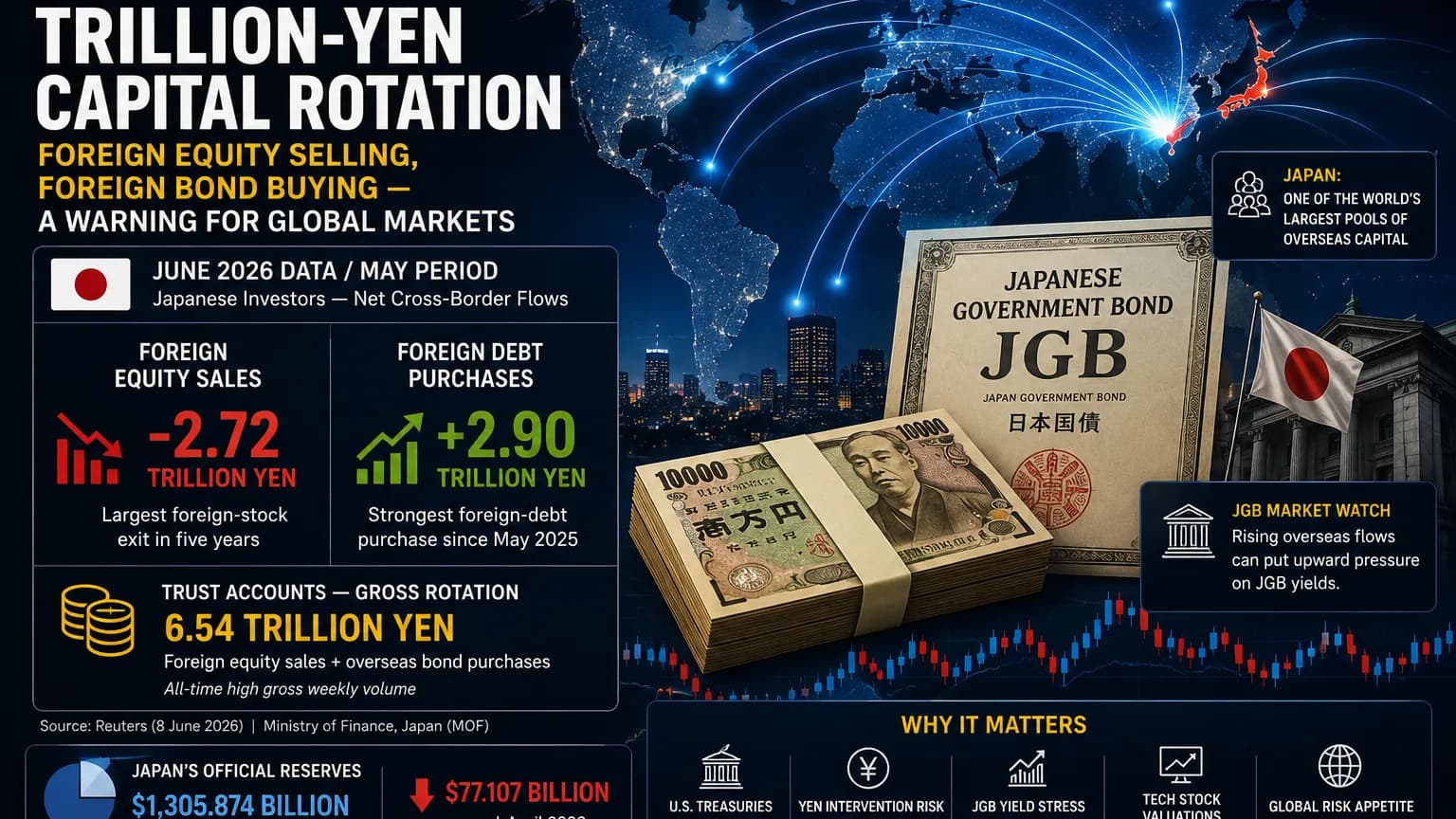
In May 2026, Japanese investors sold a net 2.72 trillion yen of foreign equities, the largest foreign-stock exit in five years, while buying a net 2.9 trillion yen of foreign debt securities, according to Reuters’ report on Japan’s foreign equity exit. The headline number is not only the equity sale. It is the direction of the rotation: away from foreign stock risk and toward foreign duration.
That matters because Japan is not just another marginal investor. Its pension funds, trust accounts, insurers and banks are part of the financial plumbing behind U.S. Treasuries, global credit, technology valuations and currency stability. When Japanese money changes direction, the signal can travel far beyond Tokyo.
The SIAIntel Signal: risk is not disappearing; it is changing address
The first mistake would be to read the May flow as simple panic. Japanese investors did not merely sell foreign assets. They sold foreign equities and bought foreign bonds.
SIAIntel’s calculation shows a 5.62 trillion yen directional swing between net foreign-equity sales and net foreign-debt purchases in May. Trust accounts made the message even sharper: they sold 3.38 trillion yen of foreign equities while buying 3.16 trillion yen of overseas bonds.
That is not a full retreat from the world. It is a change in what kind of global exposure Japanese institutions appear willing to hold.
If foreign equities represent growth, technology optimism and risk appetite, foreign bonds represent duration, income and protection against a more unstable macro cycle. The rotation therefore sends a warning: global investors may still want overseas exposure, but they may want it with more cash-flow certainty and less equity volatility.
Why Japan’s flows matter now
The rotation is arriving at a sensitive moment for Japan’s own bond market. Long-dated Japanese government bond yields have been under pressure; Reuters reported a record 30-year JGB yield and the highest 10-year JGB yield since 1996. At the same time, the Bank of Japan is still navigating the difficult exit from years of ultra-loose policy, while markets debate how far it can reduce bond purchases without destabilizing the curve.
There is also a currency channel. Japan’s foreign reserves fell sharply in May, with the Ministry of Finance reporting reserve assets of $1.305874 trillion at the end of May, down $77.107 billion from April, according to Japan’s Ministry of Finance reserve data. That keeps the yen, intervention risk and U.S. Treasury liquidity in the same conversation.
The result is a three-way tension: Japanese investors are moving toward foreign bonds, Japan’s own bond market is volatile, and currency authorities may still need liquid reserves if yen weakness returns.
SIAIntel Signal Continuity: from AI debt to Japanese duration
As SIAIntel noted in its earlier analysis of how the AI infrastructure boom is moving into the bond market, the pressure is no longer confined to technology stocks, chips or data centers. It is moving into the bond market.
The first signal came from the AI buildout. Large technology companies are raising long-term capital to fund data centers, power systems and computing capacity. That creates new demand for duration, new corporate bond supply and a new source of pressure on long-term Treasury valuations.
The second signal is now coming from Japan. Japanese institutions are not simply leaving global markets. They are changing the type of risk they want to hold: less foreign equity volatility, more foreign bond duration.
Together, the two signals point to the same deeper shift. Global markets are no longer being priced only through growth expectations. They are being repriced through capital intensity, borrowing demand, yield-curve pressure, currency policy and the hidden plumbing of institutional money.
For investors, that means the next market shock may not begin in an equity headline. It may begin in the bond market, in a currency intervention, in a Treasury auction, or in the decision of a large institutional capital pool to change where it wants duration.
Who is affected?
People, consumers and households
For households, this is not an abstract flow chart. Bond volatility affects borrowing costs, pension fund returns, insurance products and mortgage conditions. If Japanese institutions prefer bonds over equities because volatility is rising, the same risk mood can eventually touch household portfolios, retirement products and savings returns.
Countries and governments
Japan is directly affected because its domestic yield curve and currency policy are under pressure. The United States is affected because Japanese investors are major participants in dollar fixed income and U.S. Treasury liquidity. Europe and emerging markets are affected because a shift away from foreign equities can reduce global risk appetite, especially when investors are already nervous about technology valuations and funding costs.
Companies and sectors
Technology companies are the most visible equity-market channel. If large institutions rotate away from foreign stocks after a strong AI-led rally, the pressure can hit high-valuation sectors first. Banks, insurers and asset managers face a different problem: they must decide whether the bond move is defensive, tactical or the start of a longer duration cycle. Exporters also watch the yen, because currency moves can change profit expectations quickly.
Markets and investors
The direct market impact runs through U.S. Treasuries, global equity funds, credit spreads, the yen and JGB yields. Investors should not treat the May data as a single sell signal. They should treat it as a positioning signal: one major capital base is becoming more selective about equity risk.
Regulators and policy makers
The Bank of Japan, Japan’s Ministry of Finance, the Federal Reserve and U.S. Treasury-market supervisors all have a stake in this. The BOJ must avoid disorder in JGBs. The Ministry of Finance must manage yen pressure without exhausting market confidence. U.S. officials must care because forced or heavy reserve moves can touch Treasury liquidity.
Financial infrastructure and plumbing
This is also about the hidden wiring of global finance. Trust accounts, insurers, pension flows, FX reserves and government-bond markets help decide where stress appears first. When that wiring changes direction, the visible shock often arrives later: wider spreads, lower equity multiples, a weaker currency or a sharper bond auction.
Source math and evidence intelligence
The source map is deliberately cross-checked. Reuters provides the May 2026 Japanese investor flow data; Reuters also provides the JGB yield-stress context; Japan's Ministry of Finance provides the reserve-assets data; and SIAIntel's earlier AI infrastructure analysis provides the internal signal continuity.
The data snapshot is clear: Japanese investors sold 2.72 trillion yen of foreign equities and bought 2.9 trillion yen of foreign debt securities in May. SIAIntel calculates this as a 5.62 trillion yen directional rotation. Trust accounts added a second layer, with 3.38 trillion yen of foreign-equity sales and 3.16 trillion yen of overseas-bond purchases, equal to 6.54 trillion yen of gross rotation.
The cross-source confirmation matters because the flow data, JGB yield stress and reserve data all point to the same practical value: investors should watch whether global capital is moving from equity growth risk toward bond duration, Treasury liquidity and currency-policy risk.
The counter-signal: this may not be a permanent equity exit
The May data should not be exaggerated into a permanent Japan-led equity crash. Reuters also reported that investment trusts and life insurers continued buying foreign equities in May, even as trust accounts were heavy sellers. Japanese investors also bought U.S. and European stocks earlier in 2026.
That matters. A true structural retreat would require several months of similar data, not one large monthly swing.
The better reading is conditional: if JGB volatility stays high, the yen remains under pressure and global technology shares look crowded, Japanese institutions may keep favouring bonds over equities. If yields calm and the yen stabilizes, the rotation could slow or reverse.
What changes next?
The next signal is whether May becomes a one-month adjustment or the beginning of a longer capital regime.
Watch the Bank of Japan’s bond-purchase plan, the 10-year and 30-year JGB curve, yen intervention language, U.S. Treasury liquidity, Japanese trust-account flows and high-valuation technology shares. If the next data confirm the rotation, the market story will no longer be only about Japan. It will be about whether global capital is moving from growth risk to duration protection.
Sources
This analysis uses Reuters’ Japan investor-flow report for May 2026 rotation data, Reuters’ JGB and global bond-market context for yield-stress confirmation, Japan Ministry of Finance reserve data for reserve-side evidence, and SIAIntel’s AI infrastructure bond-market analysis for internal signal continuity.
<!-- SIAINTEL_LEGACY_FINAL_INSERT_VALIDATOR_MARKER_BRIDGE_PR165 lang: en markers: Executive Briefing | Infrastructure Signal | Main Analysis | Practical Impact | Who Should Care | Country and Bloc Impact Map | SIAIntel Watch | Editorial Safety Note | Sources | Turkey | Türkiye | Developed Markets | Developed markets | Emerging Markets | Emerging markets Purpose: compatibility bridge for legacy prepare/final-insert validator only. Modern visible editorial quality is enforced separately by visible impact, inline source link, publication quality and image performance guards. END_SIAINTEL_LEGACY_FINAL_INSERT_VALIDATOR_MARKER_BRIDGE_PR165 -->
Editorial Credit
This intelligence brief was prepared by the SIAIntel Editorial Desk.
Editorial oversight: Elanur Karahan, Founder & Editor-in-Chief
LinkedIn: View Profile