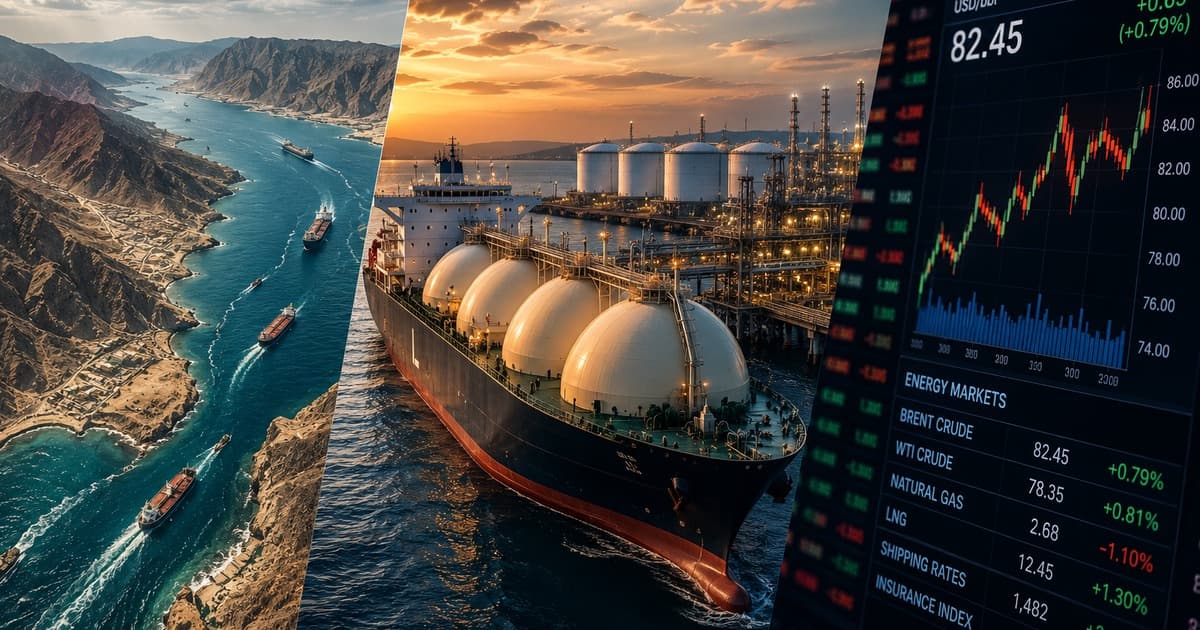
"The Hormuz normalization gap shows why oil-price relief can arrive before shipping security, insurance terms, LNG flows and port operations have fully recovered."
SIAINTEL 인텔리전스 브리프
분석 브리프
SIAIntel 검증 패널
분석, 데이터 맥락, 출처 매핑과 편집 경계가 하나의 근거 체인으로 제시됩니다.
핵심 요점
- The U.S.-Iran memorandum has given energy markets a reason to price lower disruption risk.
- But a diplomatic signal and a functioning maritime corridor are not the same thing.
- The strategic question is no longer whether markets can react quickly.
SIAIntel 관점
SIAIntel은 이 사안을 단독 헤드라인이 아니라, 출처 품질과 구조적 함의, 관찰 가능한 리스크 채널을 함께 반영한 인텔리전스 브리프로 해석합니다.
데이터 스냅샷
커버리지 영역
편집 카테고리
MARKETS
읽는 시간
예상 시간
~11 분
출처 기반
공개 근거 프로필
기사 맥락
게시일
업데이트: 2026년 6월 21일
2026년 6월 21일
근거 프레임
이 레이어는 공개 출처, 기사 맥락, 편집 프레이밍을 요약합니다. 분석 맥락이며 투자 조언이 아닙니다.
The U.S.-Iran memorandum has given energy markets a reason to price lower disruption risk. But a diplomatic signal and a functioning maritime corridor are not the same thing. The strategic question is no longer whether markets can react quickly. It is whether shipping security, insurance terms, port services and energy flows can validate that reaction.
Executive Intelligence Panel
| Intelligence signal | Current reading | Strategic meaning |
|---|---|---|
| Diplomatic framework | A 14-point memorandum calls for an end to military operations and steps toward restored commercial passage, while leaving a final agreement and several sanctions and nuclear mechanisms to further talks of up to 60 days. | The MoU is a transition framework, not proof of completed normalization. |
| Energy exposure | More than 110 bcm of LNG crossed Hormuz in 2025; about 93% of Qatar's and 96% of the UAE's LNG exports used the Strait. | LNG exposure is structurally difficult to reroute, even where crude has partial pipeline alternatives. |
| Financial pricing | Brent settled down 4.76% at $83.17 on 14 June and at $78.96 on 16 June as agreement and reopening expectations changed. | Markets can remove part of the disruption premium before physical flows recover. |
| Maritime execution | Safety, mine clearance, emergency services, vessel readiness, ports and sanctions clarity remain operational prerequisites. | The next phase is an execution test across several institutions, not a single reopening event. |
| Insurance capacity | London-market war cover remained available during the disruption, and Lloyd's later announced additional consortium capacity. | Availability matters, but safety, price and underwriting conditions still determine whether capacity is usable. |
SIAIntel assessment: The decisive indicator is not the first optimistic market move. It is the convergence of verified vessel passage, workable insurance terms and sustained energy flows.
A repricing event, not a completed normalization
The published U.S.-Iran memorandum creates a meaningful diplomatic signal. It calls for the termination of military operations, the restoration of commercial vessel traffic, de-mining and safe-passage arrangements. Yet the same text also allows as long as 60 days to negotiate a final agreement and leaves important sanctions and nuclear mechanisms unresolved. That makes the document consequential without making it conclusive. The distinction is explicit in the published 14-point U.S.-Iran memorandum.
Oil markets moved before that diplomatic and operational sequence was complete. Reuters’ 14 June oil-market report recorded Brent settling 4.76% lower at $83.17 a barrel. Two days later, Reuters’ 16 June reopening-expectations report put Brent at $78.96.
Those settlements show a rapid repricing of expected disruption risk. They do not prove that shipping, production or insurance had already returned to normal. Financial markets discount possible future conditions; ships, ports and insurers must operate under present ones. The gap between those clocks is the central strategic variable.
The energy system cannot reroute every exposure
Hormuz is not one homogeneous energy channel. Oil and LNG face different substitution constraints.
The IEA's Hormuz oil-and-gas market facts show that more than 110 bcm of LNG moved through the Strait in 2025. About 93% of Qatar's and 96% of the UAE's LNG exports used the route, together representing almost one-fifth of global LNG trade. The IEA says there are no alternative routes capable of bringing those LNG volumes to market.
Crude has more flexibility, but only within limits. The same IEA assessment says Saudi Arabia and the UAE are the only regional producers with operational crude pipelines that can bypass Hormuz, with an estimated 3.5 million to 5.5 million barrels per day of available capacity. That range is potential bypass capacity, not guaranteed throughput, and it does not apply to LNG.
This difference matters for capital allocation and procurement. A partial return of crude flows can soften oil-market stress while LNG markets remain exposed to a narrower physical route. “Hormuz normalization” therefore should not be treated as a binary signal shared equally by every commodity.
Insurance remained available, but availability was never the whole test
The insurance chronology corrects two misleading extremes: that cover disappeared completely, or that a diplomatic announcement makes ordinary underwriting conditions return automatically.
On 3 March, the Joint War Committee issued JWLA-033, expanding the listed areas for hull war, piracy, terrorism and related perils. The Joint War Committee's live listed-area register continued to identify JWLA-033 Iran as a current notice when reviewed on 21 June. A listed area identifies enhanced risk and may require additional war-risk cover; it is not an insurance prohibition, and the committee does not set a universal premium.
On 23 March, the Lloyd's Market Association's insurance-availability statement said war cover remained available in the Lloyd's and London company markets. In the LMA's survey of respondents, 88% retained appetite for international-linked hull war risks and more than 90% retained appetite for international-linked cargo. Terms still differed by syndicate, and the LMA argued that vessel and crew safety—not the total absence of insurance—was the larger barrier to transit.
After the MoU, the LMA did not declare the problem solved. Its 18 June operational-recovery statement identified navigation cooperation, verified mine clearance and surveillance, emergency-service support, seaworthy vessels and functioning GPS, port services, and sanctions and toll clarity as prerequisites for a durable return.
On 19 June, Lloyd's announced a new marine war-risk consortium led by Chubb. The announcement described up to $200 million of capacity separately for hull and P&I risks, plus another $200 million for cargo. That is an additional capacity signal. It is not a guarantee that every voyage will be written or that pricing has returned to pre-war levels.
The usable insurance signal is therefore a combination: capacity, acceptable terms, verified safety and legal clarity. Any one component can improve while the others continue to constrain traffic.
AIS evidence shows why physical recovery is difficult to measure
Transit data during the disruption carried a visibility problem of its own. In a briefing published on 24 March, Lloyd's List Intelligence's dated transit evidence reported 40 dark transits and 91 traceable transits since 1 March among cargo-carrying vessels above 10,000 dwt. It also warned that the figures could be revised upward as more information about dark transits became available.
These are historical March observations, not a current June traffic measure. They should not be converted into a percentage or treated as an exhaustive count of all vessels. An AIS gap can also have more than one cause; the data document reduced visibility, not a single motive shared by every ship.
For investors and operators, this limits the value of any one headline transit count. Stronger confirmation would come from a sequence of indicators: traceable crossings sustained over time, balanced eastbound and westbound activity, normalizing port calls, and insurance terms that do not imply exceptional operating stress.
Goldman’s 70% flow threshold is a recovery mechanism, not a ceiling
The most easily misread forecast in the Hormuz debate is the bank’s reference to roughly 70% of normal Strait flows under its recovery scenario.
In Goldman Sachs Research's 17 June base case, Daan Struyven said the bank assumed flows through the Strait would begin to recover and regional exports would return to normal by the end of July 2026. He explained that Strait flows would need to return to roughly 70% of normal Strait flows for regional exports to normalize under that recovery scenario because some volumes had already been redirected through pipelines.
The 70% figure is therefore not a forecast that recovery stops at 70%. It describes how a partially restored maritime route, combined with pipeline redirection, could support normal regional export volumes in Goldman’s base case. The timetable remains a scenario, not an observed outcome. Goldman also described risks around incomplete or non-durable reopening.
This distinction changes the strategic reading. Pipeline capacity can reduce the amount of Strait throughput needed to restore total crude exports, but it cannot remove the need for a functioning Strait, cannot be generalized to every producer, and cannot solve the LNG constraint.
Strategic Impact Matrix
| System | Confirmed signal | Transmission channel | Strategic priority |
|---|---|---|---|
| Oil markets | Brent repriced sharply around agreement and reopening expectations. | Lower expected disruption risk reduces part of the immediate supply premium. | Separate dated price moves from proof of physical recovery. |
| LNG | Qatar and UAE LNG exports remain highly dependent on Hormuz, with no equivalent bypass route for those volumes. | Asian and European buyers compete for a constrained cargo pool when flows are disrupted. | Track sustained LNG loadings and deliveries, not oil alone. |
| Shipping | Historical AIS-off activity made transit measurement incomplete. | Lower visibility weakens confidence in headline traffic counts and risk assessment. | Prefer sustained traceable activity and port-level confirmation. |
| Insurance | Cover remained available and additional capacity was announced, but terms and safety conditions still govern use. | Premiums, exclusions, sanctions screening and voyage approval shape the real cost of passage. | Watch executable terms rather than capacity headlines alone. |
| Inflation | Energy and fertilizer disruption can transmit into transport, production and food costs. | Commodity and logistics costs pass through with lags that vary by economy and contract structure. | Avoid assuming immediate household relief from a spot-price move. |
| Diplomacy | The MoU starts an implementation process while deferring a final agreement. | Compliance, sanctions decisions and maritime coordination determine durability. | Treat milestones as conditional until independently observed. |
Capital, Risk & Strategic Priority Lens
Capital
The first capital signal is a lower expected energy-disruption premium. That can improve sentiment toward energy-consuming businesses and reduce some input-cost expectations. Yet the investment conclusion should remain conditional: a lower oil settlement is immediate, while contract resets, freight terms and end-user prices adjust more slowly.
The second capital signal is divergence within energy. Crude markets benefit from limited pipeline optionality. LNG does not have an equivalent physical bypass for the exposed Qatar and UAE volumes. Capital decisions that treat “energy” as a single normalized complex risk missing that asymmetry.
Risk
The operational risk stack remains layered: maritime security, mines, emergency response, vessel condition, port operations, sanctions, underwriting and diplomacy. The LMA's post-MoU recovery checklist is useful precisely because it shows that reopening is a system, not an announcement.
Macroeconomic transmission is also conditional. The World Bank's June 2026 war-shock projections linked higher energy and fertilizer prices to food-price pressure and stronger inflation. Its numerical outlook depended on assumptions about when the worst disruptions abate. Country-level outcomes will vary with energy exposure, subsidies, currencies and contract structures; this draft does not assign a specific disinflation benefit to any country.
Strategic priority
The priority is confirmation across independent channels. A credible normalization sequence would combine:
1. sustained and traceable commercial transits; 2. verified navigation and mine-clearance progress; 3. available insurance on executable terms; 4. functioning ports, bunkering, pilotage and emergency services; 5. durable crude and LNG export recovery; and 6. diplomatic and sanctions milestones that survive beyond the initial MoU window.
No single indicator can substitute for that stack. Oil prices can be early. Insurance capacity can be available but expensive or conditional. Ships can transit while carrying incomplete AIS visibility. Diplomatic language can be constructive while implementation remains unfinished.
Reader Takeaway
Hormuz risk has moved from an acute market-pricing shock into a normalization test. The MoU matters because it creates a route toward restored traffic and lower energy risk. The oil sell-off matters because it shows how quickly expectations can change. Neither is sufficient evidence that the physical system has already normalized.
The strongest interpretation is measured: crude has partial rerouting capacity, LNG remains structurally exposed, insurance is available but conditional, transit data require care, and Goldman’s 70% figure describes a base-case recovery mechanism rather than a ceiling. The next durable signal will come from several systems moving together—not from one headline moving first.
Evidence / Source Map
- IEA: Hormuz oil, LNG and bypass-capacity facts
- BBC News: Published 14-point U.S.-Iran memorandum
- Reuters: 14 June oil settlement after agreement reports
- Reuters: 16 June oil settlement and reopening expectations
- Lloyd's Market Association: Insurance availability and underwriting appetite
- Joint War Committee: Current listed-area register
- Lloyd's Market Association: Post-MoU operational prerequisites
- Lloyd's: New Hormuz marine war-risk consortium
- Lloyd's List Intelligence: Historical March transit briefing
- Goldman Sachs: Conditional oil-flow recovery base case
- World Bank: June 2026 energy, fertilizer and inflation outlook
*Editorial note: This article is strategic market intelligence, not investment advice. Forecasts and scenarios are attributed to their publishers and are not presented as observed outcomes.*
관련 인텔리전스
이 카테고리의 관련 인텔리전스 · 1 브리프